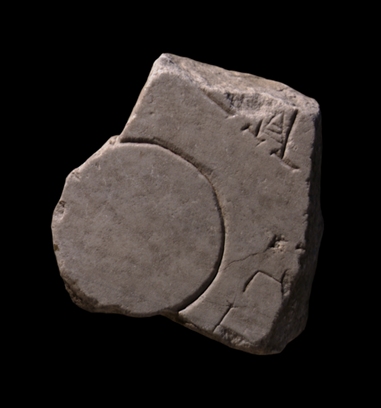
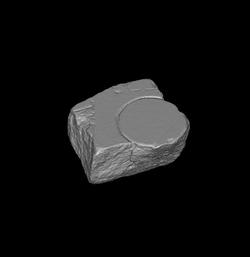
| Description The fragment is dominated by a circular feature; its incisions are deeper and wider than are the incisions elsewhere on this fragment. Two barely visible indentations at the bottom left might represent an entrance (AG 1980, p. 77). The fragment broke along the line of the left half of the circle; in the right half of its outline, traces of red paint (minium) can still be seen. At lower right, a large room opens onto the space around the circular structure. At top right, three doorways open onto the same space in a line; the middle doorway leads to a staircase represented as a V with three transverse bars that may represent upper floors (according to Pedroni 1992, the number of bars in a triangle corresponds to the number of floors in the building). At top left, the fragment edge is straight until it encounters the circular feature; there may have been a straight line here.
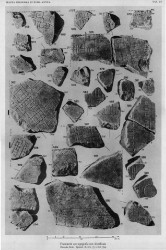
Identification: Pool of Maecenas(?) Rodríguez-Almeida joined this fragment with frs. 10tu and 10lm in slab VIII-3. This identified the fragment as belonging to a section of the city immediately east of the Porticus of Livia and the Baths of Trajan(Rodríguez-Almeida 1970-71, pp. 107-109). Excavations in the area, which revealed the remains of the circular feature depicted in this fragment near the entrance to the Brancaccio gardens, confirm this identification (Rodríguez-Almeida 1975-76, p. 278; LTUR III, p. 72). This locates the structure within the borders of the Gardens of Maecenas, and Rodríguez-Almeida has tentatively identified it with Rome's first warm water swimming pool, which Maecenas is known to have constructed ([Cass. Dio 55.7] Rodríguez-Almeida 1975-76, p. 278). By the 3rd century, when the Marble Plan was created, Maecenas' pool seems to have been completely surrounded by dense, urban architecture, as indicated in this fragment and frs. 10tu and 10lm.
Identification: Horti Maecenatis(?) If the circular feature depicted in this fragment is indeed to be identified as Maecenas' warm water swimming pool (see above), then the area must originally have been part of the Gardens of Maecenas. This is consistent with the theory of some scholars that the gardens were bordered on the north by the porticus Liviae and the vicus Sabuci (LTUR III, p. 72). If this interpretation is correct, then the tall apartment buildings and shops in close proximity to the "pool" (see especially the adjoining frs. 10tu and 10lm) must be post-Neronian construction, gradually having encroached upon the edges of the original horti. Not much is known about the gardens. Their creation was perhaps made possible by the reorganization of Rome's water supply in 33 BCE by Augustus and Agrippa. Maecenas had a domus within the gardens, and he bequeathed the entire estate to Augustus after his death (LTUR III, pp. 71-73). The original extent of the gardens is still debated (see LTUR III, pp. 71-73, for a summary of the many theories regarding the boundaries and fig. 42 for a map of the area).
Identification: Subura(?) It is uncertain whether this area, south of the vicus Sabuci, later was considered part of the residential and commercial district called the Subura. Rodríguez-Almeida suggests that the densely packed and crowded structures in this fragment and the joining frs. 10tu and 10lm match the descriptions of the Subura as an inorganized and chaotic neighborhood (AG 1980, p. 78). Archaeological and epigraphical evidence, in conjunction with the names of Medieval churches and quotes from Martial, locate the approximate boundaries of the Subura. It began near the Argiletum and the Roman forum, and from there stretched, at least in imperial times, northward up the valley between the Quirinal and Viminal Hills and eastward between the Oppian and Cispian Hills, where it probably reached as far as the Esquiline Gate (LTUR IV, p. 379). An inscription (CIL 6.9526) indicates that in the imperial period the area was divided into two sections: the Subura maior and the Subura minor. The greater Subura has been identified with the largely commercial area near the Forum Romanum, between the Viminal and the Oppian Hills, and the lesser Subura with the upper section between the Cispian and Oppian Hills where the major thoroughfare of the Subura, the clivus Suburanus, ascended towards the Esquiline Gate (LTUR IV, p. 380).
Roman poets like Martial and Juvenal described the Subura as a sordid commercial area, riddled with violence, brothels, and collapsing buildings. In reality, it was probably not different from any other neighborhood in Rome where commercial activity intermingled with the religious and political life in the great public monuments and smaller local shrines and scholae, and where the large domus of the rich stood next to the decrepit apartment buildings that housed the poor. An abundance of evidence demonstrates that even in imperial times the Subura housed senators (probably on the upper slopes) as well as sandal makers, blacksmiths, and cloth sellers. Commercial activity was probably concentrated all along the clivus Suburanus. The many epigraphic references to the synagogue in the Subura, probably located in the Subura minor near the Esquiline Gate, suggest it was the center for the largest Jewish congregation in Rome (LTUR IV, pp. 382-383).
Significance If Rodríguez-Almeida's interpretation of the circular feature in this fragment as the warm water swimming pool of Maecenas is correct, and we can identify the area as having formerly been part of the Gardens of Maecenas, then the fragment offers either a rare insight into the gradual encroachment of city architecture upon a luxurious, private garden. |
 Prev
Prev