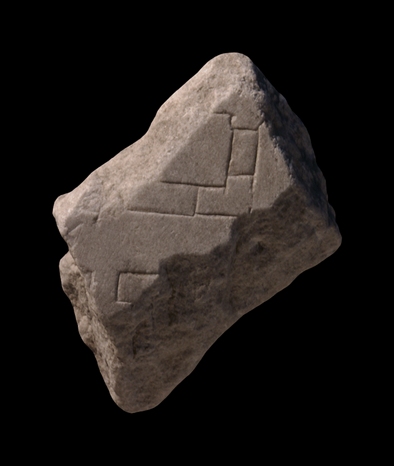
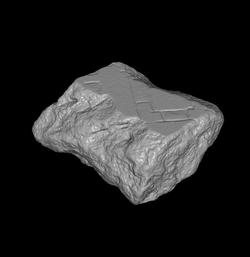
| Description The fragment depicts thick, outlined walls that are divided into compartments, alternating plain and recessed, around comparatively small spaces. At top, the bottom right corner of a rectangular room is visible. Its side walls flare out at the top, creating an architectural flourish in the groundplan here (this feature is not depicted in the drawing of the fragment in AG 1980, pl. 38, or Rodríguez-Almeida 1992, fig. 18, but it is clearly visible on the color photo above). A blank space separates this room from another outlined and recessed wall, parallel to those above, with a passageway through it. There may be additional incisions at the left corner of the fragment, but not enough survives to be interpreted.
Identification: Thermae Titi? Fr. 110, though small, shares certain features with the known fragments of slab VIII-4, which included the Flavian Amphitheater and part of the Baths of Trajan, namely its rough back, marble vein, thickness, color, and surface condition (Rodríguez-Almeida 1992, p. 69-70). It also depicts thickly outlined, recessed walls around small rooms, like those of the caldarium of the Baths of Trajan in frs. 10wxy. This fragment does not fit into the internal architecture of the Baths of Trajan, however, and the marble vein alignment requires the incisions to be aligned on an axis that is different by 30 degrees. Rodríguez-Almeida solves this problem by suggesting that fr. 110 belonged to the depiction of the Baths of Titus, which lay on the Oppian Hill between the Baths of Trajan and the Amphitheater, just west of the Domus Aurea. The axial alignment matches the requirements of fr. 110 and there is room in the internal topography of the complex for it (Rodríguez-Almeida 1992, figs. 19 and 20, p. 70-71). There are two possible places for fr. 110 within the Baths, however, and currently no way of identifying which one is correct.
The Baths of Titus were dedicated in 80 CE (LTUR V, p. 66, with references to ancient sources). Covering parts of the Domus Aurea, the construction of these public baths was in keeping with the Flavian project of returning the area of Nero's Golden House to the people of Rome. The Baths can thus be considered part of the massive building program of the Flavian emperors in Rome after their rise to power through the Roman victory in the Jewish Revolt. Only few remains of the Baths have been excavated, and the layout of the structure is mainly known from A. Palladio's famous, but questionable plan (Richardson 1992, fig. 88 and LTUR V, fig. 44 for a plan that combines the excavated parts with Palladio's drawing). According to Palladio's plan, the Baths were approached from the piazza around the Colosseum via a monumental set of stairs, faced with a vaulted portico (partially visible today). The stairs gave way to a terraced platform; almost the entire front half of this platform was taken up by what was probably a garden; the bath building proper was set back and occupied the rear half. According to Palladio's plan, the building was completely symmetrical, with the frigidarium and the tepidarium situated on the central axis, and caldaria and other rooms arranged symmetrically around this axis. Whether the walls depicted in this fragment represent the actual thickness of the inner walls of the Baths is disputed: Rodriguez-Almeida understands these to be depicted to scale, while D. Reynolds (1996, pp. 71-72) argues that such treatment of walls is a largely symbolic highlight rather than a literal representation. R. Lanciani (BullCom 1895, pp. 110-115) is credited with disentangling the 16th c. and later conflation of the Baths of Titus and the Baths of Trajan (LTUR V, p. 66).
Significance
The Baths of Titus were the third of the great imperial thermae at Rome, following the Baths of Agrippa and the Baths of Nero in the Campus Martius. They are architecturally important for certain innovations which then became standard for the large imperial thermae at Rome, such as the placement of the bathing rooms within and behind a much larger open terrace. Unfortunately, the architecture of the building is only known through a few excavated traces and standing remains, in addition to Palladio's 18th-c. plan; fr. 110, if it indeed depicts part of the Baths of Titus, is therefore a real gain in knowledge of this important building.
|
 Prev
Prev