ID AND LOCATION
| Stanford #
| 111ab |
| AG1980 #
| 111a-b |
| PM1960 #
| 111 a b |
| Slab #
| unknown |
| Adjoins
| none |
CONDITION
| Located
| false |
| Incised
| true |
| Surviving
| true |
| Subfragments
| 2 |
| Plaster Parts
| 0 |
| Back Surface
| rough |
| Slab Edges
| 1 |
| Clamp Holes
| 2 |
| Tassello
| no |
TECHNICAL INFO
|
|
|
|
|
|
|
|
|
|
|
| ANALYSIS
|
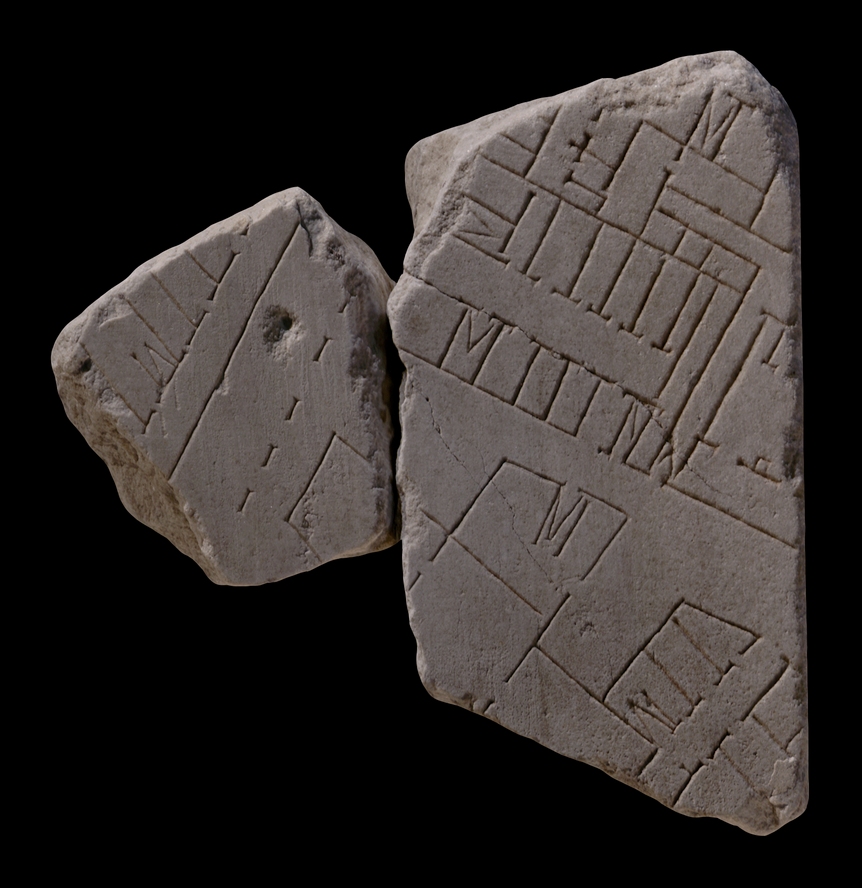
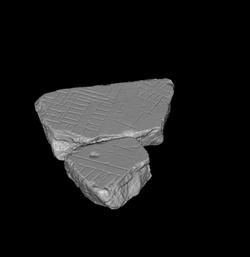
| Description The joining fragments, a and b, formed part of the edge of a slab. Two partial clamp holes are visible on the sides. A row of rooms, perhaps large tabernae, to the left in fr. 111a, is separated from two large clusters of buildings in fr. 111b by a parallel wall or step and an arcade. The large hole in the area between the wall and the arcade seems to be modern. The building that occupies most of fr. 111b consists of a multitude of smaller rooms, some of which face each other across long corridors. Five internal, V-shaped staircases are visible throughout the building. The partially visible structure across the street from the large building consists of four large rooms, perhaps unroofed, and a row of three rooms that faces another row of rooms across a narrow passageway in the lower right corner of the fragment.
Identification The density of rooms and internal stairs in the large building suggests it was a large, multi-storeyed apartment complex (insula?). The function of the rooms in the building across from it is uncertain; some of them seem to have been too large to have been roofed, but three sets of stairs indicate that there were indeed multiple levels.
Significance This piece is a typical example of unidentified fragments of the Plan. No monumental buildings are represented, and the fragment instead provides a view of the lesser known residential and commercial buildings.
|
|
| HISTORY OF FRAGMENT |
| Like the majority of FUR fragments, these pieces were discovered in 1562 in a garden behind the Church of Saints Cosmas and Damian. From here, they were transferred to the Palazzo Farnese and stored there. They were not among the fragments that were reproduced in the Renaissance drawings that are now kept in the Vatican, but Giovanni Pietro Bellori included them in his 1673 publication. In 1742, the fragments were moved to the Capitoline Museums and exhibited with some of the other known fragments in wooden frames along the main staircase. Since then, they have been stored with the other FUR fragments in various places: the storerooms of the Capitoline Museums (1903-1924), the Antiquarium Comunale (1924-1939), the Capitoline Museums again (1939-1955), the Palazzo Braschi (1955-1998), and since 1998 in the Museo della Civiltà Romana in EUR under the auspices of the Sovraintendenza ai Beni Culturali del Comune di Roma. (The history of these fragments corresponds to Iter E' as summarized in PM 1960, p. 56.)
Text by Tina Najbjerg |
|
| KEYWORDS
|
| apartments, tabernae, insula, stairs, shops |
|
 Prev
Prev