ID AND LOCATION
| Stanford #
| 115 |
| AG1980 #
| 115 |
| PM1960 #
| 115 |
| Slab #
| unknown |
| Adjoins
| none |
CONDITION
| Located
| false |
| Incised
| true |
| Surviving
| true |
| Subfragments
| 1 |
| Plaster Parts
| 0 |
| Back Surface
| rough |
| Slab Edges
| 0 |
| Clamp Holes
| 0 |
| Tassello
| no |
TECHNICAL INFO
|
|
|
|
|
|
|
|
|
|
|
| ANALYSIS
|
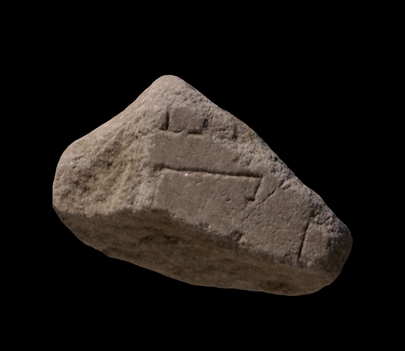
| Description A horizontal line of rooms faces a large room that opens up toward the right. To the right, a vertical line traverses the fragment, parallel to the front of the large room.
Identification The rooms at top may represent tabernae.
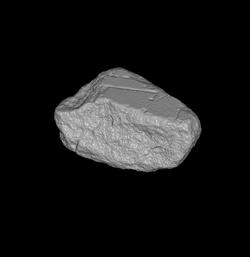
Significance 3D digital matching may help attach this small fragment to identified areas of the Plan.
|
|
| HISTORY OF FRAGMENT |
| Like the majority of FUR fragments, this piece was discovered in the garden behind the Church of Saints Cosmas and Damian in 1562. From here, it was transferred to and stored in the Palazzo Farnese. The fragment was later used as building material in a 17th-century Farnese construction, the Secret Garden, and it was rediscovered in 1888 or 1898 when the walls of the garden near the Via Giulia were demolished. Since then, it has been stored with the other FUR fragments in various places: In the storerooms of the Commissione Archeologica (1888/1898-1903), in the Antiquarium Comunale (1924-1939), in the Capitoline museums (1939-1955), in the Braschi palace (1955-1998), and since 1998 in the Museo della Civiltà Romana in EUR under the auspices of the Archaeological Superintendency of Rome (the Sovraintendenza ai Beni Culturali del Comune di Roma)(PM 1960, p. 120). N.B. PM 1960 does not indicate the whereabouts of the fragment between 1903 and 1924.
Text by Tina Najbjerg.
|
|
| KEYWORDS
|
| tabernae, shops |
|
 Prev
Prev