ID AND LOCATION
| Stanford #
| 121abc |
| AG1980 #
| 121 |
| PM1960 #
| 121 a-c |
| Slab #
| unknown |
| Adjoins
| none |
CONDITION
| Located
| false |
| Incised
| true |
| Surviving
| true |
| Subfragments
| 3 |
| Plaster Parts
| 0 |
| Back Surface
| rough |
| Slab Edges
| 1 |
| Clamp Holes
| 1 |
| Tassello
| yes |
TECHNICAL INFO
|
|
|
|
|
|
|
|
|
|
|
| ANALYSIS
|
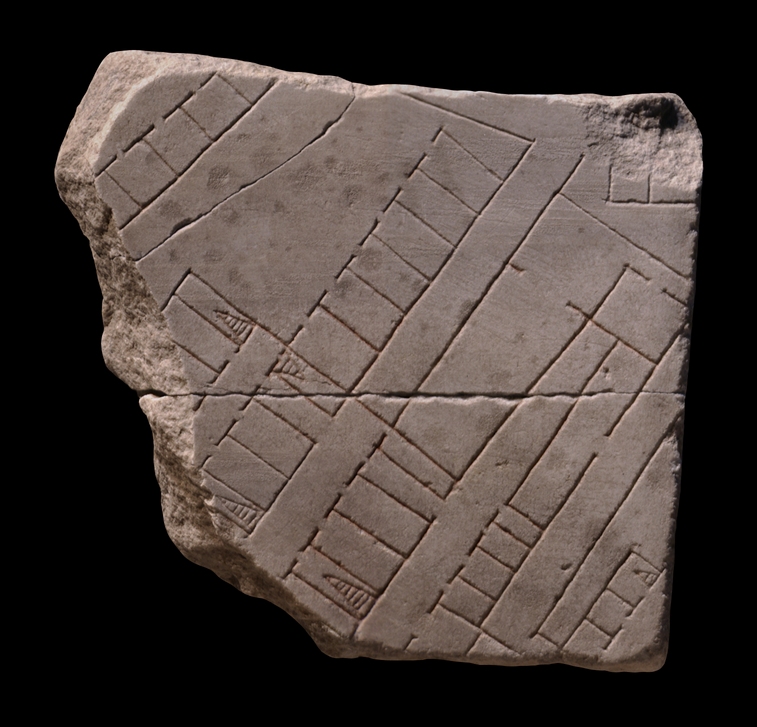
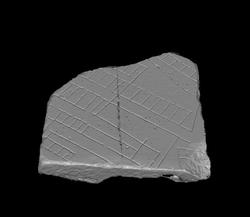
| Description The right side of these three joining fragments was a slab edge. A clamp hole is visible on the upper right side, and a partial wedge hole (tassello) can be detected along the lower edge, on the back. The architecture represented here consists of six, more or less parallel, rows of tabernae, separated by corridors and alleys. Large, rectangular enclosures are situated in continuation of the shops. Five internal staircases are visible (N.B. The staircase closest to the right edge of the fragment is not visible in PM 1960, pl. 37, nor is it included in the drawing in AG 1980, pl. 38).
Identification The regularity of the rows of tabernae in this fragment is reminiscent of the architecture found close to the Tiber in areas far from the center of the city, as seen for example in frs. 1abcde, 24a (missing), 24c, and 24d. The large enclosures near the tabernae may have held livestock, they may have been stables for horses, or have been used as working areas. Whether the different number of "rungs" in the triangles that signify internal stairs (1, 3, 5, or 7) symbolizes the number of storeys in a given building, as argued by L. Pedroni (Pedroni 1992), is uncertain.
Significance This piece is a valuable example of unidentified fragments of the Plan, as it represents the kind of lesser-known commercial structures that existed along the Tiber, far from the well-documented monumental architecture in the center of the city.
|
|
| HISTORY OF FRAGMENT |
| Like the majority of FUR fragments, these pieces were discovered in 1562 in a garden behind the Church of Saints Cosmas and Damian. From here, they were transferred to the Palazzo Farnese and stored there. They were not among the fragments that were reproduced in the Renaissance drawings that are now kept in the Vatican, but Giovanni Pietro Bellori included them in his 1673 publication. In 1742, the fragments were moved to the Capitoline Museums and exhibited with some of the other known fragments in wooden frames along the main staircase. Since then, they have been stored with the other FUR fragments in various places: the storerooms of the Capitoline Museums (1903-1924), the Antiquarium Comunale (1924-1939), the Capitoline Museums again (1939-1955), the Palazzo Braschi (1955-1998), and since 1998 in the Museo della Civiltà Romana in EUR under the auspices of the Sovraintendenza ai Beni Culturali del Comune di Roma. (The history of these fragments corresponds to Iter E' as summarized in PM 1960, p. 56.)
Text by Tina Najbjerg.
|
|
| KEYWORDS
|
| stairs, riverfront, stables, tabernae, working areas, |
|
 Prev
Prev