ID AND LOCATION
| Stanford #
| 126 |
| AG1980 #
| 126 |
| PM1960 #
| 126 |
| Slab #
| unknown |
| Adjoins
| none |
CONDITION
| Located
| false |
| Incised
| true |
| Surviving
| true |
| Subfragments
| 1 |
| Plaster Parts
| 0 |
| Back Surface
| rough |
| Slab Edges
| 2 |
| Clamp Holes
| 1 |
| Tassello
| no |
TECHNICAL INFO
|
|
|
|
|
|
|
|
|
|
|
| ANALYSIS
|
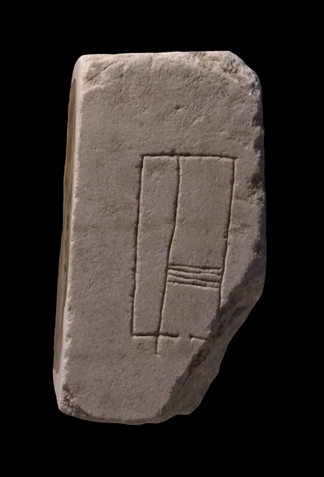
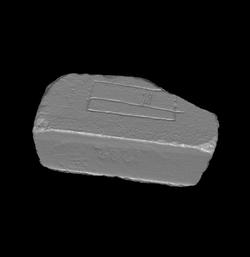
| Description The fragment was the corner of a slab. The left side and the bottom were sawed off in 1742 when the piece was exhibited in wooden frames in the Capitoline museums, hence the four straight edges. A clamp hole is visible along the lower right edge. The fragment depicts a rectangular structure that is divided into two elongated rooms. A small opening at the bottom gives access to the main room on the right, and stairs lead from the front to the rear of the room. The narrow section along the left has no openings. The building is surrounded by open space. The fact that the fragment was cut in the 18th c. along the left side and the bottom suggests that these areas were blank and that the open space continued in those directions.
Identification The structure depicted in this fragment was perhaps a small neighborhood temple or sanctuary. Unlike the monumental temples in the center of Rome which were emphasized on the Marble Plan with recessed outlines, this one is crudely drawn, suggesting it was a minor, less important structure. Its unusual architecture, unique on the Plan, may also indicate it was a funerary monument, designed according to the taste of the deceased, similar to the funerary monument to Ser. Sulpicius Galba in fr. 24c. The large, open space that surrounds the building perhaps represents a temple precinct, framed by porticoes, but the sloppy rendering of the structure makes it more likely that it was situated in a simple courtyard, or in an open piazza or field. A final interpretation is that the building was a platform structure, situated along the banks of the Tiber, similar to the feature in fr. 32i, which has been associated with the headquarters of those in charge of upkeeping the banks of the river. If this identification is correct, the blank area that was removed represented the Tiber.
Significance The crude rendering of this monument is strikingly different from that of monumental temples and buildings on the Plan. This not only demonstrates that different engravers worked on the Marble Plan, but also that artistic emphasis was placed on the important, well-known monuments.
|
|
| HISTORY OF FRAGMENT |
| Like the majority of FUR fragments, this piece was discovered in 1562 in a garden behind the Church of Saints Cosmas and Damian. From here, it was transferred to the Palazzo Farnese and stored there. It was not among the fragments that were reproduced in the Renaissance drawings that are now kept in the Vatican, but Giovanni Pietro Bellori included it in his 1673 publication. In 1742, the fragment was moved to the Capitoline Museums and exhibited with some of the other known fragments in wooden frames along the main staircase. Since then, it has been stored with the other FUR fragments in various places: the storerooms of the Capitoline Museums (1903-1924), the Antiquarium Comunale (1924-1939), the Capitoline Museums again (1939-1955), the Palazzo Braschi (1955-1998), and since 1998 in the Museo della Civiltà Romana in EUR under the auspices of the Sovraintendenza ai Beni Culturali del Comune di Roma. (This fragment's history corresponds to Iter E' as summarized in PM 1960, p. 56.)
Text by Tina Najbjerg |
|
| KEYWORDS
|
| temple, sancuary, altar, funerary monument, river platform, stairs |
|
 Prev
Prev