ID AND LOCATION
| Stanford #
| 129 |
| AG1980 #
| 129 |
| PM1960 #
| 129 |
| Slab #
| unknown |
| Adjoins
| none |
CONDITION
| Located
| false |
| Incised
| true |
| Surviving
| true |
| Subfragments
| 1 |
| Plaster Parts
| 0 |
| Back Surface
| rough |
| Slab Edges
| 1 |
| Clamp Holes
| 1 |
| Tassello
| no |
TECHNICAL INFO
|
|
|
|
|
|
|
|
|
|
|
| ANALYSIS
|
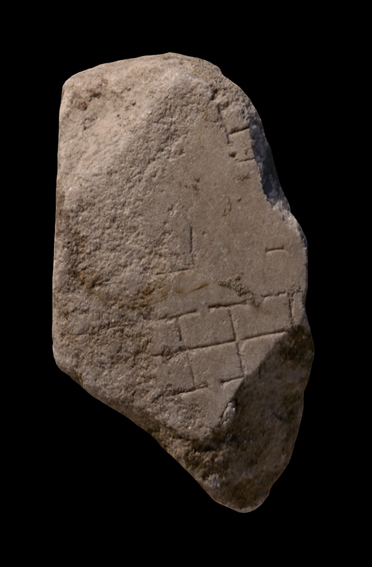
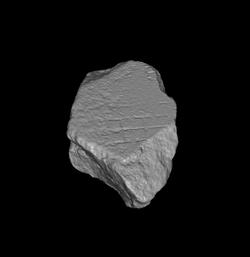
| Description The surface of this piece is badly corroded. It was part of a slab edge and a partial clamp hole is visible along the lower left side. At the bottom lies a horizontal row of back-to-back tabernae. A single dash to the far right suggests that the top row of shops was faced with an arcade that continued to the right. To the left, a corner of a large square or rectangular enclosure is visible. At top right one can see a small section of what is probably another row of tabernae, parallel or perpendicular to the one at the bottom.
Identification Rows of tabernae like those depicted here are one of the most common features on the Marble Plan. Most often, the shops consisted of a single room with a wide opening towards the street that could be screened off at night, while the owners perhaps resided with their families on a wooden platform in the back of the shop. The luxury of having an arcade in front of a row of shops as here was apparently not restricted to such grandiose areas as the slopes of the Palatine, facing the Circus Maximus (see fr. 8bde). Frs. 33abc, 34a, 34b and 34c depict a large, predominantly commercial area by the Tiber which abounds with rows of tabernae and arcades. This fragment might belong to either such areas. The covered arcades or porticoes signify that there was a second storey or a mezzanine level above the shops, which would have provided the shop owners with additional living room (Reynolds 1996, p. 158). The function of the enclosure to the left is uncertain.
Significance This fragment is a typical example of the type of combined commercial and residential structures that made up a large part of Rome's non-monumental cityscape. |
|
| HISTORY OF FRAGMENT |
| The provenance of this fragment is unknown (PM 1960, p. 121). It is now in storage with the other FUR pieces in the Museo della Civiltà Romana in EUR under the auspices of the Archaeological Superintendency of Rome (the Sovraintendenza ai Beni Culturali del Comune di Roma).
Text by Tina Najbjerg |
|
| KEYWORDS
|
| tabernae, enclosure, arcade |
|
 Prev
Prev