ID AND LOCATION
| Stanford #
| 132 |
| AG1980 #
| 132 |
| PM1960 #
| 132 |
| Slab #
| unknown |
| Adjoins
| none |
CONDITION
| Located
| false |
| Incised
| true |
| Surviving
| true |
| Subfragments
| 1 |
| Plaster Parts
| 0 |
| Back Surface
| rough |
| Slab Edges
| 0 |
| Clamp Holes
| 0 |
| Tassello
| no |
TECHNICAL INFO
|
|
|
|
|
|
|
|
|
|
|
| ANALYSIS
|
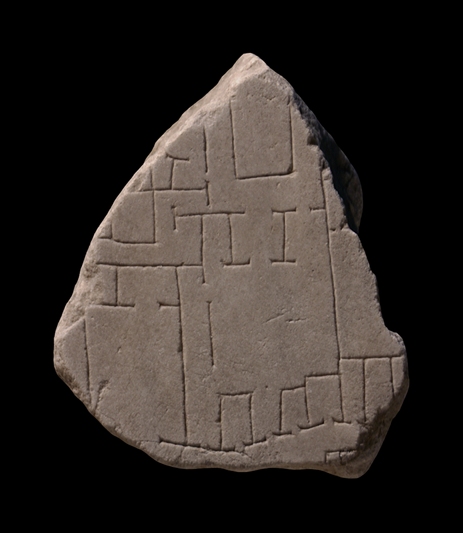
| Description A large room in the center of the fragment is fronted by three tabernae. The main entry to the room is from an opening between the shops in front. Two opening on the left give access to a long, narrow room (N.B. this narrow room is incorrectly shown as having an opening towards the street in AG 1980, pl. 38). A central opening in the back of the main room is flanked by two small rooms; it gives way to a peristyle courtyard from which two openings in the left wall (N.B. AG 1980, pl. 38, only shows one opening) lead to a narrow, winding corridor and to other rooms in the back of the house. The building shares a commom wall to the left with a large room with two smaller rooms in the back, and to the right with another building faced with tabernae (N.B. AG 1980, pl. 38, only includes two tabernae although the digital photograph makes it clear that the row continues). Across the street from these three buildings the corner of another structure is visible.
Identification: A domus The authors of PM 1960 identified the central building in this fragment as a single-family house, a domus (PM 1960, p. 121). The large front room would have been the atrium, at the back of which the tablinum was centered, flanked by two oecus. The long, narrow room to the left of the atrium was perhaps the kitchen. The center of the peristyle in the rear was perhaps used as a vegetable garden, a hortus. The narrow corridor probably gave way to the slaves' quarters, while the second opening in the left wall of the peristyle led to the more private section of the house. The two small rooms visible in this part must be cubicula. The three tabernae that flanked the entrance to the domus were probably rented out by the owner of the house. The building to the left of the domus may also have been a single-family dwelling, although on a more modest scale. The undulating street is an indication that these buildings were situated in a hilly area of Rome.
Significance Sprawling, single-family dwellings like the one depicted in this fragment were not the norm in Rome at the beginning of the 3rd century CE. A majority of the city's one million inhabitants lived in small apartments or rooms, often in ramshackle, multi-storeyed complexes. Many shop owners lived with their families at the back of their shop. The fragment is thus not an example of how the average Roman lived; instead, it presents a view of the life of a member of the upperclass or perhaps a freedman. Prime examples of other such upper-class dwellings are found in fr. 11e. |
|
| HISTORY OF FRAGMENT |
| Like the majority of FUR fragments, this piece was discovered in 1562 in a garden behind the Church of Saints Cosmas and Damian. From here, it was transferred to the Palazzo Farnese and stored there. It was not among the fragments that were reproduced in the Renaissance drawings that are now kept in the Vatican, but Giovanni Pietro Bellori included it in his 1673 publication. In 1742, the fragment was moved to the Capitoline Museums and exhibited with some of the other known fragments in wooden frames along the main staircase. Since then, it has been stored with the other FUR fragments in various places: the storerooms of the Capitoline Museums (1903-1924), the Antiquarium Comunale (1924-1939), the Capitoline Museums again (1939-1955), the Palazzo Braschi (1955-1998), and since 1998 in the Museo della Civiltà Romana in EUR under the auspices of the Sovraintendenza ai Beni Culturali del Comune di Roma. (This fragment's history corresponds to Iter E' as summarized in PM 1960, p. 56.)
Text by Tina Najbjerg |
|
| KEYWORDS
|
| domus, atrium, tablinum, oecus, peristyle, hortus, cubiculum, kitchen, tabernae |
|
 Prev
Prev