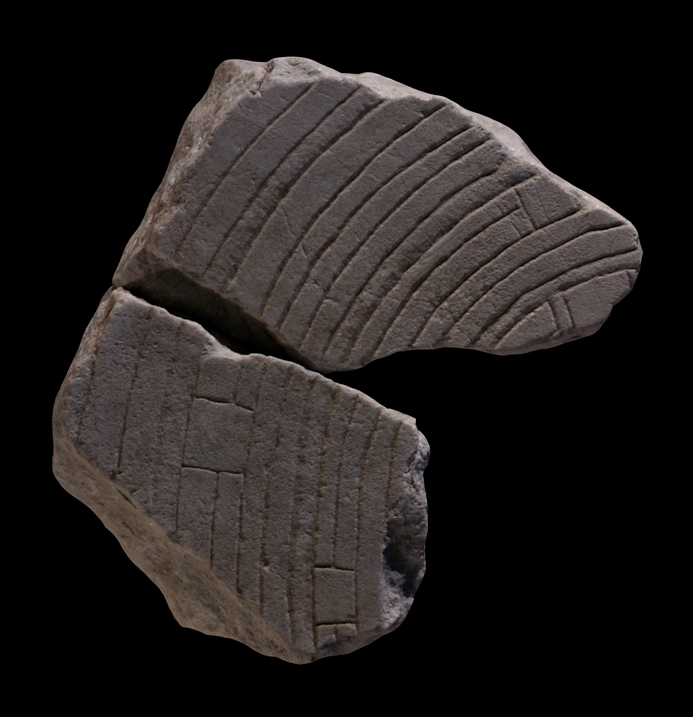
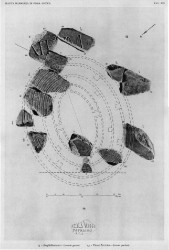
| Description The joining fragments depict part of fourteen concentric circles, five of which are recessed double lines. Three rectangles interrupt the curved lines at irregular intervals. Two parallel, recessed double lines connect the two innermost, double circles at top right. A vague guideline runs between the parallel lines and crosses the concentric circles.
Identification: Amphitheatrum The concentric lines in this fragment represent a large section of the Flavian amphitheater, identified by the partial inscription AMPHITHE[ATRUM] in frs. 13ac and
13b (PM 1960, p. 71, pl. 19; AG 1980, p. 93, pl. 11). Other parts of the building are depicted in frs.
13f,
13g,
13hi,
13l,
13m,
13n, and
13o. Vespasian initiated the construction of this amphitheater in the valley between the Oppian, Caelian and Velian hills, where it replaced the lake that had been one of the features of Nero's opulent Golden House (domus Aurea). He dedicated it in 79 CE and his sons Titus and Domitian completed it. Throughout the following centuries, several emperors restored the building and/or made changes to it. It survived fires, earthquakes, and Alaric's sack of Rome in 410 CE, and continued to be in use up until the beginning of the 6th century. Thereafter, the once so popular amphitheater fell into a general state of deterioration and was used as a burial ground, for habitation, and finally as a source of building material. By the 14th century, large sections of the building had been dismantled and its travertine blocks used for the construction of houses, gates, and papal palaces. With the erection of the Stations of the Cross in 1744 at the edge of the arena, the amphitheater entered a stage of modern restoration that continues to this day (LTUR I, pp. 30-32). In its early life the monument was referred to as the Amphitheatrum, as witnessed by the inscription on the Forma Urbis. Not until the 11th century was it associated with the colossal statue of Nero that had stood nearby and referred to as the Amphitheatrum-Coliseum. By the 12th century the building was known mainly by the popular name it retains to this day: Coliseum, or Colosseum (LTUR I, p. 30).
The Flavian amphitheater is an architectural masterpiece, constructed mainly of travertine blocks and brick around a concrete core. The ground floor and the second and third storeys of the elliptical building consist of annular corridors that surround the central arena. From the two outer corridors on the ground floor, stairs lead to the seating areas above. On the exterior, the three lower storeys are accentuated by series of arches, framed and surmounted by columns and entablature of, from below, the Tuscan, the Ionic, and the Corinthian order. The fourth storey is a solid wall adorned with Corinthian half-columns and perforated by small windows in every other intercolumniation. Corbels above the openings held masts from which awnings were stretched to cover the spectators. The arches of the ground floor provided access for the masses to the annular corridors and the upper storeys, performers entered and exited the building through the ceremonial gates at each end of the long axis, and access to the imperial and the magisterial boxes was through entrances at the end of the short axis. Further entrances were built underground at each end of each axis; the E entrance connected to a subterranean passage to the Ludus Magnus. Praecinctiones divided the main seating area of the cavea into sections: maenianum primum, secundum, and summum. Vomitoria provided access from the interior stairs to the maenianum secundum which was further divided into a lower and an upper section. The seating area closest to the arena was a raised podium with chairs for distinguished spectators. A narrow passage and a fence separated it from the arena. The arena itself consisted of a wooden floor, partially removable, that covered a complex system of subterranean rooms and passages. The rooms held not only wild animals and the elevators that raised them to the arena floor, but also other contraptions used for special effects (LTUR I, pp. 32-35; Richardson 1992, pp. 8-10).
Together, these two fragments cover almost the entire radius of the NE section of the cavea. The recessed double lines represent the outer wall, the three praecinctiones that separated the maeniana from each other, the innermost barrier, and part of the E ceremonial gate. The three rectangles
depict vomitoria.
Significance On the Forma Urbis the Flavian amphitheater is depicted as if seen from above. In this respect the engravers of the Plan diverted from their usual method of representing buildings by their ground plan. The concentric circles in these fragments represent, or rather give the impression of rows of seats (Reynolds 1996, p. 85). The only other buildings on the Plan depicted in this manner are other entertainment structures, such as the Theater of Marcellus and the Circus Maximus which is shown partially in ground plan, partially from above. |
 Prev
Prev