ID AND LOCATION
| Stanford #
| 14 |
| AG1980 #
| 14 |
| PM1960 #
| 14 |
| Slab #
| VII-7 |
| Adjoins
| none |
CONDITION
| Located
| true |
| Incised
| true |
| Surviving
| false |
| Slab Edges
| 0 |
| Clamp Holes
| 0 |
| Tassello
| no | |
|
|
|
|
|
|
|
|
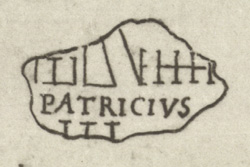
Detail from Cod. Vat. Lat. 3439 - Fo 20r,
reproduced from PM 1960, pl. 10 | |
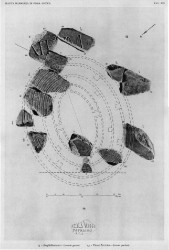
PM 1960 Plates: 10 19
AG 1980 Plates: 10
|
|
| IDENTIFICATION |
| Renaissance drawing: The Patrician Street (vicus Patricius)
|
|
| INSCRIPTION
Epigraphic conventions used |
| Transcription |
| None; the fragment itself is lost
|
| Renaissance Transcription |
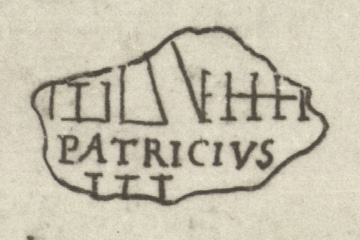
| PATRICIVS
|
| Reconstruction |
| [VICVS] PATRICIVS (AG 1980; PM 1980) |
|
|
|
|
|
| ANALYSIS
|
| Description The fragment is missing but is fortunately reproduced in Renaissance drawing Cod. Vat. Lat. 3439 - Fo 20r (see photo detail above or PM 1960, pl. 10). The drawing shows that the fragment depicted a horizontal street, flanked above and below by rows of tabernae. The letters PATRICIVS were written in the space allocated to the street. A side street moved off the horizontal street at an oblique angle and divided the top row of shops in two sections. There seems to have been a narrow entrance to an area behind the shops on either side of this side street. The shops to the right of the side street were organized into two rows, back to back.
Identification: Tabernae along the vicus Patricius The street in this lost fragment is easily identifiable as the vicus Patricius, known to have begun in the Subura neighborhood and to have followed a course identical to the current Via Urbana between the Cispian and the Viminal Hills, signaling the border between the 4th and the 6th region (PM 1960, p. 71). In 1977, E. Rodríguez-Almeida tentatively suggested that this fragment belonged in slab VII-6, just northeast of the large fragment group 11 which he positioned in the bottom left corner of the adjacent slab VII-7 and which included a stretch of the vicus Patricius (Rodríguez-Almeida 1977, fig. 14). He has since moved the fragment to slab VII-7 (AG 1980, p. 90, fig. 21; Rodríguez-Almeida 2002, pl. 12). The configuration of tabernae flanking each side of a straight vicus, as seen in this lost fragment, is indeed strikingly similar to the layout in frs. 11e and 11fgh. Rows of tabernae like those depicted here are one of the most common features on the Marble Plan. Most often, the shops consisted of a single room with a wide opening towards the street that could be screened off a night, while the owners perhaps resided with their families on a wooden platform in the back of the shop. In the larger tabernae, the back of the room might be partitioned off to create a separate living space for the family (Reynolds 1996, p. 161).
Significance If Rodríguez-Almeida's positioning of this lost fragment in slab VII-7 is correct, then the piece provides additional evidence for the type of mixed residential and commercial architecture found in the area between the Cispian and Viminal Hills (see especially frs. 11e and fgh). |
|
| HISTORY OF FRAGMENT |
| Like the majority of FUR fragments, this piece was discovered in 1562 in a garden behind the Church of Saints Cosmas and Damian. From here, it was transferred to the Palazzo Farnese and stored there. Renaissance engravers reproduced the fragment in 16th-c. drawings that are now kept in the Vatican (for more information about the creation and accuracy of these drawings, see Cod. Vat. Lat. 3439), and Giovanni Pietro Bellori included it in his 1673 publication. The whereabouts of the piece after this date are unknown. (This fragments history corresponds to Iter D as summarized in PM 1960, p. 56.)
Text by Tina Najbjerg
|
|
| KEYWORDS
|
| tabernae, street, shops, |
|
 Prev
Prev