| [FRAGMENT ANALYSIS IN PROGRESS]
Description
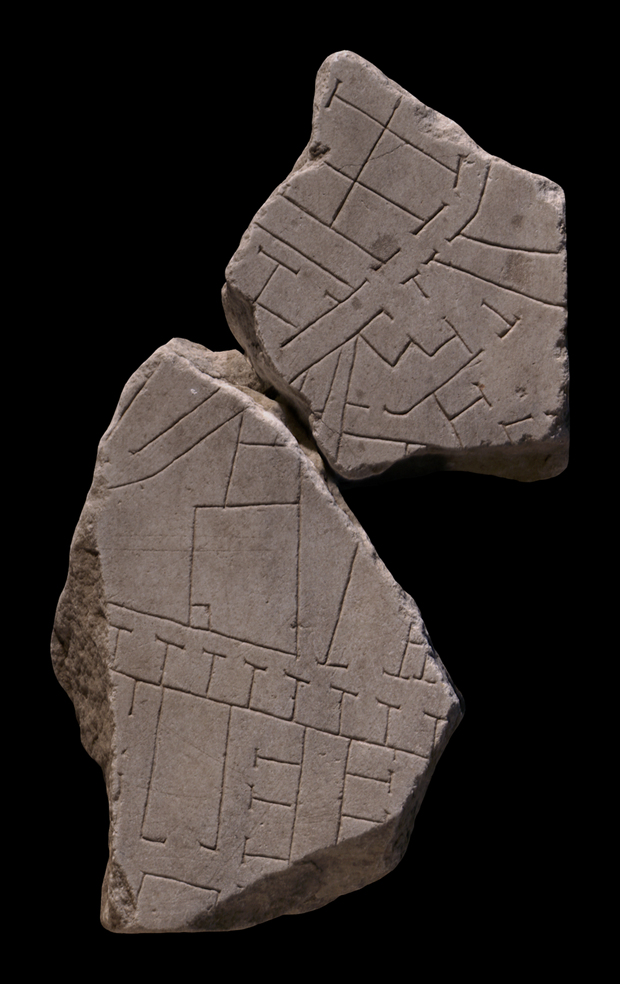
Two attached fragments, 141a is the upper fragment and has an original edge on the right side. 141b is the lower fragment with a small stretch of original slab edge with clamphole on the lower edge. A small and curvy street is visible running top right to bottom left in the upper half of the combined fragments. This street is flanked on the left by a structure with 6 back-to-back rooms and several irregular shaped rooms below.
The architecture to the right of the street is even more irregular with several rooms, open areas and possible corridors. The architecture belonging to the same block on fragment 141b consists of larger spaces, some opening up to a narrow corridor or alley running left to right. This corridor is flanked by a room of tabernae on the lower side. Behind this row of shops a block is visible with several rooms opening to a corridor and two larger rooms or areas in the middle. This architecture possibly continues into fragment 194.
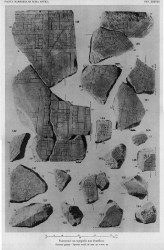
Identification: possible connection with 194 The boundary incision matching algorithm conducted at Stanford proposed a possible match for fragments 141 and 194
(Koller-Levoy 2005, 8, fig. 20). 5 pairs of corresponding incised linear features angling across the slab boundary resulted in a high matching score. Two of the matching sets of incisions were annotated as the front of a row of rooms, and another two as the back of a row of rooms; the fifth set of matching incisions, less definitive than the others, appears as if it may represent the border of a rectangular space.
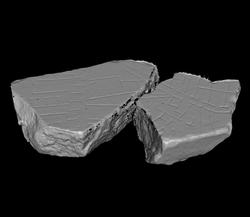
Though we have not yet researched potential placements on the wall for this hypothetical new fragment group, it contains a number of constraining elements useful for its possible positioning. Fragment 141 has a rough back surface and should fit into the corner of a slab, whereas fragment 194 has a smooth back and is only 38mm thick, so it must originate from an unusually thin slab.
Identification: steep hill with commercial and other architectureThe irregular street and shapes of buildings suggests a location on the slopes of a steep hill.
Significance: hillside with commercial and other architecture
|
 Prev
Prev