ID AND LOCATION
| Stanford #
| 157a |
| AG1980 #
| 157a |
| PM1960 #
| 157 a |
| Slab #
| unknown |
| Adjoins
| 157bc |
CONDITION
| Located
| false |
| Incised
| true |
| Surviving
| false |
| Slab Edges
| 1 |
| Clamp Holes
| 0 |
| Tassello
| no | |
|
|
|
|
|
BIBLIOGRAPHY
- AG 1980, p. 157, pl. 40
- LTUR III: Macellum Liviae (G. Pisani Sartorio), pp. 203-204; Macellum Magnum (G. Pisani Sartorio), pp. 204-206
- PM 1960, pp. 123-124, pls. 13, 39
- Richardson 1992, p. 241 (Macellum Liviae), p. 242 (Macellum Magnum)
|
|
|
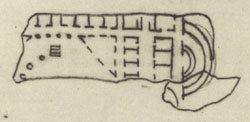
Detail from Cod. Vat. Lat. 3439 - Fo 22r,
reproduced from PM 1960, pl. 13 | |
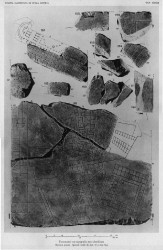
PM 1960 Plates: 13 39
AG 1980 Plates: 40
|
|
| IDENTIFICATION |
| Renaissance drawing: The Market of Livia (macellum Liviae) or the Great Market (macellum Magnum)?
|
|
| INSCRIPTION |
| None |
|
|
|
|
|
| ANALYSIS
|
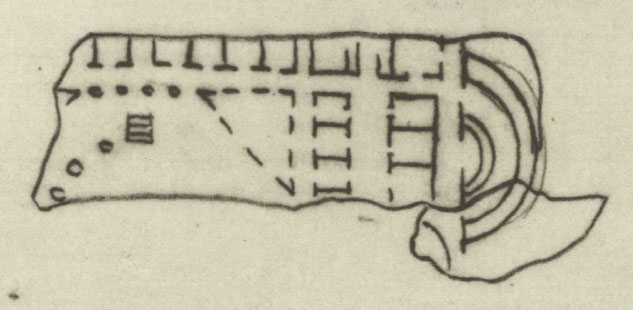
| Description The fragment itself is lost, but Renaissance drawing Cod. Vat. Lat. 3439 - Fo 22r shows it as it looked in the 16th century (see detail above or PM 1960, pl. 13, no. 20). It depicted a colonnaded courtyard, surrounded at top by one row, on the right by two rows of rooms. The inner row of rooms on the right had openings both front and back. Triangular areas, perhaps colonnaded and covered, appeared in the corners of the inner portico. In the center of the colonnaded area, a circular row of columns and a set of steps (?) appeared. Behind the outer row of rooms on the right was a semi-circular, double walkway.
Identification: Macellum Based on the Renaissance drawing, the authors of PM 1960 proposed that this missing fragment joined with fr. 157bc, which showed more of the colonnaded building (PM 1960, pl. 39). The inscription in fr. 157bc, MACELLUM, identified the structure as a market (PM 1960, p. 123). It consisted of rows of shops surrounding a square, porticoed courtyard with a circular, inner colonnade approached by four sets of steps. Each corner of the courtyard was occupied by a triangular, arcaded, and probably covered area. An additional colonnade surrounded the entire building (PM 1960, p. 124 for suggested reconstruction).
The identity of the macellum in this and in fr. 157bc is disputed. The ancient sources record two markets in imperial Rome: the Market of Livia (macellum Liviae) and the Great Market (macellum Magnum) (PM 1960, p. 124; AG 1980, p. 157). The Market of Livia was built by Augustus and dedicated by Tiberius in the name of his mother. One source locates the macellum Liviae in Regio V on the Esquiline while another situates it in Regio III (LTUR III, p. 203). Favoring the Esquiline source, some scholars associate the Market of Livia with a rectangular structure discovered outside the Esquiline Gate in 1872 (LTUR III, p. 204). Others associate it with the remains of a macellum underneath the church of Santa Maria Maggiore, i.e. in Regio III, and E. Rodríguez-Almeida has proposed that the structure underneath the church is the one depicted in this fragment (AG 1980, p. 157; LTUR III, p. 204). The Great Market was built on the Caelian Hill by Nero and dedicated in 59 CE. Previous attempts to associate this market with archaeological remains on the Caelian have failed; however, a large, commercial building, discovered in 1987 on the NW slope of the hill, seems to match the description (LTUR III, p. 205). Whether this fragment depicts the Great Market is still uncertain.
Significance The Renaissance depiction of this lost fragment has allowed scholars to join it with fr. 157bc and thus gain better understanding of the architecture of the macellum.
|
|
| HISTORY OF FRAGMENT |
| Like the majority of FUR fragments, this piece was discovered in 1562 in a garden behind the Church of Saints Cosmas and Damian. From here, it was transferred to the Palazzo Farnese and stored there. Renaissance engravers reproduced the fragment in 16th-c. drawings that are now kept in the Vatican (for more information about the creation and accuracy of these drawings, see Cod. Vat. Lat. 3439), and Giovanni Pietro Bellori included it in his 1673 publication. The whereabouts of the piece after this date are unknown. (This fragments history corresponds to Iter D as summarized in PM 1960, p. 56.)
Text by Tina Najbjerg
|
|
| KEYWORDS
|
| market, colonnade, shops, semicircle, macellum |
|
 Prev
Prev