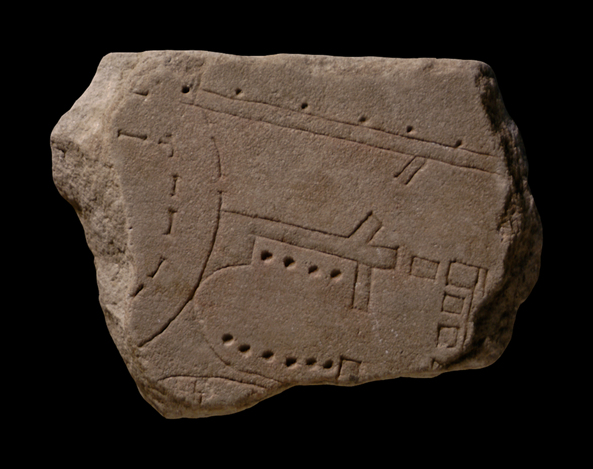
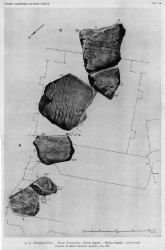
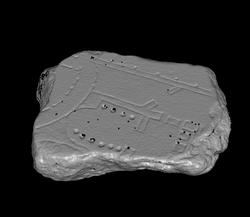
| Description The fragment was part of a slab edge; a partial clamp hole is visible. At top, a thick wall traverses the fragment at a slightly skewed angle to the slab edge. It is rendered with double lines and recessed. Far left, an opening in this wall leads from a curved portico to the space delineated by the wall. Columns line the wall on the side that faces the slab edge, and one column can be seen inside the opening. The interior of the curved portico is arcaded; the outer wall is solid except for two openings that give access to a narrow passage between the recessed wall and a temple that backs onto the curved portico. This passage is blocked further to the right by a wall, set on an angle and with a single opening in center. The temple consists of an apsed cella with a rectangular aisle on the right side. Six columns are visible on the left side of the cella; four in the side aisle. In front is a pronaos, rendered as the cella with recessed, double lines. It seems to have had six columns in front. Another set of double lines in front of the temple must represent steps that led to the pronaos. In the bottom of the fragment, a section of a large semi-circle is visible. It touches the left side of the temple cella. A recessed square is just visible inside this semi-circle.
Identification: Templum Pacis The recessed wall at top is a section of the NW facade of Vespasian's Temple of Peace (PM 1960, p. 73). More of the building is depicted in frs. 15ab and 15c. Constructed by Vespasian between 71 and 75 CE to commemorate his victory over the Jews and the destruction of Jerusalem, the Temple of Peace was in reality the third in the row of great imperial fora; not surprisingly, late antique sources occasionally refer to the building as forum Pacis or forum Vespasiani (LTUR IV, p. 67; Richardson 1992, p. 287). The Templum Pacis was a structure of great significance in antiquity as today: it gave its name to the 4th Augustan region; ancient sources such as Pliny (N.H. 36.102) proclaimed it one of the most beautiful buildings in Rome; it contained a library and the richest collection of art works known, including some moved from Nero's Domus Aurea; and, most importantly in this particular context, after a fire in 192 CE, the building was restored between 208 and 211 CE by Septimius Severus, who subsequently placed in it his great marble map of Rome, now known as the Forma Urbis Romae (LTUR IV, pp. 67-68; Richardson 1992, pp. 286-87). The building was destroyed by an earthquake in 408 CE. but immediately restored. In the 6th c. CE, it was in poor condition (a lightning strike had caused yet another fire), and recent excavations suggest that it was used as a cemetary at that point (to read about the current excavation of the building, click here). Between 526 and 530, the S corner of the structure - including the wall that held the Severan map - was incorporated into the Church of Saints Cosmas and Damian (LTUR IV, p. 68, with references).
Remains uncovered in past and current excavations confirm the location and architecture of the Templum Pacis as represented in FUR fragments 15ab, 15c, and 16a. Built on the site of the old macellum, the building was situated northeast of the Forum Romanum, nested between the Basilica Aemilia to the southwest, the fora of Caesar and Augustus to the northwest, and buildings on the W slopes of the Velia to the east. It faced the Argiletum on the northwest, and its S corner approached the Via Sacra. It consisted of a large, almost square courtyard (134 x 137 m) that was surrounded on three sides by raised porticoes; its facade consisted of a single wall with rows of columns attached on both sides. Some of the exterior columns are still visible today; a few of those on the inside are depicted in this fragment. The principal entrance to the building would have been from the Argiletum through this wall; with the construction of Domitian's Forum Transitorium, however, what was presumably a large, central entrance was reduced to five(?) small and irregularly spaced openings from the Forum Transitorium and the Porticus Absidata, one of which is visible in the top left of this fragment. Raised porticoes framed the courtyard on the three remaining sides; they were accessed from the courtyard via steps. The single column visible in the opening of the NW wall may belong to the colonnade of the NE portico. Rectangular niches, possibly two on each side, were situated in the backwalls of the two lateral porticoes; one of these is preserved underneath the Torre dei Conti (LTUR IV, p. 68, fig. 23; Richardson 1992, fig. 66). According to frs. 15ab and 15c, the courtyard contained six rows of elongated features, three on either side of a wide space along the central axis. Each feature consisted of four long rectangles connected by three short sections. Similar features are visible in the courtyards of the templum Divi Claudi and the Adonaea. Whether these features represent hedges, large statue bases, fountains, or flower beds is still disputed (LTUR IV, pp. 68-69). Recent excavations between the Via Alessandrina and the Via dei Fori have uncovered some of these features (visit the news section of the official web site for the Imperial fora). According to the preliminary results of these excavations, exhibited in the visitor's center of the Imperial fora, they seemed to have consisted of brick podia on top of which ran water channels that would have been flanked by ornamental shrubs and statuary. The thesis (Lloyd 1982) that the courtyard contained some form of garden structures thus seems confirmed. Fr. 15c demonstrates that a rectangular feature, probably a large altar, stood at the rear of the courtyard (LTUR IV, p. 69). The SE end held the principal parts of the complex: a central hall, flanked on either side by two smaller rooms or aulae, was situated behind the rear portico; it was slightly deeper than the flanking rooms. In front, it was faced with six columns on plinths; in the rear, a statue base within a shallow apse, visible in fr. 15ab, probably held a statue of Pax. A staircase with four steps led to the central hall from the courtyard through the rear portico. The six central columns of the rear colonnade were placed on plinths and aligned with those in front of the hall. Both the stairs and the columns on plinths matched the width of this substantial hall (LTUR IV, p. 69). As shown in fr. 15ab, the central room was separated from those flanking it on either side by a thick and a thin wall, in turn separated by a narrow space. The four side rooms would have opened onto the rear portico, and at least the two inner aulae might have been faced with columns like the central hall. The Severan Marble Plan hung on the SW wall of the aula to the immediate right (southwest) of the central hall. This wall is still preserved, as are many of the holes left from the clamps that held the 150 marble slabs of the map. The wall opposite the Severan map of Rome was also faced with marble slabs; traces of paint on the marble pieces remaining from this wall suggest it depicted a geographical map (LTUR IV, p. 69).
The complex served many purposes, some of which are still disputed. In addition to serving as a temple to Pax, whose cult statue was placed in the apse of the central hall, the building is known to have had a library. Comparison to the architecture of the libraries of Hadrian in Athens and Celsus in Ephesus suggests that the library was housed in the central hall (LTUR IV, p. 69). The presence of numerous pieces of art in a garden setting made it a public art gallery and a recreational space similar to the Porticus of Pompey. Whether it inherited a commercial aspect from the macellum it replaced is uncertain but not unlikely (LTUR IV, p. 69). Central to the discussion of the function of the complex is the presence there of the Severan Marble Plan. Many scholars take this as evidence that the Templum Pacis also served as the headquarters and archives of the urban prefect of Rome (Gatti in PM 1960, pp. 216-217). F. Coarelli sees the architectural similarity between the Templum Pacis and other ancient libraries known to have served as archives for cadastral records as additional evidence that such was also its purpose (Coarelli in LTUR IV, pp. 69-70). D. Reynolds has convincingly argued that the marble plan did not have a utilitarian purpose as a cadastral or locator map, as has been assumed, but simply served to decorate the room that held the scrolls with the precise cadastral surveys on which the marble plan was based (Reynolds 1995, p. 125). For more detail about the map itself, refer to the map page of this site.
Identification: Porticus Absidata The curved portico visible on the far left in this fragment is the Porticus Absidata, or "apsidal portico" (LTUR IV, p. 116; Richardson 1992, p. 311). Mentioned only in the Regionary Catalogues, this horseshoe-shaped portico was situated behind the Forum Transitorium where it formed a grand entrance from the Subura to the imperial fora. Excavated remains in combination with this FUR fragment demonstrate that a short, oblique passage led from the portico to the E corner of the Forum of Augustus, two openings gave access to the Forum Transitorium (seen in this fragment), and two opened up to the Templum Pacis (one visible here) (LTUR IV, p. 116, fig. 42; II, fig. 148). Excavations behind the Temple of Minerva have also shown that the portico consisted of a two-storeyed arcade, the lower storey vaulted, the upper a free-standing arcade (LTUR IV, fig. 43). It has been suggested that the central part was roofed; this, however, is questioned by L. Richardson who believes an open court would have been more suitable (Richardson 1992, p. 311). A water basin was later installed in this central space. In the late antiquity, houses were constructed within the confines of the portico, and in the 6th and 7th c., it is referred to as the
porticus de Subura or the porticus curva (LTUR IV, p. 116).
Identification: forum Transitorium/forum Nervae with the Temple of Minerva The space between the wall of the Templum Pacis at top, the Porticus Absidata on the left, and the hemicycle of the Forum of Augustus (see below) at bottom, is the Forum of Nerva (PM 1960, p. 73). Built by Domitian but dedicated by Nerva in 97 CE, this structure, fourth in the row of imperial fora, occupied a section of the Argiletum where it passed between the forum of Vespasian and the fora of Caesar and Augustus. Its location between the three earlier fora on one hand, and between the Forum Romanum and the Subura on the other, gave it the name forum Transitorium which was used interchangeably with the official forum Nervae - both names were recorded in the Regionary Catalogues (LTUR II, pp. 307-308; Richardson 1992, p. 167). An architectural masterpiece, Domitian's forum made excellent use of the narrow space it occupied, a challenge made even greater by the presence there of a section of the Cloaca Maxima. The NW wall of Vespasian's Templum Pacis was moved towards its central courtyard to create more space for the new forum. The two lateral sides of this new space were then decorated with an addorsed colonnade, complete with entablature and attic. A section of the SE colonnade - referred to in the Middle Ages as the Arca Noe and then the Colonnacce - is still visible in the S corner of the forum; the frieze was carved with depictions of the arts and crafts of Minerva (LTUR II, p. 308; Richardson 1992, pp. 167-168). A temple to Minerva was situated at the rear of the space, pushed back as far as the great SE hemicycle of Augustus' forum allowed. Two gently curving walls were built between the temple and the lateral walls of the forum to hide the unequal space behind the temple. Both curved sections were pierced by openings. The opening seen in this fragment was decorated with an arch (the arcus Aureus in medieval sources) and it gave access to the trapezoidal space created by the temple, the NW wall of the Templum Pacis, and the rear of the Porticus Absidata (see reconstruction of the temple and the curved walls in LTUR II, fig. 147). The trapezoidal space was probably roofed. The curve of the walls on either side of the temple was matched by the wall that made up the SW end of the new forum; here, the curve served to hide the NE wall of the Basilica Aemilia that cut off the S corner of Domitian's forum (Richardson 1992, pp. 167-168; LTUR II, fig. 148). The few existing remains of the temple to Minerva in combination with this fragment demonstrate that it was prostyle, hexastyle, and set on a tall podium with a frontal staircase. Excavations suggest that modifications were made to the original plan of the temple. Inside the cella were two lateral colonnades with six columns in each. However, where this fragment depicts the interior of the cella as being apsed, the extant remains reveal that a rectangular space would have held the cult statue. Another mistake by the engraver of this section of the Severan map is the rendering of the lateral colonnades inside the cella: only the SE colonnade is included on the plan (LTUR II, p. 309).
The architectural details of the SW end of the Forum Transitorium are not clear. The presence of the Basilica Aemilia prohibited the construction of a central entrance to the new forum from the southwest; instead, it seems that two entrance halls were situated at each end of the curved portico (?) that formed the SW end of the forum. A staircase and a propylaeum with an arched front at the SW end of this curved space gave access to the structure from the Forum Romanum; this might be the monumental entrance described as arcus Nervae in medieval sources (LTUR II, p. 311). Another entrance at the SE end seems to have led from the Basilica Aemilia directly into the new forum (LTUR II, pp. 310-311, fig. 148). Ancient sources note the presence of a Ianus figure and/or enclosure at the short SW end of the Forum Transitorium. Since the Ianus figure supposedly was able to look out on four fora, scholars have suggested that a four-sided arch occupied this end of the forum (Richardson 1992, p. 168). Excavations have not confirmed this, however, nor has the theory, based on 12th century source, that a templum Iani faced the Temple to Minerva been proven (LTUR II, p. 310). The forum Transitorium was truly a transit hall: anybody living in the Subura neighborhood would pass through this forum in order to get to the Forum Romanum and vice versa. Small openings in the lateral walls also allowed ample, if not grand, accesses to the fora of Vespasian, Caesar, and Augustus (see LTUR II, fig. 148). It is interesting to note, however, that the new forum with its marble floors, narrow openings, and approaches via staircases and curved porticoes effectively blocked all vehicular traffic to the Roman forum, before accessible via the Argiletum. (Richardson 1992, pp. 167-68).
Identification: Forum Augusti/Augustum The curved double line at the bottom of this fragment is a section of the SE hemicycle from the Forum of Augustus, one of two that flanked this forum on either side (PM 1960, p. 73). Also called forum Martis, this forum was second in the row of great imperial fora in Rome. The structure, which contained the great Temple of Mars Ultor, was dedicated by Augustus and his grandsons Gaius and Lucius in 2 BCE, when the temple was still unfinished (LTUR II, p. 289). It was located just northeast of the Roman forum, next to a stretch of the Argiletum, and perpendicular to the forum Iulium, whose E side it abutted, perhaps separated from it by a street (Richardson 1992, pp. 160-61). A 30 meter tall fire wall encased it on the northeast (LTUR II, p. 290). Considered by Pliny one of the three most beautiful structures in Rome, Augustus' forum consisted of a large, rectangular space (ca. 125 x 90 m), paved with marble slabs and flanked on both sides by porticoes that were raised three steps above the level of the central courtyard. Above these lateral colonnades ran a deep attic, richly decorated with shields and copies of the caryatids from the Erectheum in Athens. The back walls of the porticoes were articulated with niches and engaged columns, and at the NE end, they opened up into the two great hemicycles on either side of the temple. The row of engaged columns continued in front of these hemicycles as columns on plinths (Richardson 1992, p. 161). Two superimposed rows of niches - with larger niches in the center - adorned the walls of these semi-circular exedrae; inscriptions found in situ and a passage from Ovid (fast. 5.563-566) demonstrate that the niches contained on one side statues of Aeneas surrounded by members of the Iulio-Claudian family and possibly the kings of Alba Longa, on the other side Romulus, flanked by great men from Rome's past (LTUR II, pp. 290-91). One of these niches may be visible as a recessed square in this fragment. At the end of the SE portico, a small opening on the right gave access to a staircase that led to the Porticus Absidata (see above); at the end of the opposite portico lay a square hall that held a colossal statue, believed by some scholars to have represented Augustus (LTUR II, p. 292). On either side of the temple, between the temple and the lateral porticoes, two arches (built by Tiberius in honor of Germanicus and Drusus around 18 CE) led to two staircases. The SE arch, known today as the Arco dei Pantani, gave access to a small, triangular space above a set of stairs; the NW arch, possibly the one dedicated to Drusus, led to two sets of stairs and to a street behind the forum through which one entered the Subura neighborhood (LTUR II, p. 292, fig. 117; Richardson 1992, p. 161). The architectural details of the SW end of the forum, and thus the main approach from the forum Iulium, are not known, as it has never been excavated. Small openings in the back walls of the lateral porticoes gave access to the Forum Transitorium and later to the Forum of Trajan.
The Temple to Mars Ultor dominated the far (NE) end of the forum, where it backed onto the tall fire wall (LTUR II, fig. 117). It was octastyle, peripteral sine postico, and situated on a tall platform accessed by a frontal staircase. Platforms flanked the stairs on either side, and an altar sat in the center towards the front. The columns surrounding the cella stood on plinths. Inside the cella, lateral platforms supported six columns on plinths and matching endorsed columns on each side of the wide, vaulted nave. In the rear, an apse was approached by five stairs; here, a wide statue base held the cult statue of Mars Ultor (LTUR II, pp. 291-92). The statue of Mars was possibly flanked by statues of Venus and the deified Iulius Caesar (Richardson 1992, p. 163; against this, see V. Kockel in LTUR II, p. 292). Augustus' forum served a variety of purposes. Notable among these was its function as a gallery for great works of art, including a quadriga and two pictures by Apelles, and its role as Rome's foreign office (Richardson 1992, p. 162).
Significance The fragment depicts a nodal point in the center of ancient Rome: the space that connected the imperial fora to each other and the Roman forum to the Subura. It serves as a reminder of how these buildings vied for space in this area of Rome and highlights the fact that the construction of the Forum Transitorium on the site of the old Argiletum restricted access, especially vehicular, to the Roman forum from neighborhoods to the north and northeast. The fragment also reminds us that the construction of these imperial fora in pre-existing neighborhoods rarely allowed for grand, central entrances; instead, their ingenious architects experimented with smaller, almost secret openings that were barely visible behind stretches of colonnades. The visitor would walk through these unasuming openings and be surprised to find himself suddenly in a grand and richly decorated public space. The two entrances from the Porticus Absidata visible in this fragment both played with this element of surprise: one gave access to the covered, NE portico of the Templum Pacis and from there to the open courtyard with its stunning garden setting; two others led through the covered, trapezoidal space next to the Temple of Minerva to the open space of the Forum Transitorium. Still another, not visible in this fragment, would have brought the visitor from the Porticus Absidata through a narrow staircase to the NE corner of the Forum of Augustus where the gleaming Temple of Mars Ultor would have towered immediately above him and, turning left, he could have entered the great, SE hemi-cycle with its imposing sculptural arrangement.
This fragment is also an example of how the engravers of the Severan map made mistakes even when depicting well-known, public monuments such as the Temple of Minerva. As D. Reynolds points out (1996, pp. 102-103), the engravers of the map must have passed this structure every day on their way to work in the Templum Pacis and must have been familiar with its architecture. Yet, they omitted one of the lateral colonnades of the cella and made the structure look asymmetrical, suggesting that famous monuments received no more careful attention by the engravers than did anonymous buildings. |
 Prev
Prev