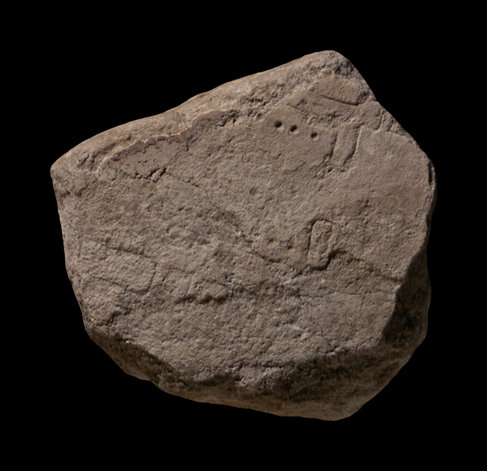
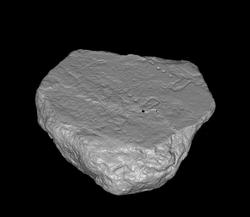
| Description The surface of this fragment is extremely corroded. It is possible, however, to make out the outlines of a temple. The cella, facing right, is rendered with recessed double lines as is common on the Map. Columns lined the cella walls inside; four appear on top; two are visible at the bottom. The temple appears to have been peripteral, as a few columns appear outside the cella; these are also rendered as recessed squares. The pronaos seem to have been fairly deep.
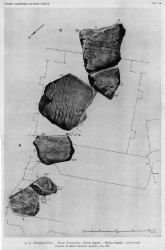
Identification: Forum Augustum/Augusti When discovered in 1562, this fragment was still joined with frs. 16b and 16c. Fr. 16c has since disappeared, but drawings by G. B. Piranesi and G. P. Bellori, as well as records from the 1742 reconstruction of the Map by the Capitoline Museums, allowed the authors of PM 1960 to rejoin the three pieces on paper (PM 1960, p. 74). Joining these fragments further allowed Carettoni to make certain observations about the temple and the surrounding portico depicted in the three pieces. He identified the portico visible in fr. 16b as the SE portico in the Forum of Augustus, and the temple seen in this fragment and in the missing fr. 16c as the Temple to Mars Ultor (PM 1960, p. 74). Also called forum Martis, the Forum of Augustus was second in the row of great imperial fora in Rome. The structure, which contained the great Temple of Mars Ultor, was dedicated by Augustus and his grandsons Gaius and Lucius in 2 BCE, when the temple was still unfinished (LTUR II, p. 289). It was located just northeast of the Roman forum, next to a stretch of the Argiletum, perpendicular to the forum Iulium, whose E side it abutted or was separated from by a street (Richardson 1992, pp. 160-61). A 30 meter tall fire wall encased it on the northeast (LTUR II, p. 290). Considered by Pliny one of the three most beautiful structures in Rome, Augustus' forum consisted of a large, rectangular space (ca. 125 x 90 m), paved with marble slabs and flanked on both sides by porticoes that were raised three steps above the level of the central courtyard. Above these lateral colonnades ran a deep attic, richly decorated with shields and copies of the caryatids in the Erectheum in Athens. The back walls of the porticoes were articulated with niches and engaged columns, and at the NE end, they opened up into the two great hemicycles on either side of the temple. The row of engaged columns in the back walls continued in front of these hemicycles as columns on plinths (Richardson 1992, p. 161). Two superimposed rows of niches - with larger niches in the center - adorned the walls of these semi-circular exedrae; inscriptions found in situ and a passage from Ovid (fast. 5.563-566) suggest that the niches contained on one side statues of Aeneas surrounded by members of the Iulio-Claudian family and possibly the kings of Alba Longa, on the other side Romulus, flanked by great men from Rome's past (LTUR II, pp. 290-91). One of these niches may be visible as a recessed square in fr. 16a. At the end of the SE portico, a small opening on the right gave access to a staircase that led to the Porticus Absidata; at the end of the opposite portico lay a square hall that held a colossal statue, believed by some scholars to have represented Augustus (LTUR II, p. 292). On either side of the temple, between the temple and the lateral porticoes, two arches (built by Tiberius in honor of Germanicus and Drusus around 18 CE) led to two staircases. The SE arch, known today as the Arco dei Pantani, gave access to a small, triangular space above a set of stairs; the NW arch, possibly the one dedicated to Drusus, led to two sets of stairs and to a street behind the forum through which one entered the Subura neighborhood (LTUR II, p. 292, fig. 117; Richardson 1992, p. 161). The architectural details of the SW end of the forum, and thus the main approach from the forum Iulium, are not known, as it has never been excavated. Small openings in the back walls of the lateral porticoes gave access to the Forum Transitorium and later to the Forum of Trajan.
The Temple to Mars Ultor, seen in this fragment, dominated the far (NE) end of the forum, where it backed onto the tall fire wall (LTUR II, fig. 117). It was octastyle, peripteral sine postico, and situated on a tall platform accessed by a frontal staircase. Platforms flanked the stairs on either side, and an altar sat in the center towards the front. The columns surrounding the cella stood on plinths. Inside the cella, lateral platforms supported six columns on plinths and matching endorsed columns on each side of the wide, vaulted nave. In the rear, an apse was approached by five stairs; here, a wide statue base held the cult statue of Mars Ultor (LTUR II, pp. 291-92). The statue of Mars was possibly flanked by statues of Venus and the deified Iulius Caesar (Richardson 1992, p. 163; against this, see V. Kockel in LTUR II, p. 292). Augustus' forum served a variety of purposes. Notable among these was its function as a gallery for great works of art, including a quadriga and two pictures by Apelles, and its role as Rome's foreign office (Richardson 1992, p. 162).
Significance Thanks to Bellori and Piranesi's drawings of the fragments that once joined this piece, Carettoni was able to identify the temple depicted here as the Temple of Mars Ultor in the Forum of Augustus. |
 Prev
Prev