ID AND LOCATION
| Stanford #
| 16e |
| AG1980 #
| 16e |
| PM1960 #
| 16 e |
| Slab #
| VI-5 |
| Adjoins
| none |
CONDITION
| Located
| true |
| Incised
| true |
| Surviving
| true |
| Subfragments
| 3 |
| Plaster Parts
| 0 |
| Back Surface
| smooth |
| Slab Edges
| 0 |
| Clamp Holes
| 0 |
| Tassello
| no |
TECHNICAL INFO
|
|
|
|
|
|
BIBLIOGRAPHY
- AG 1980, p. 96, pl. 13
- LTUR I: Basilica Aemilia (E. M. Steinby), pp. 167-168; Basilica Paul(l)i (H. Bauer), pp. 183-87
- PM 1960, pp. 75-76, pl. 21
- Richardson 1992, pp. 54-56 (Basilica Paulli)
|
|
|
|
|
| ANALYSIS
|
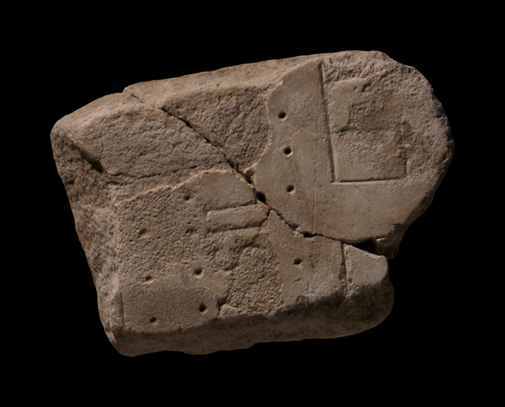
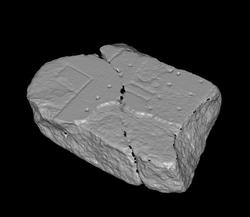
| Description Three parallel rows of columns traverse the fragment from top to bottom. A partial inscription [---]ASIL[---] appear in the wide gap between the first and second row of columns from the right. A straight line delineates the colonnaded area on the far left; a row of tabernae, separated by a gap, frame the area on the right. A vague guide line appears at an angle in the space between the rightmost colonnade and the tabernae.
Identification: Basilica Paul(l)i The triple colonnade, frontal shops, and partial inscription identify the building depicted in this fragment as the Basilica Paul(l)i, one of Rome's most famous buildings (PM 1960, p. 75 [referred to as the Basilica Aemilia]; LTUR I, pp. 183-84). It was situated on the NE edge of the Roman forum, across from the Basilica Iulia, right in the junction between the Argiletum and the Via Sacra. Its location next to the Templum Pacis is confirmed by its listing in the Regionary Catalogues under Regio IV. Due to a confusing literary record, the building was up until very recently generally identified with the Basilica Aemilia. Some scholars still believe that the building on the NE edge of the Forum Romanum underwent several reconstructions and subsequent name changes from Basilica Fulvia to Basilica Aemilia to Basilica Paulli (Richardson 1992, p. 55); others suggest the Basilica Aemilia was a completely different building, perhaps located northeast of the Lacus Iuturnae (E. M. Steinby in LTUR I, p. 168). The thesis that the Basilica Paulli replaced the Basilica Fulvia, which had been constructed by M. Fulvius Nobilior in 179 BCE, is generally accepted. L. Aemilius Paullus begun the reconstruction of the new building in 55 BCE. and it was inaugurated by his son, L. Aemilius Lepidus Paullus, in 34 BCE. After a fire in 14 BCE, it was rebuilt by Augustus and friends of Paullus, and in 22 CE it was restored by M. Aemilius Lepidus. The building suffered great damage during a fire in 283 CE and finally met its demise around 400 CE (LTUR I, p. 184). Considered by Pliny one of the three most beautiful buildings in Rome (Hist.Nat. 36.102), the Basilica Paulli consisted of three parts. Internal colonnades divided the basilica proper into a great central nave in two storeys, surrounded by an aisle on all four sides. An additional colonnade along the northeast side created an extra, narrow aisle here. A frieze depicting the early history of Rome decorated the interior of the lower storey. With the construction of the Forum Transitorium behind the basilica, the intercolumniations of the outer colonnade along the NE side were filled in and made into a solid wall (LTUR I, p. 186). A row of 15 tabernae with vaulted ceilings flanked the entire length of the nave on the southwest; three of these opened to the central nave and two gave access to the second storey above the nave. This fragment shows a section of the nave, including the NE wall added in the Flavian period, and the shops in front. The facade of the building consisted of a deep arcade, also in two storeys, in front of the tabernae. A small porch extended into the forum from the SE corner of this arcade; it is generally identified with the porticus Gai et Luci, a structure which Suetonius (Aug. 29.4) relates was dedicated by Augustus to his grandsons Lucius and Gaius Caesar; the discovery of a dedicatory inscription to L. Caesar near the SE corner of the building supports this thesis (LTUR I, p. 185; against this, see Richardson 1992, p. 56). The Basilica Paul(l)i would have been perfectly rectangular had its NW end not followed the oblique course of the Argiletum; the approach from the Argiletum consisted of a two-storeyed porch of elaborate design (see LTUR I, figs. 103-105).
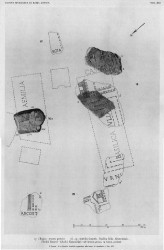
Significance As enough remains of this fragment to show the entire width of the Basilica Paulli, G. Carettoni was able to demonstrate that this measurement corresponds exactly to the actual dimensions of the building. This enabled him to refute R. Lanciani's thesis that the central area of the Severan map (the Roman forum and the Palatine) was depicted on a larger scale (1:200) than the rest of the plan (PM 1960, p. 76).
|
|
| HISTORY OF FRAGMENT |
| Like the majority of FUR fragments, this piece was discovered in 1562 in a garden behind the Church of Saints Cosmas and Damian. From here, it was transferred to the Palazzo Farnese and stored there. The fragment was later used as building material in the 17th-c. construction of the Farnese familys "Giardino Segreto" (Secret Garden) near the Via Giulia, and was rediscovered in 1888 or 1898 when the walls of the garden were demolished. Since then, it has been stored with the other known FUR fragments in various places: the storerooms of the Commissione Archeologica (1888/1898-1903), the Antiquarium Comunale (1924-1939), the Capitoline Museums (1939-1955), the Palazzo Braschi (1955-1998), and since 1998 in the Museo della Civiltà Romana in EUR under the auspices of the Sovraintendenza ai Beni Culturali del Comune di Roma. (This fragments history corresponds to Iter E as summarized in PM 1960, p. 56.) N.B. PM 1960 does not reveal the whereabouts of the fragment between 1903 and 1924.
Text by Tina Najbjerg
|
|
| KEYWORDS
|
| colonnade, porticus, basilica, nave, aisle, columns, shops, tabernae, opening, inscription, wall |
|
 Prev
Prev