ID AND LOCATION
| Stanford #
| 17 |
| AG1980 #
| 17 |
| PM1960 #
| 17 |
| Slab #
| VII-11 |
| Adjoins
| none |
CONDITION
| Located
| true |
| Incised
| true |
| Surviving
| false |
| Slab Edges
| 0 |
| Clamp Holes
| 0 |
| Tassello
| no | |
|
|
|
|
|
BIBLIOGRAPHY
- AG 1980, pp. 96-98, fig. 22, pl. 13
- LTUR II: Domus Aurea: Porticus triplices miliariae (E. Papi), pp. 55-56
- LTUR III: Horrea Vespasiani (E. Papi), pp. 49-50
- LTUR IV: Porticus Magaritaria (C. Lega), pp. 129-130; Regia (R.T. Scott), pp. 189-192
- PM 1960, pp. 75-76, pls. 13, 21
- Richardson 1992, p. 195 (Horrea Vespasiani); pp. 314-315 (Porticus Margaritatiria); pp. 119-121 (Domus: Aurea); pp. 328-329 (Regia)
|
|
|
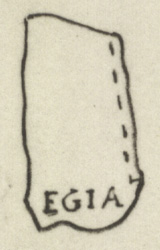
Detail from Cod. Vat. Lat. 3439 - Fo 22r,
reproduced from PM 1960, pl. 13 | |
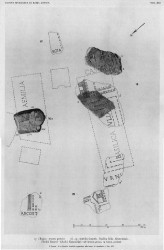
PM 1960 Plates: 13 21
AG 1980 Plates: 13
|
|
| IDENTIFICATION |
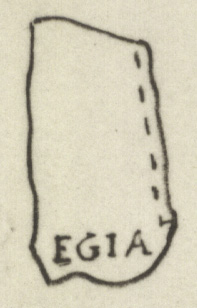
Renaissance drawing: The Regia (Regia)
Porticoed structure along the Via Sacra (horrea Vespasiani?)
|
|
| INSCRIPTION
Epigraphic conventions used |
| Transcription |
| None; the fragment itself is lost
|
| Renaissance Transcription |
| [---]EGIA
|
| Reconstruction |
| [R]EGIA (PM 1960; AG 1980) |
|
|
|
|
|
| ANALYSIS
|
| Description The fragment is missing but Renaissance drawing Cod. Vat. Lat. 3439 - Fo 22r shows it as it looked before it was lost (see detailed photo above or PM 1960, pl. 13, no. 1). The tiny fragment depicted the corner of a building, one wall of which consisted of a colonnade or arcade. The inscription was placed near this corner. The area above the inscription and in front of the portico was blank.
Identification: The Regia The inscription in this missing fragment has been reconstructed as REGIA, thus serving as a label for one of the oldest buildings in the forum Romanum, the Regia (PM 1960, p. 75). Ancient sources associate the origin of the building with Numa, and it seems to have served as the official seat of the Pontifex Maximus for centuries. Excavations have revealed the remains of the Regia between the via Sacra and the Temple of Vesta, a location that is confirmed by ancient sources (LTUR IV, pp. 189-190; Richardson 1992, p. 328). The building underwent several reconstructions (see LTUR 4, figs. 75-81), yet none of these corresponds to the architecture represented in this fragment. On the Marble Plan, the Regia must have been located below the inscription and, consequently, is not visible in this fragment (PM 1960, p. 75).
Identification: Porticoed structure along the via Sacra The portico shown in the extreme right of this fragment cannot represent part of the Regia in the Roman Forum even though the inscription to its left reads [R]EGIA. The porticoed walkway does not correspond to any of the many building phases of the Regia (PM 1960, p. 75). The building with the arcaded front would have been situated along the via Sacra, southeast of the Regia and north of the atrium Vestae. The remains of a portico have indeed been excavated in this spot; they have been associated variously with the porticus Margaritaria (PM 1960, p. 75), with the porticus triplices miliariae the vestibule to the domus Aurea (LTUR IV, p. 129; II, p. 55), and recently with the horrea Vespasiani (LTUR III, p. 49). According to the latter theory, the horrea Vespasiani in this fragment would have been mirrored by an arcaded row of tabernae on the opposite side of the via Sacra, belonging to the horrea Piperataria (LTUR III, p. 49).
Significance Very few fragments from the center of the Marble Plan remain; this area, which depicted the Roman Forum, was destroyed in the 5th century when a passageway was punched through the wall and the plan itself. The drawing of this fragent is valuable in that it represents a building from this lost area. |
|
| HISTORY OF FRAGMENT |
| Like the majority of FUR fragments, this piece was discovered in 1562 in a garden behind the Church of Saints Cosmas and Damian. From here, it was transferred to the Palazzo Farnese and stored there. Renaissance engravers reproduced the fragment in 16th-c. drawings that are now kept in the Vatican (for more information about the creation and accuracy of these drawings, see Cod. Vat. Lat. 3439), and Giovanni Pietro Bellori included it in his 1673 publication. The whereabouts of the piece after this date are unknown. (This fragments history corresponds to Iter D as summarized in PM 1960, p. 56.)
Text by Tina Najbjerg
|
|
| KEYWORDS
|
| pontifex maximus, Roman forum, colonnade, arcade, portico |
|
 Prev
Prev