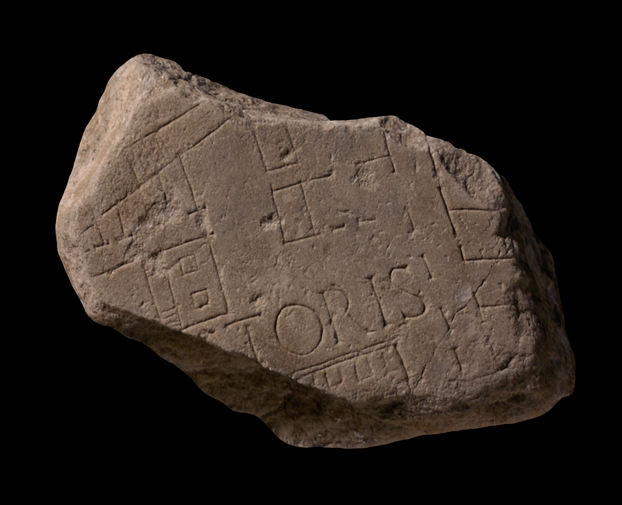
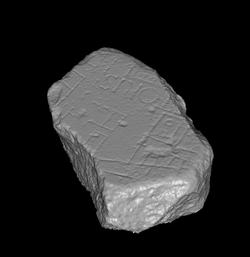
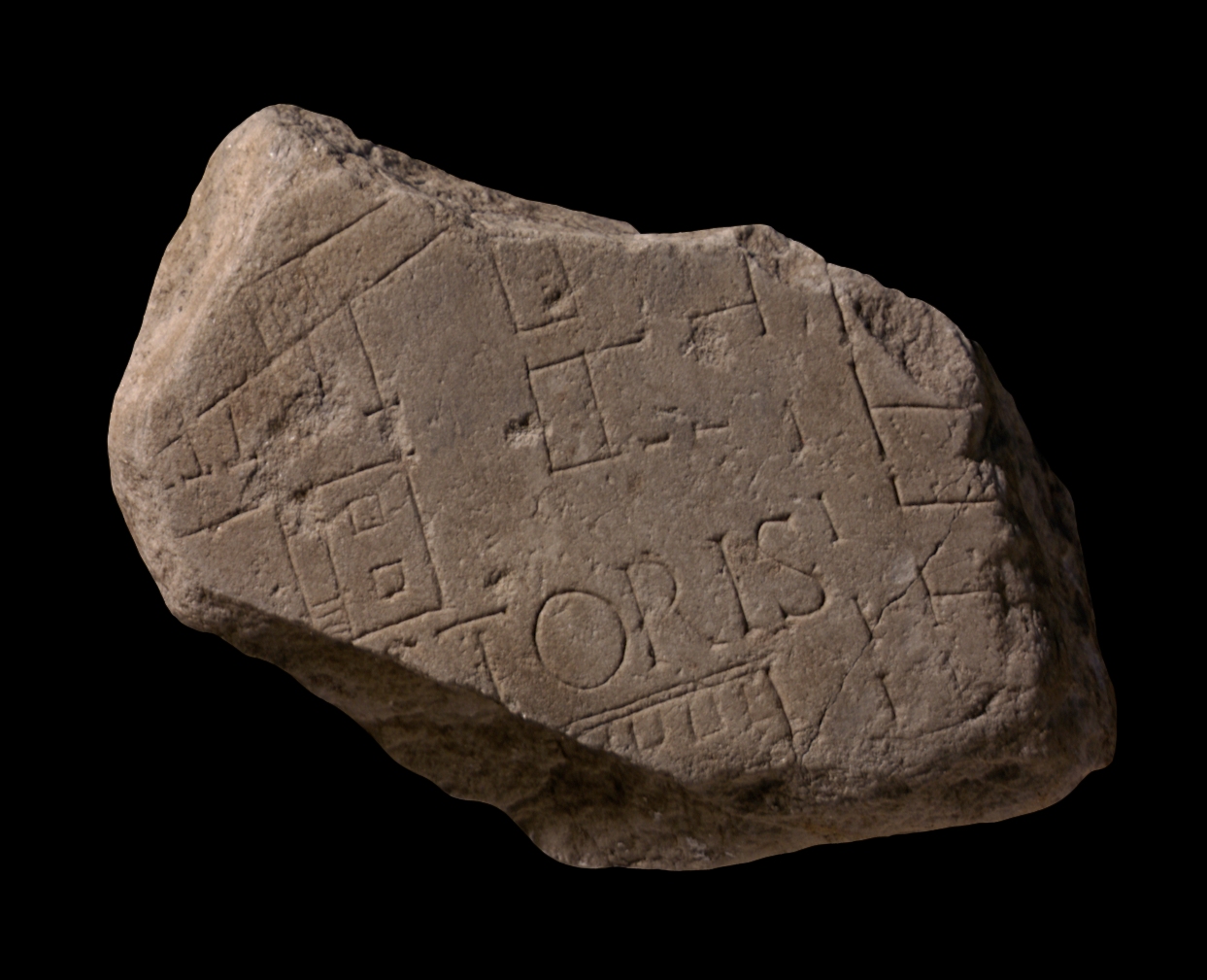
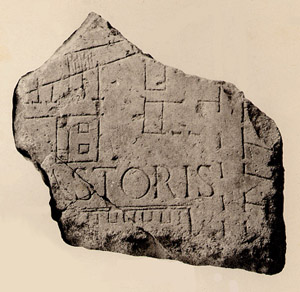
| Description On the back of the fragment are traces of a worked wedge hole, a tassello (AG 1980, p. 96-98). On the front, various structures surround a small open space in which the letters [---]S*TORIS are inscribed. Below the inscription, the corner of a temple podium and four of the temple's peripteral columns are visible. The horizontal wall of the podium is drawn as a double line. The columns were carved in outline and recessed; they would also have been filled with red inscription paint (minium), and so would have stood out among the mass of single red-painted lines on the Plan. To the right of the temple, across a street, is a vertical row of rooms or shops with entrances facing the temple, the street, and the small piazza (note that the two uppermost openings are not included in the drawing in AG 1980, pl. 13). The shops are fronted by a covered portico that is almost completely blocked at the top of the fragment. Directly above the inscription, a rectangular building opens up onto both the piazza and the street. It includes a small, rectangular room with no openings at its left end. Part of a similar room is visible right above the first, across a passage. At the top left corner of the fragment, two gently converging lines with a flight of steps between them appear to represent a long ramp or raised street. Just below, a row of small rooms backs into this ramp. Below this row of rooms runs a street or alley, and below it lies a rectangular structure. Staircases give access to the structure from the alley above it and the open space below. The closed room on the right of the staircases has two small squares in it. Another room lies to the left of the staircases.
Identification: Aedes Castoris The inscription suggests that the temple podium and colonnade at the bottom left of the fragment are part of the Temple of Castor in the Roman Forum (PM 1960, p. 75). E. Rodríguez-Almeida has raised doubts about this identification (AG 1980, p. 98), but they are laid to rest by E. M. Steinby's discussion of a photograph published by R. Lanciani in Notizie degli Scavi 1882, pl. 14:
(click here for a larger view)
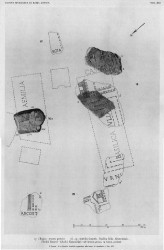
The Lanciani photograph shows two small fragments (assigned the numbers 18fg by Stanford) adhering to the bottom left corner of fr. 18a. These are now missing and they were not published in PM 1960 or in AG 1980. The lost fragments clearly show that the inscription read [C]ASTORIS (Steinby 1989, pp. 24-25, fig. 3 or LTUR III, fig. 120).
Livy (2.20.12, 2.42.5) and Dionysius of Halicarnassus (Ant. rom. 6.13) reveal the early history of the building: Vowed in 499 or 496 BCE by the dictator Postumus, the Temple was dedicated in 484 BCE by his son in the very spot where Castor and Pollux had appeared after the battle of Lake Regillus (LTUR I, p. 242). The building was restored in 117 BCE and in 74 BCE, it was rebuilt by Tiberius, it was converted into a vestibule for Caligula's palace, and Claudius also restored it. It served as a meeting place for the senate and as a bank; rooms in the foundation functioned as shops; and the platform in front was for a long period the main tribunal in the Forum for judicial and legislative gatherings (LTUR I, pp. 242-243).
Excavations have demonstrated that the Temple of Castor was an octastyle peripteral temple with eleven columns along the sides. Smaller columns lined the inside walls of the cella. This plan is confirmed by frs. 18b (now lost) and 18c, generally believed to represent the rest of the temple (LTUR I, p. 245). On the controversy of the columns at the back of the podium, partially depicted in the lost fragment 18b, see below.
Identification: Lacus Iuturnae The feature depicted on the left side of the fragment, right above the inscription, has been identified as the Fountain of Juturna (PM 1960, p. 75). This spring-fed water basin stood in the S end of the Roman Forum on the site of the spring in which Castor and Pollux were reported to have watered their horses after the Battle of Lake Regillus in 496 BCE (LTUR III, p. 168; Richardson 1992, p. 230). In its earliest phase in the 2nd c. BCE, the fountain consisted of a simple, rectangular basin. Later, perhaps around 117 BCE, it was reconstructed as a square basin with a rectangular base in the center, perhaps meant to support the statues of the Dioscuri which were found in the basin in the early 20th century by G. Boni. In the Augustan period, the interior sides of the basin were thickened so as to create a platform along all four sides, and the walls were revetted with marble.
The location of the fountain on the Plan matches its location on the ground exactly. However, its depiction here with lateral staircases, no platform, and two pedestals instead of one, does not match what is known from excavations. Also missing from the fragment is the small shrine to Juturna that was constructed right above the sacred spring.
The Marble Plan may reflect the pre-Domitianic and pre-Trajanic nature of the fountain and of other buildings next to the Temple of Castor (LTUR III, p. 169). The ramp depicted above the lacus Iuturnae corresponds to the one that led from behind the Temple of Vesta to the west end of the Via Nova, where it gave access to the atrium Vestae (see Claridge 1998, p. 93 and fig. 1).
Identification: Sub-Palatine shops Behind the Temple of Castor, the vertical row of rooms with the covered portico in front flanked the N end of the great Domitianic hall, one of the gradient structures that gave way to the imperial buildings on the Palatine from the Forum (PM 1960, p. 75; Claridge 1998, pp. 92-93, fig. 1).
Significance The Forum Romanum is a crucial area for our knowledge of Roman topography. Unfortunately, this part of the Plan was largely destroyed in the early 5th c. when the wall of the aula was perforated here to create a passageway (AG 1980, p. 21; schematic rendering of the wall in PM 1960, p. 180). This fragment is important because it is one of the very few surviving pieces of the Plan that depicts this political, religious, monumental and symbolic core of the ancient city.
Significance: Does fr. 18a belong to the Severan Marble Plan?
Steinby has expressed strong doubts that fragment 18a belonged to the Severan Marble Plan at all, but close analysis of this new color photograph as well as the Renaissance fragments suggests that it does belong. Among other problems, Steinby points to the discrepancies between the rendering of the temple in fr. 18a and in frs. 18bc.
First, on 18a, the E wall of the podium is rendered with a double line, while the corresponding W podium wall in frs. 18bc is drawn with a single line. A close look at the color photo demonstrates, however, that the square columns were left incomplete on their E side; the engraver never carved the dashed line that would have completed the E side of the colonnade. Since this particular engraver has rendered other sections of this temple in a sloppy fashion (see for example the missing sides of the two square columns in the NW corner of the podium in fr. 18bc), it is not unlikely that the double line simply was a mistake. He was supposed to carve a dashed line to complete the colonnade, but instead he carved a solid line that looks like part of the wall of the podium. Another example of a sloppy carving that influences the representation of the colonnade along the side of a temple can be seen in fr. 273b.
Second, Steinby points out that on fr. 18a, the short sides of the footprints of the outer columns are on the east and west, while on frs. 18bc they are on the north and south (Steinby 1989, pp. 26-27). A close look at the color photo, however, shows that had the engraver completed the E side of the square columns where he was supposed to, the columns would have been almost perfectly square.
Third, Steinby notes that on fr. 18a the outer columns wrap around the SE corner of the podium--standard for a peripteral temple--but on drawings of the lost fr. 18b, there appear to be no columns along the back, suggesting that the depicted temple was sine postico. However, examination of the Renaissance drawing from which our knowledge of fr. 18b is drawn (reproduced below) does not allow for certainty on this point. In general, the Renaissance drawings treat surface incisions on the fragments with a high degree of accuracy but the outlines of the fragments are sloppy. Judging by comparable fragments, it is very possible that fragment 18b in actuality broke off just beyond the final column depicted, where the podium line abruptly ends; then the outline of the fragment was cursorily drawn some way beyond, giving the erroneous impression that more of the fragment survived and that there were no additional columns where expected. (Note that the drawing of the fragment in PM 1960, pl. 21, exacerbates this distance between the end of the incisions and the end of the fragment.)
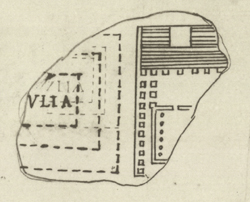
Renaissance drawing of fr. 18b,
showing Temple of Castor on the right,
reproduced from PM 1960, pl. 9.
Rodríguez-Almeida also argues that fr. 18a must belong to the Severan marble plan, but on different grounds. For one, he claims that it is of Proconnesian marble like the rest of the FUR fragments, a type of marble not commonly used in Rome before the Antonine period (see Rodríguez-Almeida 1995-96a for the full discussion).
|
 Prev
Prev