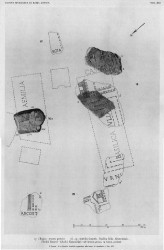
| Description Fr. 18d is now lost, but Renaissance drawing Cod. Vat. Lat. 3439 - Fol 22r shows it as it looked shortly after its discovery (see detailed photo above or PM 1960, pl. 13, no. 24). The fragment depicted on the right a building that consisted of three arcades surrounding a central hall. An inscription, of which only the letter B was visible in this fragment, was placed in this central space. In the left side of the fragment, the wall of a building appeared. It was labeled by an inscription [---]VRNI[---]that was placed between the two buildings.
Identification: Basilica Iulia The arcaded building on the right has been identified as the Basilica Iulia in the Roman Forum (PM 1960, p. 75). The tail end of the inscription that labeled this structure was visible in the now missing fr. 18b. Julius Caesar began the construction of the basilica in 54 BCE along the SW side of the Forum, between the vicus Tuscus and the vicus Iugarius, on the site of the earlier, 2nd-century basilica by T. Sempronius Gracchus (basilica Sempronia), and it was inaugurated, still incomplete, in 46 BCE. Augustus finished the building, and in 12 BCE he reconstructed it after a fire and dedicated it in the names of his grandsons, Gaius and Lucius (LTUR I, p. 177). In 283 CE the building was again destroyed by fire, and it was reconstructed by Diocletian and Maximinus. In addition to providing space for sessions of the centumviral court, the basilica seems to have served as a venue for banking and other financial business (LTUR I, p. 177).
The foundation of the basilica is still visible today. It shows that the marble-revetted building measured 101 x 49 m., and that it consisted of a central nave surrounded by two arcaded aisles with second-storey galleries above. Tabernae were placed along the back. The representation of the building in this fragment and in the also lost fr. 18b matches this layout. Missing from the Marble Plan, however, are the stairs along the entire front of the basilica on the Forum side and the elongated tabernae that lined it on the Palatine side (see LTUR I, fig. 93).
Identification: Aedes Saturni The building that appeared along the left side of this fragment is identified by the partial inscription next to it as the Temple to Saturn (PM 1960, p. 75). Situated at the foot of the Capitoline in the NW end of the Roman Forum, between the vicus Iugarius (see below) and the clivus Capitolinus (see LTUR I, fig. 129), the temple was constructed at the end of the 6th c. or the beginning of the 5th c. BCE. The area around the temple was reorganized in 174 BCE and the building itself was completely rebuilt by L. Munatius Plancus, consul in 42 BCE. In the 4th c. CE, the temple was destroyed by fire and restored (LTUR IV, p. 234). The hollow cult statue of Saturnus was filled with oil, veiled, carried a scythe, and the legs were wrapped with woolen cloths, except during the festivities of the Saturnalia. Throughout the Republic, the building contained the state treasury (the Aerarium) and archive. During the Empire, when the treasury of the people was separate from that of the emperor, the temple retained the aerarium Populi Romani (LTUR IV, pp. 234-35). While the existing foundation of the temple mainly belongs to the rebuilding in 42 BCE by Plancus, the superstructure is of the 4th c. CE. The remains show that the podium temple was prostyle, hexastyle, and measured 24 m. x 33 m. (LTUR IV, p. 235, fig. 109). The frontal stairs are missing now, but the treasury may have been situated underneath them, perhaps in a tripartite arrangement similar to that of the Temple of Jupiter in Pompeii (Richardson 1992, p. 344). Only a small section of the SE wall of the temple was visible in this missing fragment. The front of the building was represented in the now lost fr. 19.
Identification: Vicus Iugarius The space between the Basilica Iulia and the Temple to Saturn in this missing fragment is the vicus Iugarius (PM 1960, p. 75). This important street is thought to have begun in the Roman Forum (or beyond), from where it ran along the bottom of the Capitoline and ended by the porta Carmentalis (see LTUR I, fig. 129). It was the major artery between the lower Campus Martius and the Forum (see LTUR I, fig. 64), and the main route for triumphs and processions entering the Forum area (Richardson 1992, p. 424). In reality, the street is much narrower than depicted in this fragment (PM 1960, p. 75, n.1).
Significance The location of the Temple of Saturn next to the Basilica Iulia, as depicted in this missing fragment, is correct. The temple, however, is not parallel to the basilica but lies at a slight angle (PM 1960, p. 75, n.1. See actual relationship between the buildings in LTUR II, fig. 153). This discrepancy could be a mistake by the Renaissance draftsman, or it could represent yet another example of the carvers of the Marble Plan straightening and realigning the ancient monuments (a good example is seen in the Temple to the Deified Claudius).
The political, religious, monumental and symbolic core of ancient Rome, the Roman Forum is a crucial area for our knowledge of Roman topography. Unfortunately, the part of the Marble Plan that depicted this area was largely destroyed in the early 5th cent. when the wall of the aula was perforated here to create a passageway (AG 1980, p. 21; schematic rendering of the wall in PM 1960, p. 180). The drawing of this fragment is important because it depicts a section of and one of the points of access to of this nodal point in Rome.
|
 Prev
Prev