ID AND LOCATION
| Stanford #
| 18e |
| AG1980 #
| 18e |
| PM1960 #
| 18 e |
| Slab #
| unknown |
| Adjoins
| none |
CONDITION
| Located
| true |
| Incised
| true |
| Surviving
| false |
| Slab Edges
| 0 |
| Clamp Holes
| 0 |
| Tassello
| no | |
|
|
|
|
|
BIBLIOGRAPHY
- AG 1980, pp. 96-98, pl. 13
- LTUR I: Augustus, Divus, templum (novum); Aedes (M. Torelli), pp. 145-146
- LTUR II: Grecostadium (F. Coarelli) p. 372
- PM 1960, pp. 75-76, pl. 21
- Richardson 1992, pp. 45-46 (Augustus, Divus, Templum); p. 182 (Graecostadium)
|
|
|
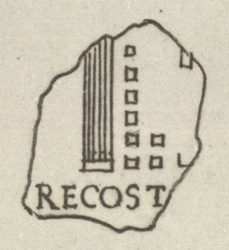
Detail from Cod. Vat. Lat. 3439 - Fo 20r,
reproduced from PM 1960, pl. 10 | |
PM 1960 Plates: 10 21
AG 1980 Plates: 13
|
|
| IDENTIFICATION |
| Renaissance drawing: Graecostadium (Graecostadium) with the New Temple to the Deified Augustus (templum novum Divi Augusti)
|
|
| INSCRIPTION
Epigraphic conventions used |
| Transcription |
| None; the fragment itself is lost
|
| Renaissance Transcription |
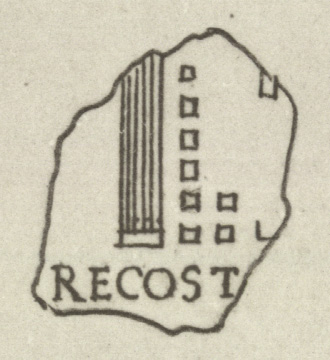
| [---]RECOST[---]
|
| Reconstruction |
| [G]RECOST[ASIS] or [G]RECOST[ADIUM] (PM 1960)
[G]RECOST[ADIUM] (AG 1980) |
|
|
|
|
|
| ANALYSIS
|
| Description The fragment itself is lost but is reproduced in Renaissance drawing Cod. Vat. Lat. 3439, fo 20r (see detail above or PM 1960, pl. 10, no. 4). The fragment depicted part of the pronaos and cella of a podium temple. The pronaos was approached by six wide steps in front. The columns of the pronaos are rendered as squares. Only six of the frontal columns are visible but the fact that a) the frontal stairs continue beyond the sixth column at top, and b) the two columns behind the front row are not matched by two others at top, indicates that the fragment does not show the entire width of the temple and that there were more than six columns in front. A section of the entrance to the cella may be visible at top right; strangely, however, it is not matched below by a similar wall section. Below the temple and parallel to it, the partial inscription [---]RECOST[---] appears.
Identification: Graecostadium The inscription in this missing fragment labeled an enigmatic structure known from the Regionary Catalogues where it is listed in Regio VIII after the Vicus Iugarius and before the Basilica Iulia and the Porticus Margaritaria. This situates the building with great probability behind the Basilica Iulia and between the Vicus Iugarius and the Vicus Tuscus (LTUR II, p. 372). It is known to have been restored by Antoninus Pius after a fire, and it was destroyed again in 283 CE by the same fire that ravaged the nearby Basilica Iulia. The Graecostadium contained the templum novum Divi Augusti, which is probably the temple depicted in this fragment (LTUR I, pp. 145-46; II, p. 372; Richardson 1992, p. 182). The temple, meant to house the official worship of the deified Augustus, was built by Tiberius and dedicated in 37 CE by Caligula, who, according to Suetonius (Cal. 22), used it to connect the Capitoline to the Palatine. Caligulean coins depict it as a hexastyle temple. It was restored by Domitian in 89 or 90 CE and again by Antoninus Pius who must have made considerable changes to it, as his coins show it as octastyle, as does this lost fragment. Based on a) this fragment, b) the appearance of the name Graecostadium on a late antigue slave collar, c) Plutach who mentions an "Agora and Temenos of the Greeks," and d) Seneca who claims there was a slave market in this area, F. Coarelli reconstructs the Graecostadium as a great porticoed area that surrounded the temple and functioned as a slave market; he furthermore identifies the puzzling name as a deformation of statarion Graecorum, meaning "market for Greek slaves." (LTUR II, p. 372). The Temple to the Deified Augustus was constructed during the time of Tiberius, suggesting to Coarelli that also the surrounding Graecostadium was built at this time, perhaps as a replacement of the Aequimelium.
Significance This fragment provides the only known visual evidence for the relationship between the Graecostadium and the templum novum Divi Augusti.
|
|
| HISTORY OF FRAGMENT |
| Like the majority of FUR fragments, this piece was discovered in 1562 in a garden behind the Church of Saints Cosmas and Damian. From here, it was transferred to the Palazzo Farnese and stored there. Renaissance engravers reproduced the fragment in 16th-c. drawings that are now kept in the Vatican (for more information about the creation and accuracy of these drawings, see Cod. Vat. Lat. 3439), and Giovanni Pietro Bellori included it in his 1673 publication. The whereabouts of the piece after this date are unknown. (This fragments history corresponds to Iter D as summarized in PM 1960, p. 56.)
Text by Tina Najbjerg
|
|
| KEYWORDS
|
| temple, pronaos, cella, columns, colonnade, square columns, steps, portico, slave market, open space, |
|
 Prev
Prev