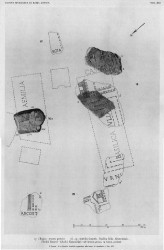
| Description The fragment is lost but Renaissance drawing Cod. Vat. Lat. 3439 - Fo 14r shows it as it looked shortly after its discovery (see detailed photo above or PM 1960, pl. 3, no. 3). In the top right corner, the fragment depicted the front of a temple podium. Five of the columns in front of the pronaos were visible, as was a narrow, central staircase, surrounded by two platforms(?) What the triangular area in front of the temple depicts is uncertain. Below this temple, and parallel to it, was situated another structure of which only the top left corner is visible. A small, stair-like feature protruded from the front of this building. The left side of the fragment was occupied by what seems to be a single structure of a strange design. Its top and right side were rendered as a line of square columns, but instead of meeting in a 90-degree angle, these walls made a sharp turn inwards, almost as if they respected the triangular space in front of the temple. This structure was labeled by an inscription in the top left corner: [---]ORDIA.
Identification: Aedes Saturni The building that appeared in the top right corner of this now lost fragment is identified by the partial inscription in the also missing fr. 18d as the Temple to Saturn (PM 1960, p. 75. L. Richardson [1980] is against this interpretation). Situated at the foot of the Capitoline Hill in the NW end of the Roman forum, between the vicus Iugarius and the clivus Capitolinus (see LTUR I, fig. 129), the temple was constructed at the end of the 6th c. or the beginning of the 5th c. BCE. The area around the temple was reorganized in 174 BCE and the building itself was completely rebuilt by L. Munatius Plancus, consul in 42 BCE. In the 4th c. CE, the temple was destroyed by fire and restored (LTUR IV, p. 234). The hollow cult statue of Saturnus was filled with oil, veiled, carried a scythe, and the legs were wrapped with woolen cloths, except on Saturnalia. Throughout the Republic, the building contained the state treasury (the Aerarium) and archive. During the Empire, when the treasury of the people was separate from that of the emperor, the temple retained the aerarium Populi Romani (LTUR IV, pp. 234-35).
While the existing foundation of the temple mainly belongs to the rebuilding in 42 BCE by Plancus, the superstructure is of the 4th c. CE. The remains show that the podium temple was prostyle, hexastyle, and measured 24m x 33m (LTUR IV, p. 235, fig. 109). The frontal stairs are missing now, but the treasury may have been situated underneath them, perhaps in a tripartite arrangement similar to that of the Temple of Jupiter in Pompeii (Richardson 1992, p. 344). The division of the frontal stairs in this fragment into a set of narrow stairs in the center surrounded by two platforms may support this theory.
Identification: Templus Divi Vespasiani The structure in the bottom right corner of this missing fragment has been identified as the Temple to the Deified Vespasian (PM 1960, p. 75. Against this, Richardson 1980). Begun by Titus and completed by Domitian between 80 and 87 CE, the temple was later restored by Septimius Severus. It was situated in the NW end of the Roman forum, at the foot of the Capitoline hill with its back against the Tabularium, between the Temple of Concordia and the porticus Deorum Consentium (see LTUR I, fig. 129). The surviving remains of the podium show that the temple was prostyle, hexastyle, and measured 21m by 27.75m (LTUR V, p. 124). The part of the temple shown in this lost fragment is supposedly the E corner of the front of the podium (PM 1960, p. 75). None of the frontal columns is shown in the Renaissance drawing, however, and the building is depicted as facing the Temple of Saturn directly, while it in reality is located further to the northeast (see LTUR I, fig. 129).
Identification: Aedes Concordiae The inscription in the top left corner of this lost fragment identifies the building below it as the Temple of Concordia in the Roman forum (PM 1960, p. 75). This temple was originally vowed by Camillus in 367 BCE but the building of the same name, which is visible today in the NW end of the Roman forum, was constructed in 121 BCE by L. Opimius. The temple, frequently used for senate meetings, was destroyed by fire in 9 BCE and restored by Tiberius in 7 BCE (LTUR I, p. 317). The existing remains and Tiberian coins show that the peripteral sine postico temple was of an unusual, T-shaped design: With its back to the front of the Tabularium, the cella was wider than it was deep (45 m wide versus 24 m deep) and considerably broader than the 34 m wide pronaos and the frontal staircase (see LTUR I, figs. 129, 185-188). The Renaissance drawing above shows a strangely compressed rendering of the SW corner of this building. The front is narrower than the rear, as in reality, but the transition between the two parts is here drawn at an oblique angle instead of the correct 90-degree angle. The columns along the side of the cella and in front of the pronaos are included, but those along the side of the pronaos and in front of the cella are missing, as is the front staircase. Is this discrepancy the fault of the Renaissance engravers or is it an example of the problems of alignment that faced the carvers of the Marble Plan?
Significance: Does this fragment represent the Temples of Saturn, of Vespasian and of Concordia in the Forum Romanum? While the authors of the two great authoritative works on the Marble Plan, PM 1960 and AG 1980, do not doubt that this missing fragment represented the Temples of Saturn, of Vespasian and of Concordia in the Roman forum and therefore had to be placed in slab V-11, L. Richardson has challenged this assumption (Richardson 1980). He claims that G. and P.M. Lugli's 1947-reconstruction of the Temple of Saturn is incorrect, mainly because it was based on the presumed plan of the temple in fr. 19 which shows the approach to the temple as consisting of two rectangular platforms framing each side of a narrow, central staircase that widens at the top to span the width of the entire podium. Richardson proposes that fr. 19 does not depict the Temple of Saturn, of the deified Vespasian, and of Concordia in the Roman forum. The general plan of these three buildings is known today, and the the Renaissance drawing of the missing fragment does not match these remains: The triangular area in front of the presumed Temple of Saturn seems to be approached by stairs which is unlikely, as the clivus Capitolinus rises here; if the lines that frame this triangular area represent a precinct wall, then where is the entry? In addition, there are too few front steps shown in the drawing - in comparison to the Temple of Castor, there should be many more; and the line of the podium is not indicated here although it is included in fr. 18d which shows the S wall of the temple. The rendering of the Temple of Vespasian in fr. 19 also does not correspond to reality: It is situated incorrectly in relationship to the Temple of Saturn, and it shows no columns or steps in front. Finally, the Renaissance drawing depicts the supposed Temple of Corcordia as having columns along the side, which is incorrect; it does not repeat the unusual T-shape of the building; and the imposing frontal staircase is missing. The author does not think it likely that the Renaissance draftsman could have made so many mistakes, and concludes that the fragment belongs some where else on the Marble Plan. He proposes that the [---]ORDIA inscription in fr. 19 refers not to [CONC]ORDIA but to [VENUS VERTIC]ORDIA. The temple to Venus Verticordia must have been sitauted some where between the Circus Maximus and the Aventine Hill, an area that corresponds to slabs VIII-6 and VII-14 on the Marble Plan. Hardly any fragments have been located in this area of the Plan, and there is thus ample space to position fr. 19 here.
|
 Prev
Prev