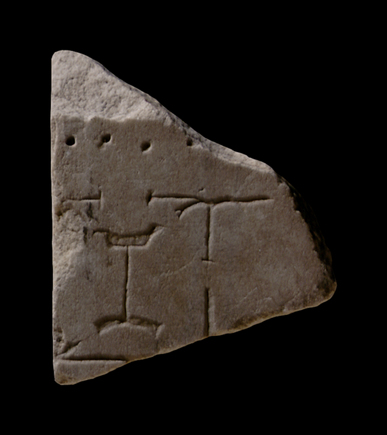
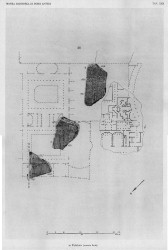
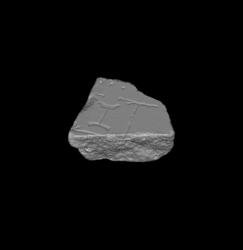
| Description The fragment was part of a slab edge; a partial clamp hole is visible. A horizontal colonnade traverses the piece along the top. Below the colonnade, and parallel to it, lies a wall with two openings visible. The openings lead to two rooms, situated side by side, that are connected via an opening in the vertical wall common to the both. The back wall of the room on the left is barely visible at the bottom of the fragment. This room contains an H-shaped feature, and curved features in the corners of both rooms perhaps represent apsidal spaces within each room.
Identification: Palatium Comparison to existing remains on the Palatine Hill demonstrates that G. Huelsen's identification of this fragment as belonging to the upper level of the imperial palace complex there was correct (PM 1960, p. 77). The Palatine was the chief place of residence for the emperors of Rome, from Augustus to Constantine, and again in the 5th century. Augustus' humble abode was soon supplanted by the palaces of Tiberius, Caligula, and Nero, and the subsequent Domitianic and Severan constructions essentially turned two thirds of the hill into one giant, imperial complex (for detailed descriptions and reconstructions of the entire palace complex and all its phases, see LTUR II, pp. 40-45 [Domus Augustana, Augustiana; Domus Flavia; Vigna Barberini], pp. 63-64 [Domus Aurea: complesso del Palatino], pp. 111-112 [Domus Germanici], pp. 189-197 [Domus Tiberiana], pp. 199-202 [Domus Transitoria], figs. 10-15, 18, 26, 53-65; LTUR IV, figs. 6-7 [Palatium]). The following description, which focuses on the main portions of the Flavian and Severan sections, is summarized from LTUR II, pp. 40-45 and Richardson 1992, pp. 114-117. For reconstructions of these sections, refer to LTUR IV, figs. 6-7.
The remains of the imperial complex that are visible on the Palatine today primarily belong to Domitian's palace, designed by the architect Rabirius, and to a Severan expansion of the compound. The palace was entered from the northwest through the main reception area on the upper level; it was framed on the north and west by a colonnaded porch. This section consisted of a reception hall in the shape of a basilica, followed by a large, almost square hall, the so-called Aula Regia, and finally the smaller "Lararium" with access to more private rooms behind it, including a staircase to an upper storey. From these three reception halls one entered a great peristyle with an octagonal maze (for plantings?) surrounding a central pool or fountain. West of this peristyle lay a series of three rooms, divided by straight and curved walls into smaller, interconnecting niches and rooms of unknown function. This fragment depicts the N end of these rooms and the N corner of the peristyle (PM 1960, p. 77). East of this peristyle, smaller rooms flanked a wide entrance that led to a second peristyle. At the rear of the first peristyle, aligned with the central reception room, lay a great hall with a shallow apse in the back. It was completely open in front towards the peristyle, and five windows on either side provided partial view of two oval nymphaea, surrounded by colonnades, that flanked it. The raised floor allowed for the floor of the hall to be heated. This was the famous cenatio Iovis, a banquet hall celebrated by Martial (8.39) and Statius (Silv. 4.2). Fr. 20c depicts the joint between the W peristyle, the rooms east of it, the banquet hall, and the oval nymphaeum east of it.
The NE section of the upper palace consisted of two joining peristyles. The first of these was divided into three equal sections and had a semi-circular projection in front, which may have served as a formal vestibule or imperial box (Richardson 1992, p. 116). This peristyle probably functioned as a grand entrance court into the second peristyle. The second peristyle, almost square in shape with rounded corners in front, had a shallow pool in the center; as mentioned, it was also accessed from the western peristyle via a wide opening in its W wall. On the southeast, this second peristyle gave access to a square, colonnaded hall, flanked by two apsidal rooms and other rooms beyond them. The central hall provided a view of the hippodrome garden that abutted the NE side of the palace (see below).
The main residential section of the palace was situated southwest of these two peristyles. On the upper level, it consisted of a series of small and large rooms in a rectilinear pattern, adorned with curved niches and light wells. The rooms on the lower level were symmetrically arranged around a great, sunken court with surrounding columns or arcades and a central pool. Four peltate islands inside the pool served as statue bases. Fr. 20a depicts the NE corner of the sunken court and some of the upper-level rooms or light wells northeast and southeast of it (PM 1960, p. 77).
An opening in the SW wall of the court gave access to a large room that led to the concave SW facade of the palace. A colonnade ran along the entire facade, creating a gently curved promenade with a view of the Circus Maximus. In the triangular spaces between the back wall of the curved
facade and the sunken court were small rooms and exedrae of elaborate design, radiating from semi-circular light wells (see reconstruction in LTUR II, fig. 10 or Richardson 1992, fig. 28). Little remains of these rooms today, but the missing fr. 20b depicted part of the complex architecture in this section of the palace. Fr. 20b also showed part of the SW portion of the palace. This area lay outside the main section, to which it was slightly off angle. It consisted of a large, colonnaded area in front of two apsidal halls lying side by side. It is traditionally identified as the library precinct added by Domitian to the Temple of Apollo (Platner-Ashby 1929, pp. 158-166; Claridge 1998, p. 121).
The great sunken garden that ran the length of the entire E side of the palace was shaped as a hippodrome, its SW end curved; rooms at the straight NE end gave the impression of carceres (Richardson 1992, p. 116). Arcades flanked the open garden along the sides and the curved SW end. Colonnades ran above these arcades and across the garden towards the NW end. Semi-circular pools lay at either end, and an oval enclosure of late date occupied the SW end of the garden. Rooms behind the curved SW end extended the hippodrome to meet the SW facade of the palace. Similarly, rooms arranged around a great nymphaeum at the NE end extended the structure to meet the NE facade of the palace. A huge, semi-circular exedra in the SE side of the hippodrome garden may have functioned as a great imperial box or as a garden pavilion. Vaulted chambers on the ground floor supported a series of niches and colonnades above; a half-dome covered the entire exedra.
Septimius Severus added a wing to the imperial palace that extended from the hippodrome garden to the Septizodium. Today, only the massive substructures of this wing, generally referred to as the Domus Severiana, are visible. The rooms at top of this section would have provided a splendid view of Rome. It may have served as a monumental entrance from the Via Appia. Finally, an enigmatic structure of Domitianic date below the SW corner of the palace, the so-called Paedagogium, seems to have formed an annex to the imperial complex at top. The few remains reveal that it consisted of a central, semi-circular exedra flanked by a series of rooms and faced with a colonnade and other rooms of uncertain arrangement (see LTUR IV, pp. 7-8 ["Paedagogium"], figs. 1 and 6).
The architectural details of the vast, imperial compound are still not clearly understood; the identification and date of the individual parts are also still disputed. Traditionally, scholars have used the toponym domus Flavia to describe the official reception area in the NW part of the palace, and domus
Augustana or Augustiana to refer to the two levels of more private, residential architecture east of it (see W. L. MacDonald, The architecture of the Roman Empire I [New Haven and London 1965] fig. 5 for a clear overview of this division). According to this thesis, this fragment depicts a section of the domus Flavia. The traditional view has been challenged by L. Sasso D'Elia, however, who proposes the exact opposite: it makes more sense to apply the name domus Flavia to the private section of the palace where the Flavian family lived, and domus Augustana to the official rooms of the emperors (LTUR II, p. 41). MacDonald (1965, p. 49) suggests the entire palace should be called domus Augustana or Augustiana. The names Palatium and domus Palatina or Palatinae were used frequently in antiquity to describe the palace in its entirety (LTUR II, p. 150 [Domus Palatina]; IV, p. 14 [Palatium]; Richardson 1992, p. 115). The domus Tiberiana, the domus Germanici, the domus Transitoria, and the domus Aurea seem to always have been considered separate from the main (Domitianic and Severan) palace (Richardson 1992, p. 115).
Significance Although the width of the room with the H-shaped feature depicted in this fragment does not match the actual remains, the thickness, smooth back, and ductus compare well to the securely identified fr. 20a and the architectural details are close enough to the extant architecture to identify the fragment as showing part of the imperial palace (PM 1960, p. 78). R. Lanciani suggested that the carvers of the map depicted buildings in the Roman forum on a smaller scale (1:200) than the rest of the Severan map (1:240); C. Hülsen later followed up on this thesis, proposing that also the buildings on the Palatine were depicted on a smaller scale (1:220)(PM 1960, pp. 76-78). The authors of PM 1960, however, demonstrated that this was not the case for the Forum Romanum and argued that it was also not true for buildings on the Palatine, although they admitted that in the latter case, not enough remains of the map in this section to be able to test the thesis against the remaining architecture (PM 1960, p. 78).
|
 Prev
Prev