ID AND LOCATION
| Stanford #
| 20h |
| AG1980 #
| 20h |
| PM1960 #
| 468 |
| Slab #
| VII-12 |
| Adjoins
| none |
CONDITION
| Located
| true |
| Incised
| true |
| Surviving
| true |
| Subfragments
| 1 |
| Plaster Parts
| 0 |
| Back Surface
| smooth |
| Slab Edges
| 0 |
| Clamp Holes
| 0 |
| Tassello
| no |
TECHNICAL INFO
|
|
|
|
|
|
BIBLIOGRAPHY
- AG 1980, pp. 99-100, pl. 14
- Cecamore 1994-95
- LTUR I: Apollo Palatinus (P. Gros), pp. 54-57; Area Apollinis, pp. 112-113; Area Apollinis (Palatium)(E. Rodríguez-Almeida), p. 113
- PM 1960, p. 143, pls. 13, 50
- Richardson 1992, p. 14 (Apollo Palatinus, Aedes); p. 31 (Area Apollinis)
|
|
|
|
|
| ANALYSIS
|
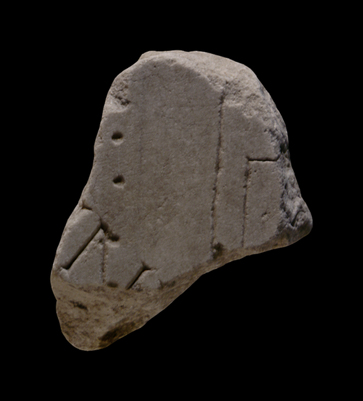
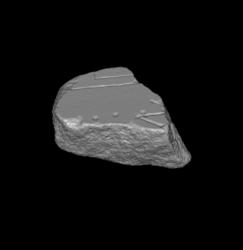
| Description A colonnade traverses the fragment on the left; on the right, a wall runs parallel to the portico. The upper left corner of another structure can be seen on the far right. A partial inscription [---]IN[---] is written diagonally across the colonnade.
Identification: Area Apollinis Based on the fragment's smooth back, thickness, veining direction, and ductus, E. Rodríguez-Almeida located this fragment close to frs.
20e (missing) and
fg
in slab VII-12 immediately in front of the Temple to Apollo on the Palatine and suggested that the letters IN belong to the inscription visible in the missing fr. 20e which he reconstructed as [A]REA APO[LLI]N[IS] (AG 1980, p. 99). Although the Regionary Catalogues place the area Apollinis et Splenis in Regio 1, Rodríguez-Almeida argues that the similar thickness and veining direction of these fragments and other FUR pieces from the Palatine area confirm this location (AG 1980, p. 99). C. Cecamore has pointed out that E. Rodríguez-Almeida's proposed position of these three fragments is unlikely, as excavations on the Palatine in front of the Temple to Apollo have not revealed any remains that might match the square platform depicted in frs. 20e and 20fg. She solves the problem, however, by sliding all three pieces (20e, 20fg and 20h) slightly north (down and to the left on the map); in this adjusted position, the platform matches foundations discovered southwest of the Temple to Apollo plus the colonnade visible in this fragment aligns perfectly with the corner of the colonnade seen south of the libraries in the missing fr. 20b (Cecamore 1994-95, p. 28, fig. 21).
Rodríguez-Almeida's positioning of this fragment identifies the colonnaded walkway partially visible here and partially in fr. 20e as the portico that framed the large, rectangular space in front of the Temple of Apollo on the Palatine, the area Apollinis (AG 1980, p. 99, pl. 14). Constructed upon an artificial terrasse, ca. 70 x 30 m, that overlooked the Circus Maximus, the portico formed part of the Augustan complex on the Palatine that also included Augustus' house and the Temple to Apollo (LTUR I, p. 56). It consisted of a large, colonnaded area with two apsidal halls (libraries?) opening onto its SE side. It is traditionally identified as the library precinct added by Domitian to the Temple of Apollo (Platner-Ashby 1929, pp. 158-166; Claridge 1998, p. 121). Ancient sources refer to the portico as the Phoebi porticus (Prop. 2.31.1-2), porticus (Suet. Aug. 29.4), templumque Apollinis in Palatio cum porticibus (Aug. R. Gest. div. Aug. 19.1), Cass. Dio 53.1)(LTUR I, p. 113).
Significance Rodríguez-Almeida positioning of this fragment (and Cecamore's adjustment of its precise location) greatly improves our knowledge of the complicated archaeology around the Temple of Apollo on the Palatine. |
|
| HISTORY OF FRAGMENT |
| Like the majority of FUR fragments, this piece was discovered in 1562 in a garden behind the Church of Saints Cosmas and Damian. From here, it was transferred to the Palazzo Farnese and stored there. The fragment was later used as building material in the 17th-c. construction of the Farnese familys "Giardino Segreto" (Secret Garden) near the Via Giulia, and was rediscovered in 1888 or 1898 when the walls of the garden were demolished. Since then, it has been stored with the other known FUR fragments in various places: the storerooms of the Commissione Archeologica (1888/1898-1903), the Antiquarium Comunale (1924-1939), the Capitoline Museums (1939-1955), the Palazzo Braschi (1955-1998), and since 1998 in the Museo della Civiltà Romana in EUR under the auspices of the Sovraintendenza ai Beni Culturali del Comune di Roma. (This fragments history corresponds to Iter E as summarized in PM 1960, p. 56.) N.B. PM 1960 does not reveal the whereabouts of the fragment between 1903 and 1924.
Text by Tina Najbjerg
|
|
| KEYWORDS
|
| colonnade, columns, portico, area of Apollo, libraries, |
|
 Prev
Prev