ID AND LOCATION
| Stanford #
| 230 |
| AG1980 #
| 230 |
| PM1960 #
| 230 |
| Slab #
| IV-6 |
| Adjoins
| none |
CONDITION
| Located
| false |
| Incised
| true |
| Surviving
| true |
| Subfragments
| 1 |
| Plaster Parts
| 0 |
| Back Surface
| smooth |
| Slab Edges
| 0 |
| Clamp Holes
| 0 |
| Tassello
| no |
TECHNICAL INFO
|
|
|
|
|
|
|
|
|
|
|
| ANALYSIS
|
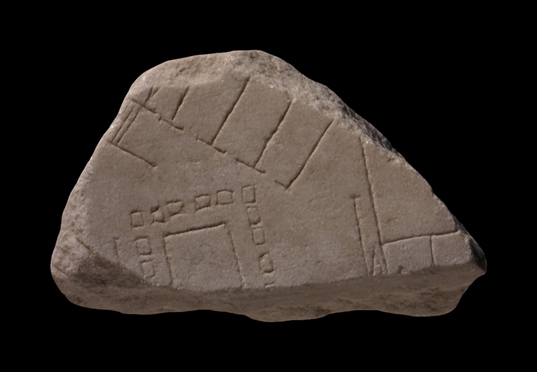
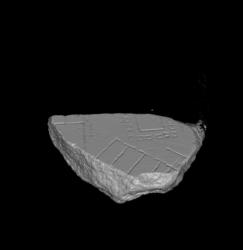
| DescriptionThe back of a hexastyle, peripteral temple is visible in the lower left part of the fragment. While the surrounding columns are rendered with outlined squares, the walls of the cella are drawn with a single line only, which is an unusual way in which to render temple architecture on the Plan. A multi-room structure whose outer wall is parallel to the side of the temple appears to the right. Its exterior staircase is rendered as a triangle. Above the temple, and in an oblique angle to it, lies another structure that consists of a row of rooms. It also has an exterior staircase; this one is rendered as short, parallel lines between the front of the rooms and a wall that lies parallel to it.
Identification: Temple to Jupiter Fulgur? Based on the smooth back, thickness, veining direction, and texture of this fragment, E. Rodríguez-Almeida was able to position it in slab IV-6. He suggested that the temple depicted in the fragment was oriented in such a way in the Campus Martius that it would have been referred to in antiquity as being located "in campo" (Rodríguez-Almeida 1991-92, p. 12). Based on this, and on the unusual rendering of the cella which perhaps indicates it was open to the sky, Rodríguez-Almeida identified the temple in the fragment with that of Jupiter Fulgur, known to have stood somewhere in the Campus Martius and which Vitruvius (1.2.5) relates was hypaethral (Rodríguez-Almeida 1991-92, pp. 16-17). NB. D. Manacorda (Manacorda 1990) identifies the temple in fr. 234c as that of Jupiter Fulgur; L. Richardson (1992, p. 219) associates it with Temple D in the Largo Argentina.
Significance If Rodríguez-Almeida's identification of the temple in this fragment is correct, the piece provides the only visual clue to the architecture of the enigmatic temple of Jupiter Fulgur. |
|
| HISTORY OF FRAGMENT |
| Together with the majority of the fragments, this piece was discovered in 1562 behind the Church of Saints Cosmas and Damian (PM 1960, p. 128).
Text by Tina Najbjerg. |
|
 Prev
Prev