ID AND LOCATION
| Stanford #
| 238b |
| AG1980 #
| 238b |
| PM1960 #
| 238 b |
| Slab #
| IV-6 |
| Adjoins
| 238a |
CONDITION
| Located
| false |
| Incised
| true |
| Surviving
| false |
| Slab Edges
| 0 |
| Clamp Holes
| 0 |
| Tassello
| no | |
|
|
|
|
|
|
|
|
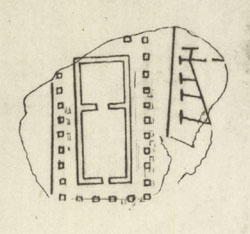
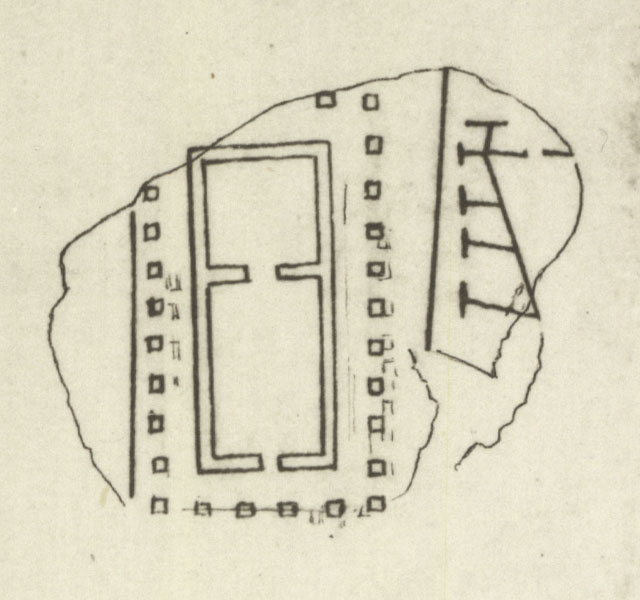
Detail from Cod. Vat. Lat. 3439 - Fo 15v,
reproduced from PM 1960, pl. 5 | |
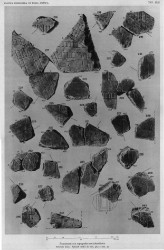
PM 1960 Plates: 5 42
AG 1980 Plates: 43
|
|
| IDENTIFICATION |
| Renaissance drawing: Temple of Mars (aedes Martis in circo)?
|
|
| INSCRIPTION |
| None |
|
|
|
|
|
| ANALYSIS
|
| Description The fragment is missing, but Renaissance drawing Cod. Vat. Lat. 3439 - Fo 15 v shows it as it looked when still joined with fr. 238a (see detailed photo above or PM 1960, pl. 5, no. 1). Together, the two fragments depict a peripteral temple with an adyton that is accessed through a deep cella. The walls of the temple and the surrounding columns are rendered with double lines and with squares, as is common for temple structures on the Plan. The surviving fr. 238a shows that both walls and columns were recessed and would have been filled with red paint. A thin line, almost parallel to the temple side (note that according to the surviving fr. 238a it IS parallel to the temple), traverses the fragment and separates the temple from a triangular cluster of tabernae.
Identification: Temple of Mars? E. Rodríguez-Almeida has pointed out that the temple depicted in fragments 238a and b is Greek in style rather than Roman: It lacks a podium and consists of an adyton behind a deep cella (Rodríguez-Almeida 1991-92, pp. 12-16). Note that in the drawing of this fragment in AG 1980, pl. 43, the right wall of the temple incorrectly continues up and off the edge of the piece instead of turning left to create the upper right corner of the adyton. This is a serious error, as it implies that there was a posticum behind the adyton, which the digital photograph of fr. 238a reveals there is not. Rodríguez-Almeida was able to locate fr. 238a within slab IV-6 based on its smooth back, texture, and veining direction, and he suggested that the temple depicted in frs. 238a and b was positioned perpendicular to the Circus Flaminius and that it therefore must have held the ancient designation "in circo." Based on the Greek style of the temple and on its orientation in relation to the Circus Flaminius, he argued that it is to be identified with the Temple of Mars "in circo," remains of which have been unearthed underneath the church of San Salvatore (Rodríguez-Almeida 1991-92, pp. 12-16; see LTUR III, fig. 156). That the San Salvatore remains are those of the Temple of Mars was also argued by F. Zevi in 1976 (F. Zevi, "L'identificazione del tempio di Marte "in circo" e altre osservazioni" in Mélanges J. Heurgon II [1976], pp. 1047-1064). The Temple of Mars was built ca. 138 BCE for D. Iunius Brutus Callaicus by the architect Hermodorus of Salamis (LTUR III, p. 226 ). According to Pliny (HN 36.26) the temple held a colossal seated statue of Mars and a nude Venus, both by Scopas (LTUR III, pp. 226-7).
Significance Frs. 238a and b were key to Rodríguez-Almeida's identification of the remains of the Temple of Mars underneath the church of San Salvatore. If Rodríguez-Almeida's location of these fragments in slab IV-6 and his identification of the temple depicted in them are correct, he seems to have proven that the ancient designation "in circo" could be applied to buildings that were perpendicular to the Circus Flaminius, not just to those that were aligned with it.
|
|
| HISTORY OF FRAGMENT |
| Together with the majority of the fragments, this piece was discovered in 1562 behind the Church of Saints Cosmas and Damian. It is now missing but appears together with fr. 238a on a Renaissance drawing in the Vatican: Cod. Vat. Lat. 3439 - Fo 15 v (PM 1960, p. 129, pl. 5, no. 1). For more information about the creation and accuracy of these drawings, see Cod. Vat. Lat. 3439.
Text by Tina Najbjerg. |
|
 Prev
Prev