ID AND LOCATION
| Stanford #
| 244 |
| AG1980 #
| 244 |
| PM1960 #
| 244 |
| Slab #
| unknown |
| Adjoins
| none |
CONDITION
| Located
| false |
| Incised
| true |
| Surviving
| true |
| Subfragments
| 1 |
| Plaster Parts
| 0 |
| Back Surface
| smooth |
| Slab Edges
| 0 |
| Clamp Holes
| 0 |
| Tassello
| no |
TECHNICAL INFO
|
|
|
|
|
|
|
|
|
|
|
| ANALYSIS
|
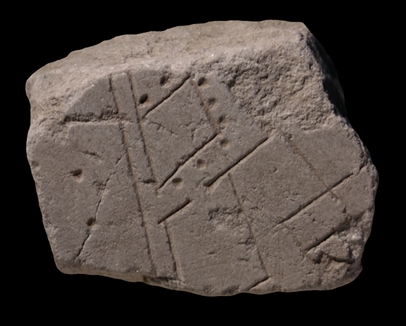
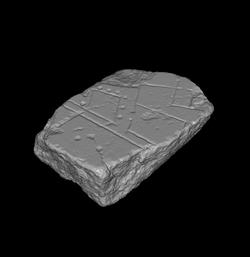
| Description Left, the upper right corner of a large open space incorporates a circle of at least three columns. It is separated from buildings on the right by a vertical street or alley that traverses the entire fragment. This street gives access to a diamond-shaped courtyard, top right, which is surrounded on three sides by nine columns (only eight are visible). An opening at the bottom of this porticoed courtyard gives access to a large, rhomboidal hall or enclosure at the bottom of the fragment. The porticoed court and the hall are separate from a trapezoid-shaped enclosure, bottom right. This enclosure incorporates, but does not give access to, a smaller room in the bottom right corner which seems to continue into another enclosure on the far right.
Identification Small and medium-sized courtyards surrounded on three or four sides with porticoes like the one in this fragment are fairly common on the Marble Plan. Other examples can be seen in frs. 10g, 11a, 11b, 11d, 11e, 95a, 101, 350ab, and 484. Generally, such small, colonnaded courtyards are incorporated into bath complexes (fr. 10g), serve as garden spaces or vegetable plots in private houses (frs. 11d, 11e, 350ab), function as pleasant, open-air areas or work spaces behind rows of tabernae (frs. 11a, 11b, 101), or common gardens in apartment complexes (fr. 484). In all these cases, access from the street to the courtyard is limited. The peristyle in this fragment, however, is accessed directly from the street which may indicate that it served a more public function than those mentioned above.
Significance The rhomboid, trapezoid, and diamond shapes of the buildings in this fragment are probably the visible results of the problems caused by the map makers and engravers having to mosaic together the results of surveys of different areas of the city, or the problem is caused when trying to depict hilly areas. It is especially pronounced in fragments like 10g. |
|
| HISTORY OF FRAGMENT |
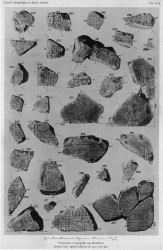
| Like the majority of FUR fragments, this piece was discovered in 1562 in a garden behind the Church of Saints Cosmas and Damian. From here, it was transferred to the Palazzo Farnese and stored there. It was not among the fragments that were reproduced in the Renaissance drawings that are now kept in the Vatican, but Giovanni Pietro Bellori included it in his 1673 publication. In 1742, the fragment was moved to the Capitoline Museums and exhibited with some of the other known fragments in wooden frames along the main staircase. Since then, it has been stored with the other FUR fragments in various places: The storerooms of the Capitoline Museums (1903-1924), the Antiquarium Comunale (1924-1939), the Capitoline Museums again (1939-1955), the Palazzo Braschi (1955-1998), and since 1998 in the Museo della Civiltà Romana in EUR under the auspices of the Sovraintendenza ai Beni Culturali del Comune di Roma (This fragments history corresponds to Iter E as summarized in PM 1960, p. 56).
Text by Tina Najbjerg
|
|
| KEYWORDS
|
| colonnade, courtyard |
|
 Prev
Prev