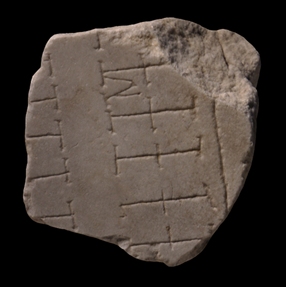
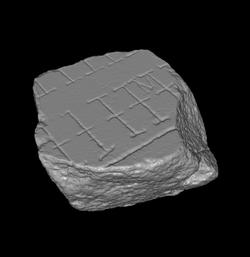
| Description A vertical street separates two vertical rows of tabernae. The tabernae on the right all consist of a front and and a back room, the latter opening onto what is perhaps a narrow alley or a sidewalk. Stairs led to a second floor or mezzanine.
Identification Rows of tabernae are one of the most common features on the Marble Plan. In general, the shops consisted of a single room with a wide opening towards the street that could be screened off at night, and the owners probably resided with their families on a wooden platform in the back of the shop. The tabernae in this fragment are slightly more luxurious and not that common on the Plan. They consist of a front room which would have functioned as the shop, and a back room that would have provided the shopowner with a living space, storage, a working area, or some combination of these. The narrow opening in the back provided private access to the room from the outside. Other examples of tabernae with openings on two opposite ends are visible in frs. 11e (top left), 496a (bottom), and 544 (Reynolds 1996, pp. 160-61, fig. 3.11). None of these examples, however, incorporates the wall that separates the front and the back rooms as does this fragment.
Significance This piece is a typical example of unidentified fragments of the Plan. No monumental buildings are represented, and the fragment instead provides a view of the lesser known commercial/residential structures. It is, however, the only fragment known to show a particular type of taberna that consists of two rooms, front and back, with openings at both ends and in the dividing wall. |
 Prev
Prev