ID AND LOCATION
| Stanford #
| 246 |
| AG1980 #
| 246 |
| PM1960 #
| 246 |
| Slab #
| IV-6 |
| Adjoins
| none |
CONDITION
| Located
| false |
| Incised
| true |
| Surviving
| true |
| Subfragments
| 1 |
| Plaster Parts
| 0 |
| Back Surface
| smooth |
| Slab Edges
| 0 |
| Clamp Holes
| 0 |
| Tassello
| no |
TECHNICAL INFO
|
|
|
|
|
|
|
|
|
|
|
| ANALYSIS
|
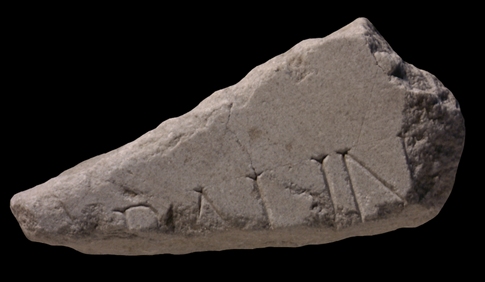
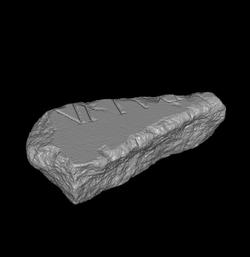
| Description Five letters,[.]ALIN, are partially visible. A horizontal guide line follows the top of the inscription and another crosses the top left corner of the "N" at an oblique angle.
Identification R. Staccioli identified the inscription in this fragment as the label for one or more small baths, balnea (Staccioli 1961, p. 96, pl. 42). E. Rodríguez-Almeida furthermore located the fragment in slab IV-6 based on its thickness, smooth back, and the presence of a belt of micacious, green specks that traverses all fragments from this particular slab (Rodríguez-Almeida 1991-92, 23-26, fig. 11). The natural gradient of the slab even enabled him to position the fragment within the slab to an area left of the vicus Stablarius in the SW corner of the Campus Martius (fig. 12). The position of the letters [B]ALIN[EA] in an open space led Rodríguez-Almeida to conclude that they did not label one of the four baths known to have been located in this area, but referred to an area mentioned in Martial (5.70.4), the Balinea Quattuor, which incorporated these four baths (LTUR I, p. 63; Rodríguez-Almeida 1991-92, pp. 23-24).
Significance If Rodríguez-Almeida is right, then this fragment demonstrates that Martial's balinea quattuor (5.70.4) was not a reference to four specific baths but to the section of the Campus Martius that incorporated them. |
|
| HISTORY OF FRAGMENT |
| Like the majority of FUR fragments, this piece was discovered in 1562 in a garden behind the Church of Saints Cosmas and Damian. From here, it was transferred to the Palazzo Farnese and stored there. Renaissance engravers reproduced the fragment in 16th c. drawings that are now kept in the Vatican (Cod. Vat. Lat. 3439), and Giovanni Pietro Bellori included it in his 1673 publication. The fragment was later used as building material in a 17th c. Farnese construction, the Secret Garden, and it was rediscovered in 1888 or 1898 when the walls of the garden near the Via Giulia were demolished. Since then, the fragment has been stored in various places: The storerooms of the Commissione Archeologica (1888/1898-1903), the Capitoline Museums (1903-1924), the Antiquarium Comunale (1924-1939), the Capitoline Museums again (1939-1955), the Palazzo Braschi (1955-1998), and since 1998 in the Museo della Civiltà Romana in EUR under the auspices of the Sovraintendenza ai Beni Culturali del Comune di Roma (This fragments history corresponds to Iter C as summarized in PM 1960, p. 56).
Text by Tina Najbjerg
|
|
| KEYWORDS
|
| baths, Campus Martius, balnea, |
|
 Prev
Prev