ID AND LOCATION
| Stanford #
| 249 |
| AG1980 #
| 249 |
| PM1960 #
| 249 |
| Slab #
| unknown |
| Adjoins
| none |
CONDITION
| Located
| false |
| Incised
| true |
| Surviving
| true |
| Subfragments
| 1 |
| Plaster Parts
| 0 |
| Back Surface
| smooth |
| Slab Edges
| 1 |
| Clamp Holes
| 0 |
| Tassello
| no |
TECHNICAL INFO
|
|
|
|
|
|
|
|
|
|
|
| ANALYSIS
|
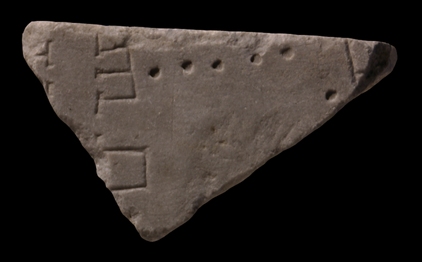
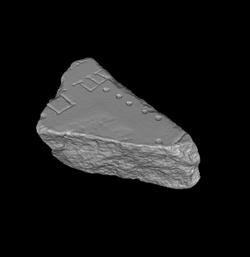
| Description The fragment was part of a slab edge. It depicts a section of a large courtyard that is flanked at least on two sides by columns. The entrance to the couryard on the left is flanked on both sides by tabernae that face the street in front of the building. Barely visible on the far left is a row of shops that faces the colonnaded building across the street. N.B. In AG 1980, pl. 44, there are 3 small lines missing: One of the sidebars of the shops across the street from the peristyle building; one of the vertical lines to the left of the entrance to the building; and a small vertical line in the far right tip of the fragment.
Identification Colonnaded courtyards, or peristyles, are common on the Marble Plan. Despite their varying shapes and sizes, they must have served the same function: They provided open space and a pleasant break from the crowded city. The central area may have functioned as a vegetable or flower garden. Since this courtyard is easily accessed from the street through the wide opening on the left, however, it may have served a somewhat public function like that of a small neighborhood macellum.
Significance This piece is a typical example of unidentified fragments of the Plan. No monumental buildings are represented, and the fragment instead provides a small view of a commercial/residential neighborhood of Rome. |
|
| HISTORY OF FRAGMENT |
| The provenience of this fragment is unknown (PM 1960, p. 129). It has presumably been in storage since 1998 with the other known FUR fragments in the Museo della Civiltà Romana in EUR under the auspices of the Sovraintendenza ai Beni Culturali del Comune di Roma.
Text by Tina Najbjerg
|
|
| KEYWORDS
|
| peristyle, courtyard, colonnade, tabernae, slab edge |
|
 Prev
Prev