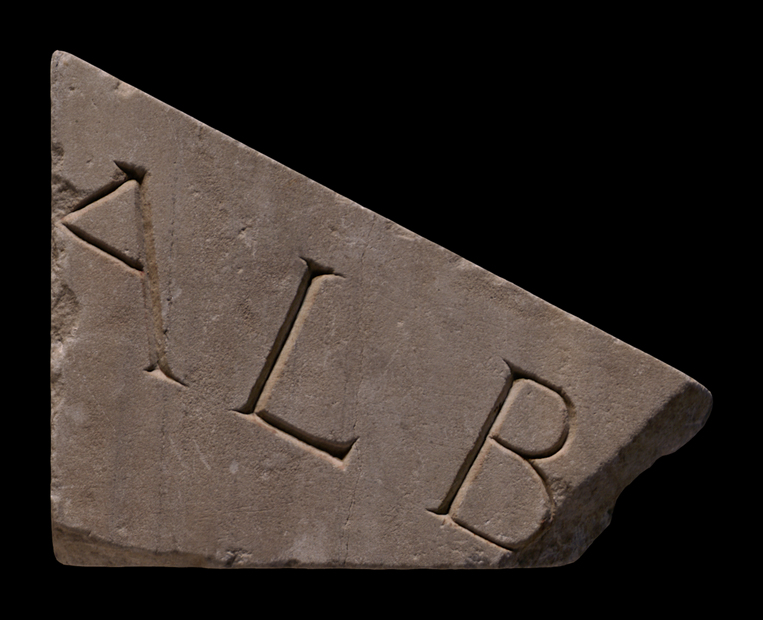
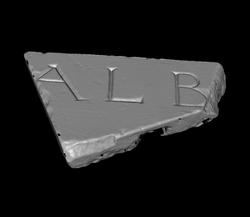
| Description The fragment was the corner of a slab. There is a clamp hole along the bottom edge. Three letters, ALB, traverse the piece in an oblique angle to the bottom. Faint guidelines are visible along the top and bottom of the inscription. The straight edge above and parallel to the inscription is the result of modern cutting.
Identification: Praedia et horrea Galbana For years, scholars who identified this fragment as having been part of the inscription that labeled the horrea Galbana on the FUR, tried in vain to position it near the three buildings in fr. 24a and 24c which were assumed to be the actual horrea. In 1977-78, however, E. Rodríguez-Almeida demonstrated that fr. 91 with the letters IA was from the same inscription as this piece, and that the entire label read [PRAED]IA [ET HORREA G]ALB[ANA]. Based on archaeological evidence recorded by Lanciani and on FUR fragments 24a, 24c, 24A, and 24B, he showed that the praedia et horrea Galbana covered a vast area from the porticus Aemilia in the N to an unknown point past the Monte Testaccio in the S, from the slopes of the Aventine Hill in the E to the horrea Lolliana in the W. It was therefore not necessary for an inscription labeling the entire estate to have been placed in frs. 24a and c; it could have been situated further southward, i.e. toward the top of the Plan. He then positioned the two fragments in the lower left corner of slab IX-8 (fr. 24A) and along the right side of slab IX-7 (fr. 24B)(Rodríguez-Almeida 1977-78, p. 21, figs. 3, 5).
Originally belonging to the family of Servius Sulpicius Galba, probably the praetor of 187 BCE, the private estate later became imperial property, most likely during the reign of Galba (LTUR III, p. 40). The proximity of a funerary monument (visible in fr. 24c) to a later family member of the same name, perhaps the consul of 144 BCE (Ferrea 1998) or of 108 BCE (F. Coarelli, LTUR III, p. 42) confirms the identity of the Republican property, which may at an earlier state have been called the praedia Sulpicia and have incorporated the horrea Sulpicia, mentioned by Horace (Carm. 4.12.18)(LTUR II, p. 40). The abundant epigraphical evidence suggests that the residential spaces of the imperial complex gradually yielded to large warehouses for the storage of the public grain supply, and of oil, wine, food, clothing, and marble (LTUR II, p. 41; Richardson 1992, p. 193). The mountain of discarded amphoras that constitutes the nearby Monte Testaccio is a testimony to the large scale operation of these horrea. Inscriptions also suggest that the many warehouse workers, variously referred to as horrearii, operarii Galbenses, or Galbenses, to name a few, were organized into three cohortes and that there were different collegia, or societies to which they could belong (LTUR II, p. 41). The latter implies that the complex included scholae for the meetings of these collegia, and most likely also bathing establishments, both of which are probably included in the neighboring horrea Lolliana, visible in fr. 25.
Significance Rodríguez-Almeida's location of this fragment in the lower left corner of slab IX-8 helped demonstrate the vast extent of this imperial estate/warehouse complex by the Tiber. The combination of this fragment with fr. 24B, which showed that the FUR label recorded the dual name of the complex, also helped explain why there was no label placed across the three buildings in frs. 24a and 24c which were known to have been part of the estate. |
| Like the majority of FUR fragments, this piece was discovered in 1562 in a garden behind the Church of Saints Cosmas and Damian. From here, it was transferred to the Palazzo Farnese and stored there. It was not among the fragments that were reproduced in the Renaissance drawings that are now kept in the Vatican, but Giovanni Pietro Bellori included it in his 1673 publication. In 1742, it was moved to the Capitoline Museums and exhibited with some of the other known fragments in wooden frames along the main staircase. Probably at this time, a blank section of the fragment was cut off in a line just above the inscription (PM 1960, p. 27). In 1903, museum curators included the fragment in a reconstruction of the FUR mounted on a wall behind the Palazzo dei Conservatori (1903-1924). Since then, it has been stored with the other known FUR fragments in various places: the storerooms of the Antiquarium Comunale (1924-1939), the Capitoline Museums again (1939-1955), the Palazzo Braschi (1955-1998), and since 1998 in the Museo della Civiltà Romana in EUR under the auspices of the Sovraintendenza ai Beni Culturali del Comune di Roma. (This fragments history corresponds to Iter E as summarized in PM 1960, p. 56.)
Text by Tina Najbjerg |
 Prev
Prev