ID AND LOCATION
| Stanford #
| 261 |
| AG1980 #
| 261 |
| PM1960 #
| 261 |
| Slab #
| unknown |
| Adjoins
| none |
CONDITION
| Located
| false |
| Incised
| true |
| Surviving
| true |
| Subfragments
| 1 |
| Plaster Parts
| 0 |
| Back Surface
| smooth |
| Slab Edges
| 0 |
| Clamp Holes
| 0 |
| Tassello
| no |
TECHNICAL INFO
|
|
|
|
|
|
|
|
|
|
|
| ANALYSIS
|
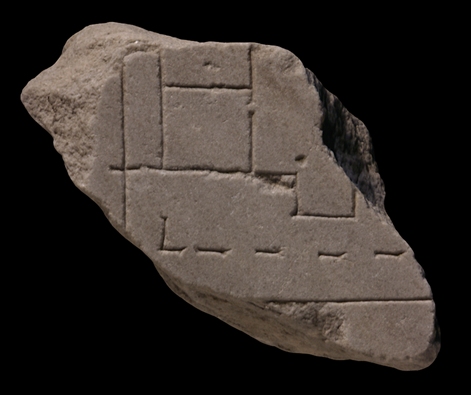
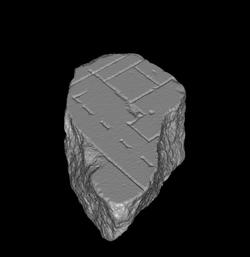
| Description A vertical line to the far left and a horizontal line at the bottom of the fragment seem to create a rectilinear enclosure. Above and parallel to the horizontal line lies an arcade; it turns to the right before it meets the vertical wall. The vertical wall encloses to the right a long, narrow space with an opening at the bottom, then one, probably two or more, almost square rooms on top of each other. A tiny opening is visible in the top right corner of the bottom square. This opening leads to a larger space which seems to feature an exedra at the bottom towards the arcade. One column is visible in the top left corner of this exedra - it was probably matched by another, making the exedra distyle.
Identification The large, square room, the arcade, the distyle exedra, and the carefully carved, rectilinear lines seem to fit well with the type of architecture found on the Plan in the center of Rome. Compare, for example, AG 1980, pl. 26, which includes such large monuments as the Saepta Iulia, the Diribitorium, the Porticus Divorum, and the Iseum. This fragment may belong to that area.
Significance This fragment may belong with already located and identified areas of the Plan.
|
|
| HISTORY OF FRAGMENT |
| Like the majority of FUR fragments, this piece was discovered in 1562 in a garden behind the Church of Saints Cosmas and Damian. From here, it was transferred to the Palazzo Farnese and stored there. The fragment was later used as building material in the 17th c. construction of the Farnese familys Giardino Segreto (Secret Garden) near the Via Giulia, and was rediscovered in 1888 or 1898 when the walls of the garden were demolished. Since then, it has been stored with the other known FUR fragments in various places: the storerooms of the Commissione Archeologica (1888/1898-1903), the Antiquarium Comunale (1924-1939), the Capitoline Museums (1939-1955), the Palazzo Braschi (1955-1998), and since 1998 in the Museo della Civiltà Romana in EUR under the auspices of the Sovraintendenza ai Beni Culturali del Comune di Roma. (This fragments history corresponds to Iter E as summarized in PM 1960, p. 56.) N.B. PM 1960 does not reveal the whereabouts of the fragment between 1903 and 1924.
Text by Tina Najbjerg.
|
|
| KEYWORDS
|
| arcade, column, exedra |
|
 Prev
Prev