ID AND LOCATION
| Stanford #
| 273abcd |
| AG1980 #
| 273a-d |
| PM1960 #
| 273 a-d |
| Slab #
| unknown |
| Adjoins
| none |
CONDITION
| Located
| false |
| Incised
| true |
| Surviving
| true |
| Subfragments
| 4 |
| Plaster Parts
| 0 |
| Back Surface
| smooth |
| Slab Edges
| 1 |
| Clamp Holes
| 1 |
| Tassello
| no |
TECHNICAL INFO
|
|
|
|
|
|
|
|
|
|
|
| ANALYSIS
|
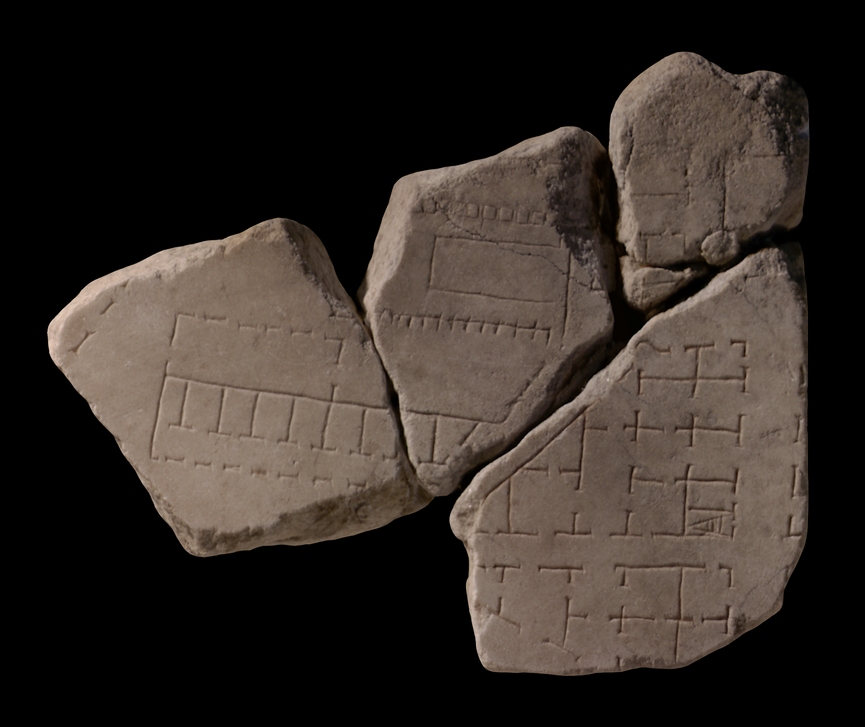
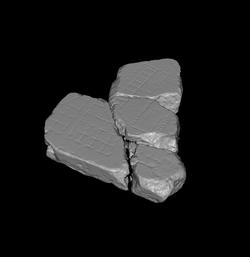
| Description Frs. c and d were part of the edge of a slab; a clamp hole is visible at the bottom of fr. d. The architecture depicted on this fragment is divided into sections of rhomboidal and trapezoidal shapes. To the far left, a short section of an arcade is visible. It lies at an oblique angle to the structure to its right, which consists of a long, horizontal row of tabernae. The entire stretch of shops is fronted by an arcade. The right side of this stretch of shops is cut off at an oblique angle, more or less parallel to the arcade in the far left side of fr. a. The left half of the shops shares the back wall with a rectagular enclosure, whose other three walls consist of arcades. A diagonal arcade continues the angle of the right end of the shops and connects with a structure that occupies most of fr. b. This structure consists of a rectangle that is flanked at the back by a straight, solid wall, on the right by a row of square columns, and on the left by a line intersected by short, perpendicular strokes. A passageway, following almost precisely the break line between frs. b and c, then b and d, separates these two structures from the three blocks or insulae that occupy the right side of the fragment group. At top right lies a group of rooms, best visible in the reconstruction drawing in PM 1960, p. 131, most of which do not seem to open onto the street. Below is situated an almost triangular section of rooms. Its left side falls at an oblique angle that follows the break between frs. b and d, and the angle of the right end of the horizontal row of shops on the left. The rooms inside this section are rectilinear and they all have at least two openings. A staircase in the bottom right room indicates that the building was multi-storeyed. This section is separated from the triangular section below by a narrow, horizontal street. Also this section consists of rectilinear, open rooms. The horizontal street that separates the top section from the middle section makes a right turn and it flanks the middle and the bottom section on the right. The face of other buildings, or perhaps a vertical arcade, is barely visible in the right edge of the fragment group.
Identification The structure that occupies most of fr. b has been identified as an incompletely engraved temple (PM 1960, p. 130). The strangely defined line below what must be considered the cella is perhaps a sloppy attempt to render a colonnade of square columns like the one that flanks the cella above. The finished temple would probably have been peripteral sine postico. The limited access to the buildings in the top right section may indicate they were of residential use primarily. The open nature of the two sections below, however, makes it difficult to imagine their function. They were probably too open to have been residential, and perhaps even commercial. Wooden partitions would, of course, not be depicted on the Plan, and it is possible that these structures served some ad hoc commercial function.
Significance The sloppy depiction of the temple in this fragment group suggests that it did not belong with the monumental, and generally well defined, architecture in the center of Rome. That the group should be located somewhere outside of the city center is further suggested by the mainly commercial and residential nature of the depicted architecture; such architecture was generally relegated to the outlying areas of the city (see for example the types of architecture found across the Tiber in the flat area of Trastevere in fragment group 524 in slab IV-7, and the riverfront structures in slabs VII-18, VI-7 and VI-9).
|
|
| HISTORY OF FRAGMENT |
| Provenience of fr. a is unknown (PM 1960, p. 131). Like the majority of FUR fragments, frs. b, c, and d were discovered in 1562 in a garden behind the Church of Saints Cosmas and Damian. From here, they were transferred to the Palazzo Farnese and stored there. They were not among the fragments that were reproduced in the Renaissance drawings that are now kept in the Vatican, but Giovanni Pietro Bellori included them in his 1673 publication. In 1742, the fragments were moved to the Capitoline Museums and exhibited with some of the other known fragments in wooden frames along the main staircase. Frs. b and c came apart when the pieces were removed from the walls of the Capitoline museum and certain details were lost which now are only visible in a photo by Moscioni; this photo is reproduced in a drawing in PM 1960, p. 131. Since then, the pieces have been stored with the other FUR fragments in various places: the storerooms of the Capitoline Museums (1903-1924), the Antiquarium Comunale (1924-1939), the Capitoline Museums again (1939-1955), the Palazzo Braschi (1955-1998), and since 1998 in the Museo della Civiltà Romana in EUR under the auspices of the Sovraintendenza ai Beni Culturali del Comune di Roma. (The history of frs. b and c corresponds to Iter E as summarized in PM 1960, p. 56.)
Text by Tina Najbjerg
|
|
| KEYWORDS
|
| temple, tabernae, arcades, apartments, staircase |
|
 Prev
Prev