| [FRAGMENT ANALYSIS IN PROGRESS]
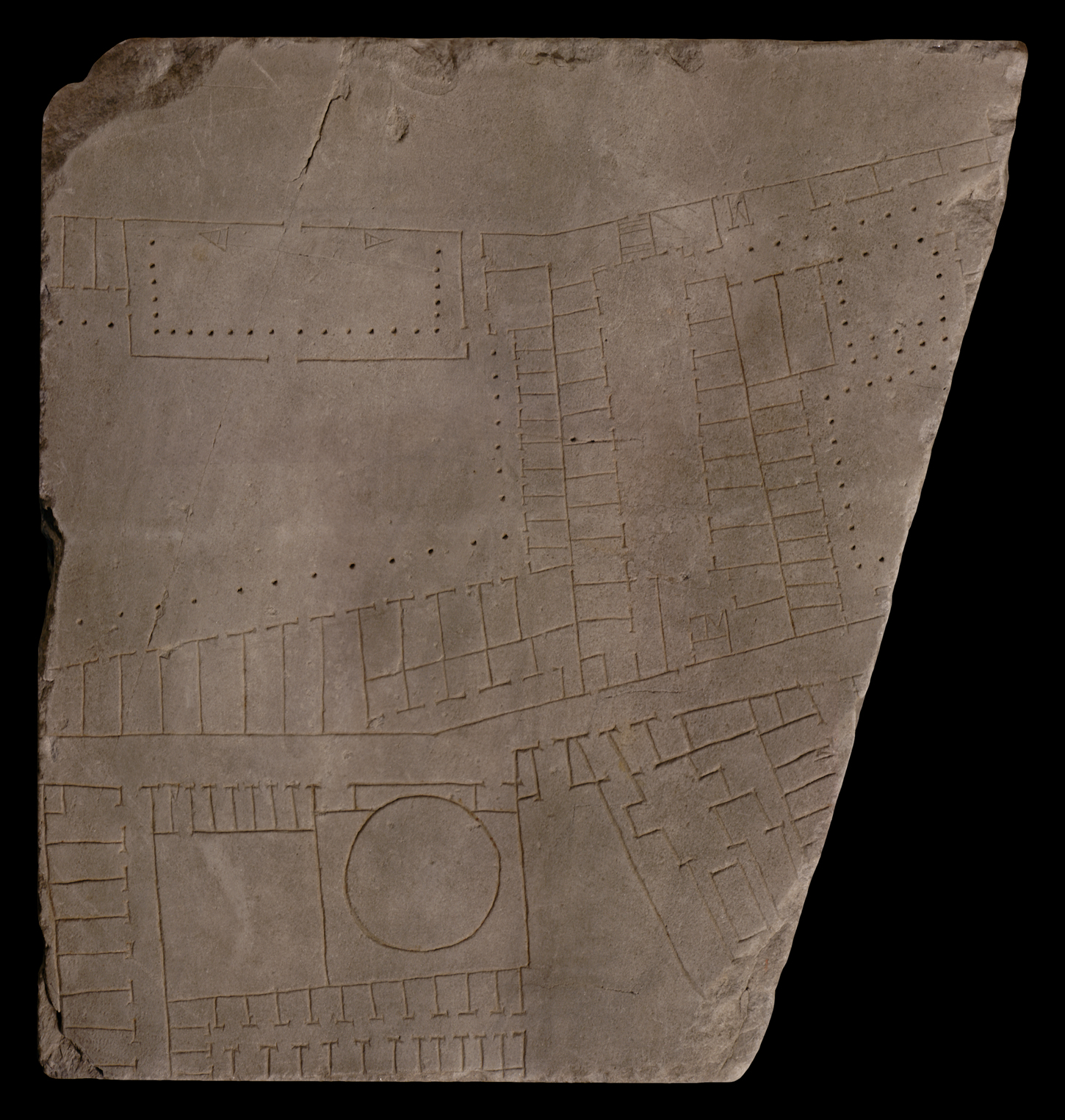
Description Fragment has three original edges on top, bottom and left side. The fragment is about one third of the complete slab VI-9#. Top edge has two clampholes, left edge has three and the lower edge has one clamphole.
Upper part of the fragment shows the Tiber river, represented by a wide open space. Alongside the river on the right bank three one-room buildings are visible opening up to a large open space that dominates the upper left part of the fragment. A row of columns runs parallel to the single-room buildings. To the right of these a large structure with a single row of columns on three sides is located. The structure has three doorways to the large open area and one opening to the Tiber directly. The structure also has two triangles on both sides of the Tiber opening, representing staircases leading down to the river (?)
Along the right side of this structure a narrow corridor or alley runs from the Tiber to the large open area, flanked on the top right by an irregular shaped structure and a square building with two doorways. The right side of the large open area is flanked by a row of rooms (workshop/storage/wharf?) with a parallel row of columns in front. The lower side of the open area also has one-room buildings which are longer and becoming shorter towards the left, continuing into fragment 150. The row on the right forms back to back one-room buildings of which the bottom ones open out to a small rectangular space, possibly a corridor or walkway. These align a road that is running left-right through the fragment, bending slightly upwards towards the right.
To the right of the large open area lies a rectangular structure, extending from the Tiber to the left-right road. The structure is formed by an open area with a row of single-rooms on the left and right side. The top is formed by two larger areas with an external staircase in the middle, leading from the river to the open area. The lower part of this structure has two larger buildings with multiple rooms and two doorways to the street. The right building also has an internal staircase.
In the top right corner a third structure is visible which also extends from the Tiber to the road and can be divided into three parts. The top consists of a row of rectangular rooms, one of which has an opening towards the Tiber. The room directly to the right has an internal staircase. A row of columns runs parallel to these rooms in a walkway or corridor. Below is the second part formed by two long rooms opening to the walkway, and a square courtyard with a row of columns on all sides and a double row on the lower side. More buildings are visible to the right of this courtyard but their layout is not distinguishable. The third part of this structure consists of another open area with colonnades on the three visible sides and a row of single rooms on the left.
In the lower part of the fragment a row of rooms is visible on the left, opening up to a corridor or alley that runs top-bottom and forms a T-crossing with the wider left-right street. Both the rooms and the alley continue on fragment 34b.
The block on the right of the alley consists of a row of tabernae along the road, one of which has a staircase and a second opening to a large rectangular space in the back. Next to it is a large square building with a large circular feature inside its walls. The top of the building has two rooms in the corner opening to the street and a square space in the middle in front of the circular feature.
The back of these two structures consists of two horizontal rows of single-rooms facing each other with a narrow alley in the middle. The lower row has another row of similar rooms back-to-back that is visible on fragment fn23.
The lower right corner of the slab has a large wedge-shaped space, tapering towards the top. Here two rooms flank the entrance from the street. To the left is another rectangular building with four rooms in the top, three of which open out to the street and two to the structures below. The lower part has a strangely shaped court area with a square feature in the back (pool, podium?), flanked by longitudinal but odd shaped spaces. What appears to be a row of one-room buildings is visible towards the right where the slab is broken.
Identification: Temple of Fors Fortuna The large round feature at the lower left is usually interpreted as a funerary monument (PM 1960, p. 88), but the surrounding buildings all appear to be public, making this an exceptional tomb. The circular feature protrudes into the front of the surrounding rectangular enclosure; this looks to the author more like a monumental temple entrance. Moreover, the location is marked; the Via Campana-Portuensis changes its course directly in front of this round structure (to return to its original course ca. 270m farther south), and on the circular structure's south side is the only visible opening into a large open space behind the street-side buildings. Coarelli suggests the circular feature is the Temple of Fors Fortuna at the first mile of the Via Campana (Coarelli 1992). In this case the square around the circular feature could be the podium and the rectangular space in front a staircase.
The Via Campana ran from the Pons Sublicus through the Transtiberim to the mouth of the river. Patterson in LTUR notes that the route was important for provisioning the city. The Via Portuensis was perhaps built in the first c AD in order to improve traffic between the new harbor of Claudius at Portus and Rome (Patterson in LTUR). Its route within the city was the same as that of the Via Campana. The road shows up on several FUR fragments: 138a and 138bcde.
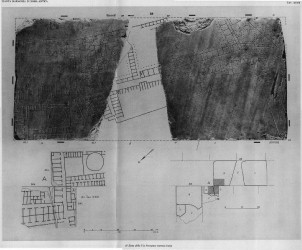
Identification: match with 150 and fn23 The boundary incision matching algorithm developed at Stanford University detected a strong match with similar aligning features on fr. 150, including the row of columns and the front wall of the row of rooms, with both of these linear features making an identical angle to the slab edges present on frs. 28a and 150 (Koller-Levoy 2005, 6). The two fragments in their proposed relative positioning are shown in fig. 12. The open space and angling row of columns depicted on fr.150 extends and perhaps marks a corner of the interior of the large open structure portrayed on the upper left quadrant of fr. 28a, lying between the River and the Via Campana-Portuensis. Further evidence confirming this match across slab boundaries is observable in the details of the incisions.
The spacing of the columns ppears uniform if we assume that one column is missing from the eroded portion in between the two fragment surfaces. The columns on both fragments are centered directly between the room openings on the fragments, and the style of the incisions appears the same. Furthermore, the thickness, veining direction, and rough back surface of fr. 150 are consistent with that expected for fragments placed in the slab to the left of fr. 28a.
Fragment fn23 is one of the fragments discovered in the 1999 Templum Pacis excavations and digitized at Stanford in 2001. Running the computer boundary incision matching algorithm resulted in a very highly scored match with fragment fr.28a (Koller-Levoy 2005, fig 2, 3). This position places the fragment in the corner formed between fragments 28a and 34b (fig. 3).
Identification: industrial space at the waterfront in Transtiberim The fragment shows industrial space and perhaps storage on the right bank of the Tiber. Harbor-activities were most likely took place here, evidenced by the direct openings to the river of the buildings on the upper part of the fragment.
Significance
A large fragment like this one is useful in studying clampholes and the actual construction of the Plan. The fragment shows the urban fabric on the right bank of the Tiber and the high degree of industrial and commercial buildings related to port activities as well as possible religious space.
|
 Prev
Prev