ID AND LOCATION
| Stanford #
| 300ab |
| AG1980 #
| 300a-b |
| PM1960 #
| 300 a b |
| Slab #
| unknown |
| Adjoins
| none |
CONDITION
| Located
| false |
| Incised
| true |
| Surviving
| true |
| Subfragments
| 2 |
| Plaster Parts
| 0 |
| Back Surface
| smooth |
| Slab Edges
| 1 |
| Clamp Holes
| 1 |
| Tassello
| no |
TECHNICAL INFO
|
|
|
|
|
|
|
|
|
|
|
| ANALYSIS
|
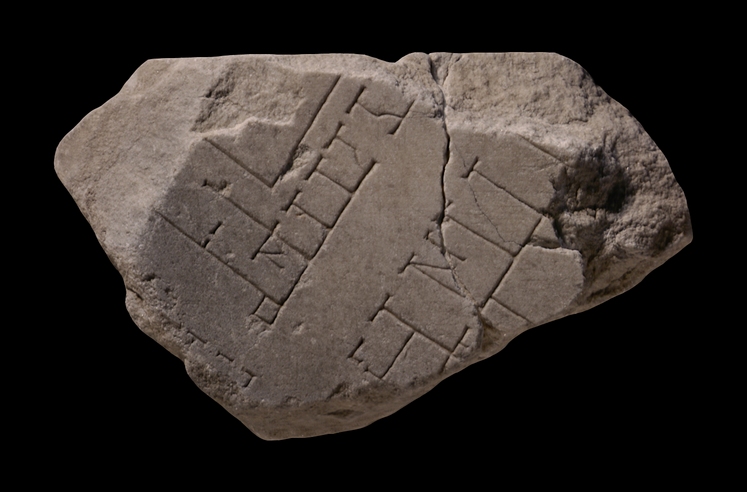
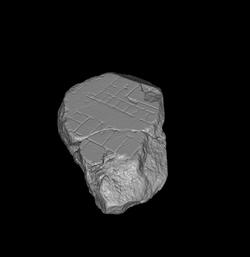
| Description The joined fragments were part of a slab edge; a clamp hole is visible on the back, right at the breaking point. Two streets intersect and divide the depicted architecture into three blocks. Of the bottom left section, only parts of an arcade are visible. The top left section consists of a row of rooms that faces away from the street and inwards towards the center of the building where the corner of a rectangle (a courtyard? a basin?) is visible. Only one of the rooms opens onto the street; its two walls are splayed out, as if depicting an arched entrance. The row of rooms is bordered on the left by a short wall behind which is a staircase. A longer line beyond the stairs defines the street and may represent a step down from a sidewalk, as opposed to a wall. It makes a corner with the front of the row of rooms. A small, square feature abuts the corner of this section. Across the street, in the right side of the fragment, a corner of another block is visible. It is faced with a row of tabernae that opens onto the street, and one of which contains a staircase to upper floors. Although the front line of this section seems to continue in the drawing in AG 1980, pl. 46, the color photo shows that it makes a turn. It thus matches the corner of the building across the street, and the intersection is between two equally wide streets. More rooms seem to line this section along the lower street. A larger room or courtyard behind these shops is visible in the far right corner.
Identification The building in the upper left seems to have limited access and may be an apartment structure or a small market. The small square in the corner may represent a street fountain or water basin (PM 1960, p. 132). The multi-storey insula in the lower right consists at least partially of shops. The rectilinear layout of the insulae in this fragment is similar to that depicted in frs. 37A and 138.
Significance This fragment is typical of non-identified fragments of the Plan. No monumental buildings are represented, and the fragment instead provides a view of the lesser known structures that made up the urban fabric of Rome: the residential and commercial buildings.
|
|
| HISTORY OF FRAGMENT |
| Like the majority of FUR fragments, these pieces were discovered in 1562 in a garden behind the Church of Saints Cosmas and Damian. From here, they were transferred to the Palazzo Farnese and stored there. The fragments were later used as building material in the 17th c. construction of the Farnese familys Giardino Segreto (Secret Garden) near the Via Giulia, and were rediscovered in 1888 or 1898 when the walls of the garden were demolished. Since then, they have been stored with the other known FUR fragments in various places: the storerooms of the Commissione Archeologica (1888/1898-1903), the Antiquarium Comunale (1924-1939), the Capitoline Museums (1939-1955), the Palazzo Braschi (1955-1998), and since 1998 in the Museo della Civiltà Romana in EUR under the auspices of the Sovraintendenza ai Beni Culturali del Comune di Roma. (The history of these fragments corresponds to Iter E" as summarized in PM 1960, p. 56.) N.B. PM 1960 does not reveal the whereabouts of the fragments between 1903 and 1924.
Text by Tina Najbjerg |
|
| KEYWORDS
|
| fountain, basin, street, intersection, tabernae, courtyard, insula |
|
 Prev
Prev