ID AND LOCATION
| Stanford #
| 306 |
| AG1980 #
| 306 |
| PM1960 #
| 306 |
| Slab #
| unknown |
| Adjoins
| none |
CONDITION
| Located
| false |
| Incised
| true |
| Surviving
| true |
| Subfragments
| 1 |
| Plaster Parts
| 0 |
| Back Surface
| smooth |
| Slab Edges
| 0 |
| Clamp Holes
| 0 |
| Tassello
| no |
TECHNICAL INFO
|
|
|
|
|
|
BIBLIOGRAPHY
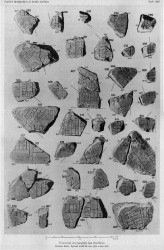
- AG 1980, pl. 46
- PM 1960, p. 133, pl. 45
- LTUR IV: Stadium Domitiani (P. Virgili), pp. 341-343
|
|
|
|
|
| ANALYSIS
|
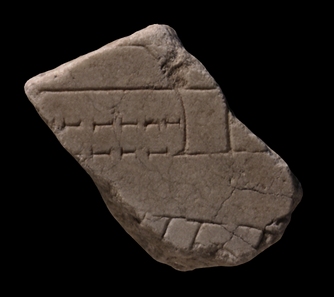
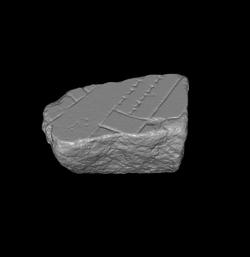
| Description A horizontal line traverses the fragment at the top. Below, and parallel to this line, lies a double arcade. Strangely, the dashes of the individual arcades do not align. On the right, the end of the arcades is marked by a rectangle whose left side is concave. The curve of the rectangle seems to continue to the top of the fragment. The rectangle itself connects with the horizontal line at top. At the bottom of the fragment, a row of rooms or T-shaped piers makes a gentle downward curve towards the right. An open space or passageway separates these from the arcades above.
Identification The rectangle with the concave side may represent an arched entrance into the area to the right which is no longer visible in this fragment. The curved line of rooms or T-shaped piers at the bottom is similar to the outside of the sphendone of the Circus Maximus, seen for example in frs. 7abcd and 7e. While this fragment cannot fit into the missing sections of the Circus Maximus, it may, however, depict the sphendone of some other entertainment building in Rome, such as the Stadium of Domitian (stadium Domitiani) in the Campus Martius, which, thus far, has not been identified in any FUR fragment. Domitian's stadium would have had the same shape as the Circus Maximus and would have been rendered on the Marble Plan similarly to the Circus, and probably also to the Flavian amphitheater whose architecture it supposedly resembled (LTUR IV, pp. 341-342).
Significance If this fragment indeed represents a section of Domitian's stadium, it would be the first FUR fragment to be recognized as belonging to this building. The fragment seems in any event to belong to an area with somewhat monumental architecture, perhaps close to the center of the city. |
|
| HISTORY OF FRAGMENT |
| Like the majority of FUR fragments, this piece was discovered in 1562 in a garden behind the Church of Saints Cosmas and Damian. From here, it was transferred to the Palazzo Farnese and stored there. It was not among the fragments that were reproduced in the Renaissance drawings that are now kept in the Vatican, but Giovanni Pietro Bellori included it in his 1673 publication. In 1742, the fragment was moved to the Capitoline Museums and exhibited with some of the other known fragments in wooden frames along the main staircase. Since then, it has been stored with the other FUR fragments in various places: the storerooms of the Capitoline Museums (1903-1924), the Antiquarium Comunale (1924-1939), the Capitoline Museums again (1939-1955), the Palazzo Braschi (1955-1998), and since 1998 in the Museo della Civiltà Romana in EUR under the auspices of the Sovraintendenza ai Beni Culturali del Comune di Roma. (This fragments history corresponds to Iter E as summarized in PM 1960, p. 56.)
Text by Tina Najbjerg |
|
| KEYWORDS
|
| arcades, arch, sphendone, curved architecture |
|
 Prev
Prev