ID AND LOCATION
| Stanford #
| 307ab |
| AG1980 #
| 307a-b |
| PM1960 #
| 307 a b |
| Slab #
| III-12 |
| Adjoins
| none |
CONDITION
| Located
| false |
| Incised
| true |
| Surviving
| true |
| Subfragments
| 2 |
| Plaster Parts
| 0 |
| Back Surface
| smooth |
| Slab Edges
| 1 |
| Clamp Holes
| 0 |
| Tassello
| no |
TECHNICAL INFO
|
|
|
|
|
|
|
|
|
|
|
| ANALYSIS
|
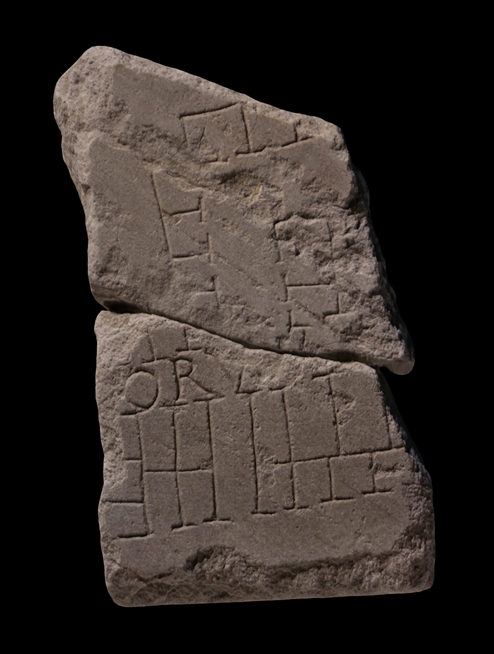
| Description The bottom subfragment (307b) was part of a slab edge. The surface of the fragment group exhibits corrosion along the direction of the marble veining. A horizontal street separates the depicted architecture in two sections. The street is labeled: the letters ORVM are visible (PM 1960, p. 133). Below the partial inscription are two horizontal rows of back-to-back tabernae. They are separated into two groups by a vertical passageway in the center. The shops facing the bottom diminish in size towards the right. Above the labeled street lies a rectangular courtyard which is surrounded by inward-facing rooms on the sides and at top. The room at the top contains a staircase.
Identification Back-to-back tabernae like those on this fragment are ubiquitous on the Plan, and the type depicted here is of the most common type seen on the FUR. Each shop consisted of a single room with a wide opening towards the street that could be screened off at night. The owners probably resided with their families on a wooden platform in the back of the shop, although shops located in large, commercial areas by the Tiber perhaps were solely for commercial use. The building at top with the inward-facing rooms fits R. A. Staccioli's criteria for warehouses or horrea. According to his typology, a horreum of Type 1 consists of a simple rectangular building with two rows of rooms facing a central corridor. A wall generally encloses the building on three sides, with only a narrow opening at one end (Staccioli 1962). The warehouse in this fragment has a room at top with a staircase that leads to a second story. That warehouses could be multi-storied is demonstrated by the horreum in fr. 92.
E. Rodríguez-Almeida has suggested that this fragment belongs in slab III-12 along with other fragments that show similar characteristics, such as marble color and condition, thickness, veining, and style of engraving (Rodríguez-Almeida 2000). However, if the inscription text is assumed to have been rendered upright, then the marble veining direction is not at all consistent with other fragments placed in slab III-12. An alternative hypothesis places fr. 307 nearby but along the bottom edge of slab IV-6 (Koller-Levoy 2005).
Significance This fragment is typical of non-identified fragments of the Plan. No monumental buildings are represented, and the fragment instead provides a view of the lesser known structures that made up the urban fabric of Rome: the residential and commercial buildings.
|
|
| HISTORY OF FRAGMENT |
| Like the majority of FUR fragments, these pieces were discovered in 1562 in a garden behind the Church of Saints Cosmas and Damian. From here, they were transferred to the Palazzo Farnese and stored there. Renaissance engravers reproduced fr. b in 16th c. drawings that are now kept in the Vatican (Vat. Lat. 3439), and Giovanni Pietro Bellori included it in his 1673 publication. Boths fragments were later used as building material in the 17th c. construction of the Farnese familys Giardino Segreto (Secret Garden) near the Via Giulia, and were rediscovered in 1888 or 1898 when the walls of the garden were demolished. Since then, they have been stored with the other known FUR fragments in various places: the storerooms of the Commissione Archeologica (1888/1898-1903), the Antiquarium Comunale (1924-1939), the Capitoline Museums (1939-1955), the Palazzo Braschi (1955-1998), and since 1998 in the Museo della Civiltà Romana in EUR under the auspices of the Sovraintendenza ai Beni Culturali del Comune di Roma. (These fragments' history corresponds to Iter E" and C' as summarized in PM 1960, p. 56.)
Text by Tina Najbjerg and David Koller
|
|
| KEYWORDS
|
| warehouse, horrea, street, inscription, tabernae, stairs |
|
 Prev
Prev