ID AND LOCATION
| Stanford #
| 30abc |
| AG1980 #
| 30a-c |
| PM1960 #
| 39 a b; 634 |
| Slab #
| V-11 |
| Adjoins
| 30def |
CONDITION
| Located
| true |
| Incised
| true |
| Surviving
| true |
| Subfragments
| 3 |
| Plaster Parts
| 0 |
| Back Surface
| smooth |
| Slab Edges
| 1 |
| Clamp Holes
| 0 |
| Tassello
| no |
TECHNICAL INFO
|
|
|
|
|
|
BIBLIOGRAPHY
- AG 1980, p. 111, pls. 22, 23, 58
- Gatti 1960
- Gatti 1961
- Gatti 1979
- LTUR I: Crypta Balbi (D. Manacorda), pp. 326-29
- LTUR V: Theatrum Balbi (D. Manacorda), pp. 30-31
- PM 1960, pp. 106, 153, pls. 10, 32, 57
- Richardson 1992, p. 101 (Crypta Balbi), pp. 381-82 (Theatrum Balbi)
- Rodríguez-Almeida 1991-92
|
|
|
|
|
| ANALYSIS
|
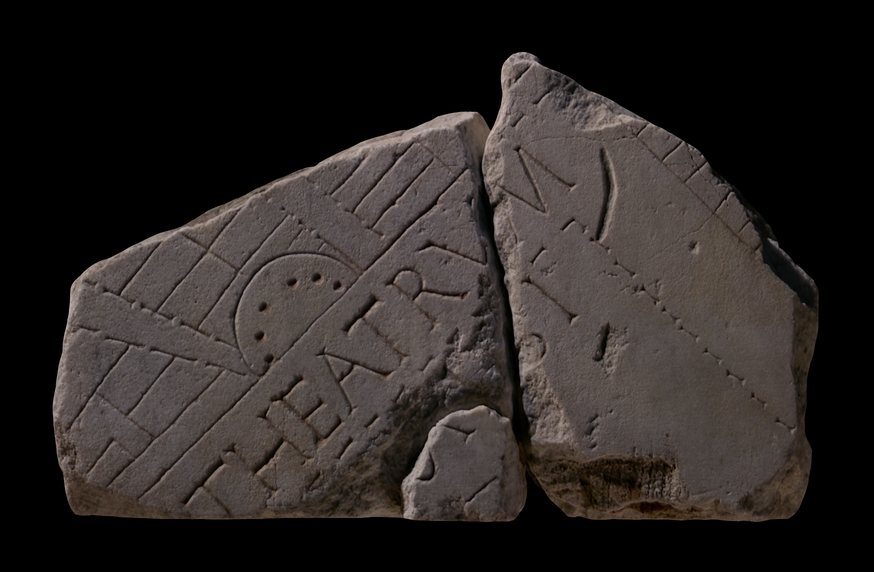
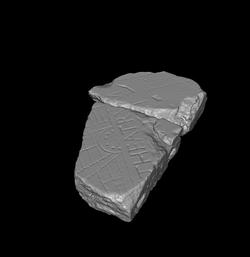
| Description The fragments depict the upper right joint of two covered arcades or porticoes. The letters THEATRUM are inscribed in the horizontal portico, while additional letters, [-]A*[-]B*I, are placed below in the area of the open courtyard. A short, horizontal line crosses the tip of fr. 30b. A semicircular exedra with six internal columns abuts the back wall of the portico at top. Above, three vertical streets are cut abruptly by the wall of the portico. Rows of elongated rooms occupy the spaces between these streets. Additional rooms flank the building on the right. The back wall of the portico in the upper right corner is pierced by openings, thus providing access to the structure from the outside.
Identification: Theatrum, crypta Balbi The partially visible porticus in these fragments represents a corner of the crypta Balbi, the porticoed courtyard extension of the Theater of Balbus (PM 1960, p. 106). One of Rome's three permanent theaters, the theatrum Balbi was constructed by L. Cornelius Balbus and inaugurated in 13 BCE (LTUR V, p. 30). In a series of brilliant articles in the 1960s and 70s, G. Gatti proposed to relocate the theater from its assumed location on the Monte Cenci to a spot just south of the Via delle Botteghe Oscure (Gatti 1960, 1961 and 1979). The joining of this fragment to frs. 30def and the matching of their architecture to that depicted in fr. 35dd allowed Gatti to reposition this fragment to the lower right corner of slab V-11 (LTUR I, fig. 156). This in turn enabled him to associate the theatrum and crypta Balbi complex with actual remains between the Via delle Botteghe Oscure and the Piazza Mattei, formerly assumed to be those of the Circus Flaminius. Remains of the semicircular exedra and internal columns visible in this fragment were discovered behind the church of S. Caterina dei Funari; walls of tufa and travertine along Via delle Botteghe Oscure and Via dei Delfini corresponded exactly with the N and S walls of the crypta in this fragment and in fr. 35dd; and brick walls southeast of the exedra matched walls delineated in this spot in this fragment (see Gatti 1979, fig. 10). Although the theater itself is not depicted on the FUR, Gatti reconstructed its position just west of the crypta, between Via Caetani and Via Paganica, where remains of the cunei of the cavea had been discovered (Gatti 1979, pp. 206-218; LTUR V, figs. 17-18). Although the name of the crypta Balbi is only known from the 4th-c. Regionary Catalogues, the building can now be tentatively reconstructed as a square courtyard that was surrounded on three sides by enclosed walkways and attached to the back (E side) of the theater. What made the structure a crypta as opposed to a porticus must have been the fact that the walkways were arcaded (as shown in this fragment) rather than colonnaded (LTUR I, p. 328). Not shown in the FUR fragments are a rectangular niche in the wall of the semicircular exedra (see reconstruction of exedra in LTUR I, fig. 193) and niches in the N wall, both revealed through excavations. The line that crosses the tip of fr. 30b is the E edge of a still unexplored monument that stood in the center of the interior courtyard. It has been identified by some as the republican aedes Vulcani or the temple to Fortuna Equestris (Rodríguez-Almeida 1991-92), both of which preceded the construction of the theater, but the precise centrality of the monument within the crypta indicates rather that it was contemporary with the construction of the theater complex (LTUR I, p. 327 with references).
Significance The edge of these fragments and the orientation of the inscription provided Gatti with the initial clue that the fragment cluster did not belong in slab V-13 but in slab V-11. They were thus key to locating the Theater and Crypta of Balbus in their correct position between the Via delle Botteghe Oscure, the Piazza Mattei, and the Via dei Delfini. These fragments are also our main source of knowledge about the building's architecture. |
|
| HISTORY OF FRAGMENT |
| Frs. 30a and b were discovered along with the majority of fragments in 1562 behind the Church of Saints Cosmas and Damian. From here, they were transferred to the Palazzo Farnese and stored there. Renaissance engravers reproduced fr. 30a in 16th-c. drawings that are now kept in the Vatican (Cod. Vat. Lat. 3439), and Giovanni Pietro Bellori included it in his 1673 publication of the Plan. In 1742, it was moved to the Capitoline Museums and exhibited with some of the other known fragments in wooden frames along the main staircase.
After its initial discovery, fr. 30b was reused as building material in a 17th-c. Farnese construction, the "Secret Garden," and it was rediscovered in 1888 or 1899 when the walls of the garden near the Via Giulia were demolished. In 1903, museum curators joined the piece with fr. 30a (and with fr. 419, which is now known to be incorrect) in a reconstruction of the FUR mounted on a wall behind the Palazzo dei Conservatori (1903-1924).
Fr. 30c was discovered during excavations in the aula of the Forum Pacis in 1891 (PM 1960, pp. 28, 153), and it was kept in the storerooms of the Commissione Archeologica until 1903, and then in the Capitoline Museums until 1924.
Since 1924, the three fragments have been stored together with other known FUR fragments in various places: The Antiquarium Comunale (1924-1939), the Capitoline Museums again (1939-1955), the Palazzo Braschi (1955-1998), and since 1998 in the Museo della Civiltà Romana in EUR under the auspices of the Sovraintendenza ai Beni Culturali del Comune di Roma (The history of fragments 30a and 30c corresponds to Iter A and G as summarized in PM 1960, p. 56, while the history of fr. 30b is recounted on p. 106).
Text by Tina Najbjerg |
|
| KEYWORDS
|
| theater, cryptoporticus, courtyard, portico, cavea, exedra, niche, |
|
 Prev
Prev