ID AND LOCATION
| Stanford #
| 317 |
| AG1980 #
| 317 |
| PM1960 #
| 317 |
| Slab #
| unknown |
| Adjoins
| none |
CONDITION
| Located
| false |
| Incised
| true |
| Surviving
| true |
| Subfragments
| 1 |
| Plaster Parts
| 0 |
| Back Surface
| smooth |
| Slab Edges
| 0 |
| Clamp Holes
| 0 |
| Tassello
| no |
TECHNICAL INFO
|
|
|
|
|
|
|
|
|
|
|
| ANALYSIS
|
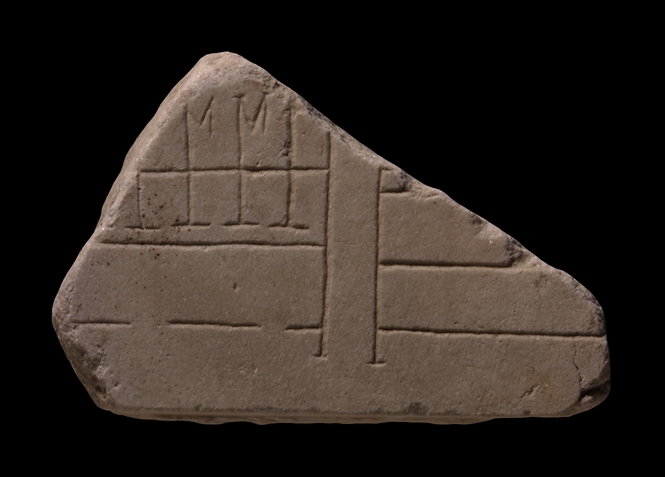
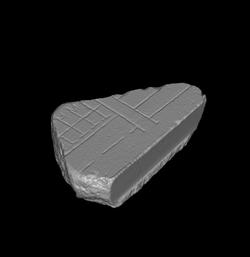
| Description A series of straight, parallel lines traverse the fragment. They are cut through at the center by a wide, perpendicular passageway. On either side of the passageway, only the bottom lines align with each other. The bottom left line consists of long dashes as opposed to a solid line. On the left, a row of rooms is placed between the first and second horizontal lines from the top. The rooms face downwards. Right above them lies another series of rooms; these all contain a staircase.
Identification The rendering of the vertical passageway, with the two ends emerging at the bottom, suggests that it cut through the surrounding architecture and was on a different level, probably lower. That the surrounding architecture was on sloping high ground is further suggested by the stairs at top left. The bottom part of the fragment was sawed off in the 18th c., suggesting it must have depicted a large, blank space. On the Plan, large blank spaces can refer to any area of the city devoid of human construction, such as the Tiber river, courtyards, large basins, precincts, gardens, etc. The ramp or passageway, then, provided access to this open space by cutting through the sloping architecture that surrounded or flanked the open space. If the open space represented the river, the ramp would have provided boat access to and from the river. A similar ramp is seen in fr. 32g. Although the edges of the Tiber are generally not represented on the Plan, one exception can be seen in fr. 348 (recently identified as a Tiber fragment by D. Koller) in which the river edge is rendered with both a straight dashed and a straight solid line around the stepped access ramp. Another option is that the fragment depicted the edge of a large entertainment monument with sloped seating. The horizontal lines follow the conventional way of rendering sloped seating areas on the Plan; see for example the straight, long sides of the Circus Maximus in fr. 8c where each line represents the praecinctiones that separated the seating sections. Might this fragment represent a section of one of the large entertainment structures with straight sides, still not identified on the FUR, such as the Circus Flaminius (only a wall of this building is known from frs. 31u, 31ii, and 31cc) or the stadium Domitiani? Why the presumed praecinctiones in this case do not align, and why the bottom left line is dashed cannot be explained.
Significance Locating and identifying this large fragment, which may belong either to the Tiber or one of Rome's great entertainment monuments, would be a great gain.
|
|
| HISTORY OF FRAGMENT |
| Like the majority of FUR fragments, this piece was discovered in 1562 in a garden behind the Church of Saints Cosmas and Damian. From here, it was transferred to the Palazzo Farnese and stored there. It was not among the fragments that were reproduced in the Renaissance drawings that are now kept in the Vatican, but Giovanni Pietro Bellori included it in his 1673 publication. In 1742, the fragment was moved to the Capitoline Museums and exhibited with some of the other known fragments in wooden frames along the main staircase. For this reconstruction, a large, blank section of the fragment was cut off to fit it into the frames (PM 1960, p. 27). Since then, it has been stored with the other FUR fragments in various places: the storerooms of the Capitoline Museums (1903-1924), the Antiquarium Comunale (1924-1939), the Capitoline Museums again (1939-1955), the Palazzo Braschi (1955-1998), and since 1998 in the Museo della Civiltà Romana in EUR under the auspices of the Sovraintendenza ai Beni Culturali del Comune di Roma. (This fragments history corresp
onds to Iter E as summarized in PM 1960, p. 56.)
Text by Tina Najbjerg
|
|
| KEYWORDS
|
| ramp, passageway, tabernae, stairs |
|
 Prev
Prev