ID AND LOCATION
| Stanford #
| 319 |
| AG1980 #
| 319 |
| PM1960 #
| 319 |
| Slab #
| unknown |
| Adjoins
| none |
CONDITION
| Located
| false |
| Incised
| true |
| Surviving
| true |
| Subfragments
| 1 |
| Plaster Parts
| 0 |
| Back Surface
| smooth |
| Slab Edges
| 1 |
| Clamp Holes
| 0 |
| Tassello
| no |
TECHNICAL INFO
|
|
|
|
|
|
|
|
|
|
|
| ANALYSIS
|
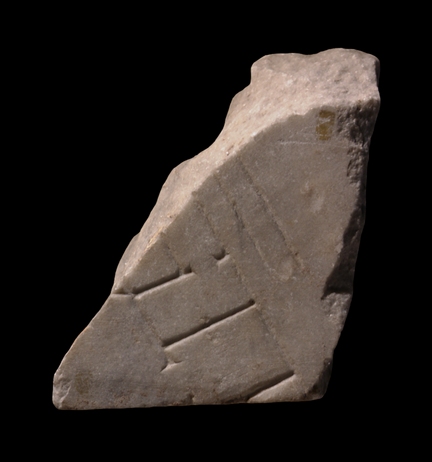
| Description The fragment was part of a slab edge. A series of three or four rooms share a common back wall on the right. One room is completely open to the left; the room above it is entirely closed except for a small opening into the fourth room at the top. To the right of the common back wall, and parallel to it, lie to parallel lines that end abruptly in mid-space. One is slightly longer than the other.
Identification Discovering the nature and function of these rooms is practically impossible. What purpose the two parallel lines to the right served is equally uncertain. The lines are finely engraved with distinct serifs, suggesting that the fragment belonged to an area of the Plan where a skilled engraver was at work, perhaps near the monumental center of Rome.
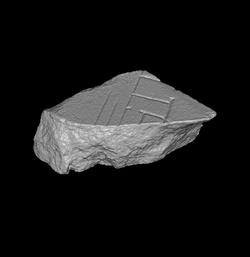
Significance 3D digital matching may allow us to join this fragment to already identified and located areas on the Plan and thus help us discover the nature of the depicted architecture.
|
|
| HISTORY OF FRAGMENT |
| The fragment was discovered in 1891 during excavation of the aula of the Forum Pacis (PM 1960, p. 133). Since then, it has been stored with the other known FUR fragments in various places: the storerooms of the Commissione Archeologica (until 1903), the Capitoline Museums (1903-1924), the Antiquarium Comunale (1924-1939), the Capitoline Museums again (1939-1955), the Palazzo Braschi (1955-1998), and since 1998 in the Museo della Civiltà Romana in EUR under the auspices of the Sovraintendenza ai Beni Culturali del Comune di Roma. (This fragments history corresponds to Iter G as summarized in PM 1960, p. 56.)
Text by Tina Najbjerg
|
|
| KEYWORDS
|
| rooms, parallel double lines |
|
 Prev
Prev