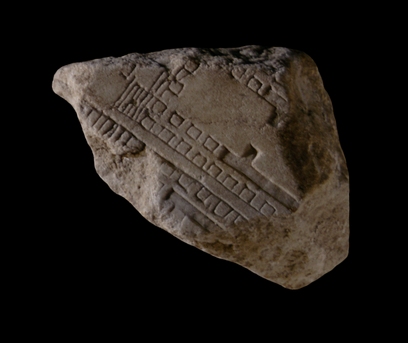
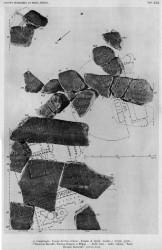
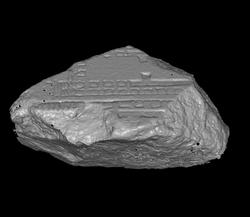
| Description The fragment depicts part of two podium temples side by side. Of the less well-preserved temple, bottom left, part of the pronaos, which is three columns deep, a corner of the cella, seven of the lateral columns, and at least six steps of the frontal staircase are visible. The pronaos of the better-preserved temple (top right) is four columns deep. The temple was hexastyle and had at least eight columns along the sides. There is a platform(?) at the center of the frontal staircase and an altar in front. The columns of both temples are rendered with squares and the walls of the cellae with recessed double lines--a technique employed for most temples on the Marble Plan.
Identification: Forum Holitorium The fragment depicts the two northernmost temples in a row of three that stood in the Forum Holitorium, Rome's vegetable market (PM 1960, p. 91). The Forum Holitorium was originally bordered on the northeast by structures at the foot of the Capitoline Hill, on the north by the Temples of Bellona and Apollo, on the south/southwest by the Tiber, and on the southeast by the Forum Boarium (LTUR II, p. 299; Richardson 1992, p. 165). According to ancient sources, it contained four temples in its center: that of Ianus, of Spes, of Iuno Sospita, and of Pietas (LTUR II, p. 299; Richardson 1992, p. 165). Toward the end of the Republic, new buildings slowly encroached upon the area of the Forum Holitorium and with the construction of the Theater of Marcellus, the Temple of Pietas was demolished (LTUR II, p. 299). Parts of the three remaining temples are visible today, as they were incorporated into the church of S. Nicola in Carcere (see LTUR II, figs. 127-128).
Identification: Ades Iani The temple to the left on this fragment is the northernmost of the three buildings; part of its N wall is visible in fr. 31il. It is believed to be the Temple of Ianus, constructed in 260 BCE by C. Duilius (LTUR III, p. 90. Richardson 1992, pp. 217-218, suggests it is the Temple of Iuno Sospita). It was destroyed by fire and reconstructed several times. As indicated by this fragment, the temple was peripteral sine postico, hexastyle, with nine columns on the flanks, and three in two rows in the pronaos.
Identification: Aedes Iunonis Sospitae The temple to the right on this fragment, and the central one of the three temples in the Forum Holitorium, has been identified as the Temple of Iuno Sospita, built by C. Cornelius Cethegus, consul of 160 BCE, and reconstructed in 90 BCE by the consul L. Iulius Caesar (LTUR III, p. 129). The temple was peripteral pycnostyle, with six columns in front and back and eleven columns along the sides. As demonstrated by this fragment, a row of four columns flanked the pronaos (LTUR III, p. 129).
Significance Together with fr. 31il, this fragment confirms the ground plan of two of the partially preserved temples in the Forum Holitorium and their location in relation to the Theater of Marcellus. This fragment also vividly demonstrates the way in which most temples were highlighted on the Plan. The outlined and distinctly recessed cella walls and the squares rather than dots used to depict the columns would have been filled with minium (red paint); they would have stood out from the Plan's vast surface of thin red lines--an integral part of the monument's overall effect. |
 Prev
Prev