[In progress]
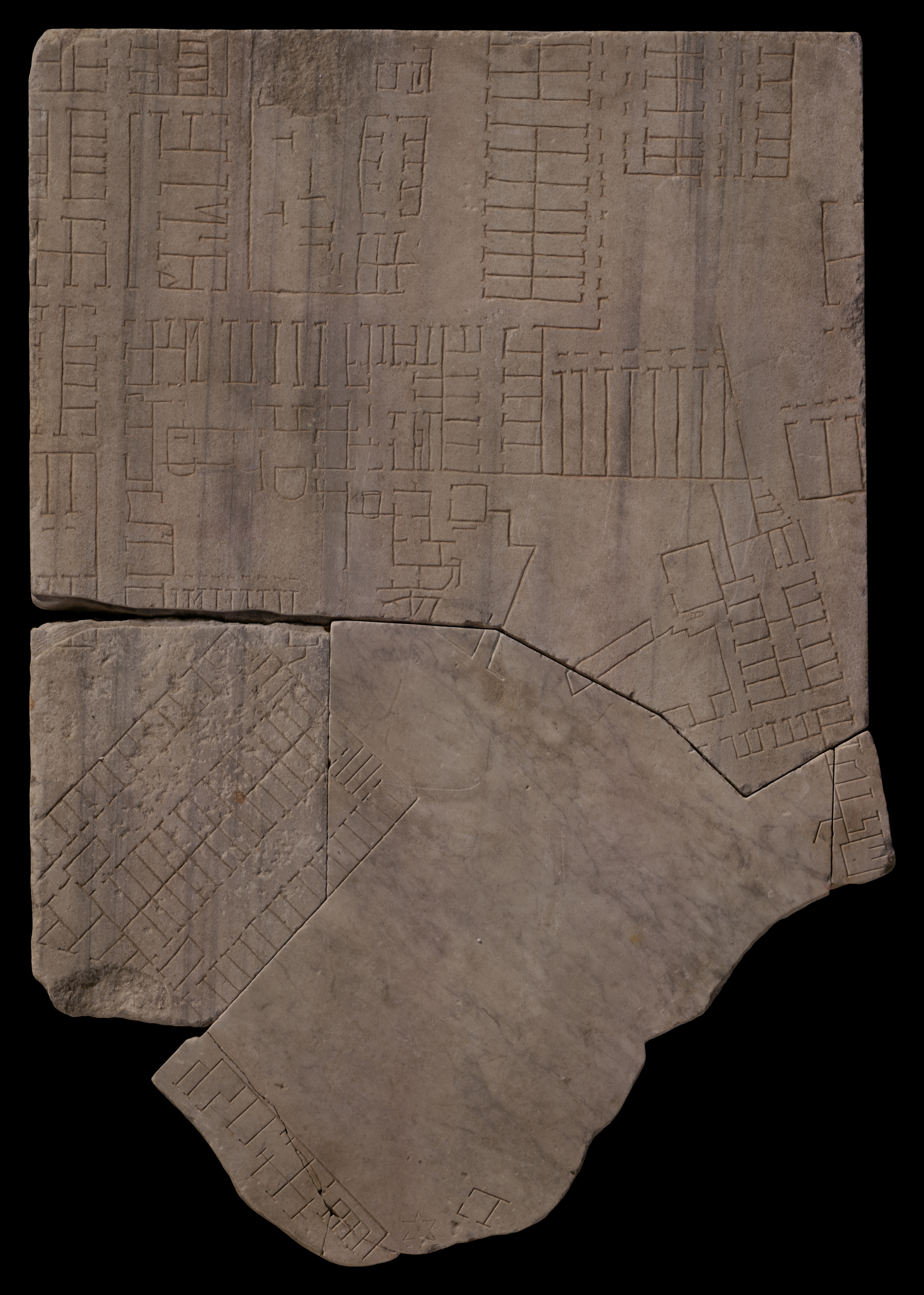
Identification: Naumachia Transtiberina The great open space covering frs. 28b, 28c, 33abc and 34c was identified in 1942 as the Naumachia Transtiberina of Augustus. This was not accepted by PM 1960. Coarelli has argued more recently that other proposed locations for this Naumachia simply aren't extensive enough, while here are both sufficient space and the arrival of the Aqua Alsietina, built for the Naumachia. Indeed, the deviation of the Via Campana here and farther to the south may be linked to the construction of the Naumachia, which needed all available space. The Naumachia's northern edge is clearly visible at the middle right edge of group 33, giving a total length of ca. 540m, a good correspondence to the 533m reported in the Res Gestae 12.23. To the north, visible on this fragment, a warehouse intrudes into the area of the Naumachia and should therefore postdate it, meaning that the Plan offers precious evidence of the state of the Naumachia in the Severan period.
Identification: Barracks of the Castra Ravennatium? The building aligned N-S at middle left of fragment group 33,
with a double courtyard, each one surrounded by
tabernae, was interpreted by E. Rodríguez-Almeida as an ergastulum or barracks rather than a warehouse
(AG 1980, pp. 119-120). Coarelli estimates that it housed 600-1000 people; given its location, orientation, and apparent early date (1st c. CE), he suggests that this was functionally linked to the Naumachia, and may have housed the Castra Ravennatium, who were known to be in Trastevere and connected to the complex. The double courtyard perhaps suggests that two cohorts were present; after the abandonment of the Naumachia (ca. 80 CE?), they seem to have functioned as the local port and river police. |
 Prev
Prev