ID AND LOCATION
| Stanford #
| 35ff |
| AG1980 #
| 35ff |
| PM1960 #
| 322 |
| Slab #
| IV-5 |
| Adjoins
| 35ee |
CONDITION
| Located
| true |
| Incised
| true |
| Surviving
| true |
| Subfragments
| 1 |
| Plaster Parts
| 0 |
| Back Surface
| smooth |
| Slab Edges
| 1 |
| Clamp Holes
| 1 |
| Tassello
| no |
TECHNICAL INFO
|
|
|
|
|
|
BIBLIOGRAPHY
- AG 1980, p. 122, pl. 26
- Coarelli 1997, pp. 296-345
- Cozza 1968
- LTUR IV: Porticus Minucia Frumentaria (D. Manacorda), pp. 132-137, fig. 51; Porticus Minucia Vetus (F. Coarelli) pp. 137-38
- PM 1960, p. 134, pl. 45
- Richardson 1992, pp. 315-16 (Porticus Minucia Frumentaria), p. 316 (Porticus Minucia Vetus), fig. 69
|
|
|
|
|
| ANALYSIS
|
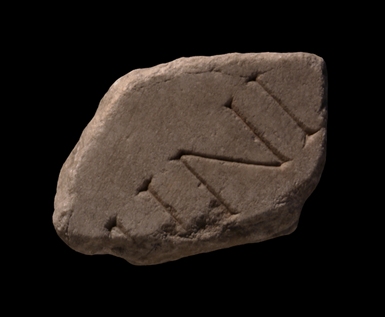
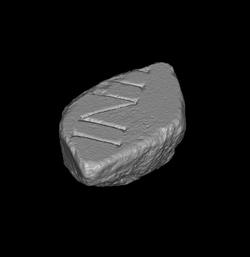
| Description The only incisions visible on this small fragment are two incomplete letters, probably MI, followed by the letters NI. The piece was part of a slab edge; a clamp hole can be seen along the edge.
Identification: Porticus Minucia In 1968, L. Cozza identified this fragment as being part of the inscription that labeled the Porticus Minucia or Minicia (Cozza 1968). This great porticus, remains of which have been excavated underneath the Via delle Botteghe Oscure, was bordered by the Diribitorium and the Saepta Iulia to the north, by the Republican temples in the Largo Argentina to the west, and to the south, by the Theater and Cryptoporticus of Balbus. The porticus consisted of an open space that was surrounded, probably on all four sides, by double colonnades. As visible in fr. 35dd, small tristyle bays projected forth from the innermost colonnade, probably in each corner of the quadriporticus (see reconstruction in LTUR IV, fig. 51 or Richardson 1992, fig. 69). Part of its W wall is visible in fr. 37c. Cozza was also able to join this fragment to fr. 35ee, thus demonstrating that a podium temple was situated within the porticus.
Cozza's identification of the quadriporticus under the Via delle Botteghe Oscure as the porticus Minucia has not solved all the problems of this enigmatic building, however. While most ancient sources refer to the porticus Minucia as a single structure, the Regionary Catalogues lists two buildings by the name of Porticus Minucia in Regio IX: The porticus Minucia Vetus and the porticus Minucia Frumentaria (LTUR IV, p. 137). The Porticus Minucia Vetus, which enclosed the Temple to the Lares Permarini and contained a statue of Hercules, was dedicated by M. Minucius Rufus, consul in 110 BCE, and completed in 100 BCE. It was repaired by Domitian, probably after the fire in 80 CE (LTUR IV, p. 137). The Porticus Minucia Frumentaria was a center for grain distribution, probably built in the Claudian period, and it is known to have had 44 ostia, or openings (LTUR IV, p. 134). Scholars are still disputing whether to identify the porticus under the Via delle Botteghe Oscure as the Porticus Minucia Vetus or the Frumentaria. Stressing that there must have been two structures situated next to each other (one perhaps being an extension of the other), some scholars associate the porticus that surrounds the Republican temples in the Largo Argentina with the Porticus Minucia Vetus; they suggest that Temple D in the Largo Argentina is the Temple to the Lares Permarini; and they identify the quadriporticus underneath the Via delle Botteghe Oscure with the Porticus Minucia Frumentaria and the temple inside it with the Temple to the Nymphs (LTUR IV, p. 132 with references; AG 1980, p. 122; Coarelli 1997). Others follow Cozza's lead and associate the Botteghe Oscure porticus with the Porticus Minucia Vetus and the temple in its center with that of the Lares Permarini (LTUR IV, pp. 132-33, with references). Emphasizing the utilitarian nature of the Frumentaria with its 44 ostia, they disassociate this building with the two traditional porticus-type buildings in the Largo Argentina and under the Via delle Botteghe Oscure, and situate it elsewhere in Rome.
Significance This fragment was key to Cozza's identification and location of the Porticus Minucia between the Diribitorium and the Theater and Crypta Balbi. |
|
| HISTORY OF FRAGMENT |
| Like the majority of FUR fragments, this piece was discovered in 1562 in a garden behind the Church of Saints Cosmas and Damian. From here, it was transferred to the Palazzo Farnese and stored there. It was not among the fragments that were reproduced in the Renaissance drawings that are now kept in the Vatican, but Giovanni Pietro Bellori included it in his 1673 publication. In 1742, the fragment was moved to the Capitoline Museums and exhibited with some of the other known fragments in wooden frames along the main staircase. Since then, it has been stored with the other FUR fragments in various places: the storerooms of the Capitoline Museums (1903-1924), the Antiquarium Comunale (1924-1939), the Capitoline Museums again (1939-1955), the Palazzo Braschi (1955-1998), and since 1998 in the Museo della Civiltà Romana in EUR under the auspices of the Sovraintendenza ai Beni Culturali del Comune di Roma. (This fragment's history corresponds to Iter E' as summarized in PM 1960, p. 56.)
Text by Tina Najbjerg |
|
| KEYWORDS
|
| porticus, ostia, openings, grain distribution |
|
 Prev
Prev