ID AND LOCATION
| Stanford #
| 363 |
| AG1980 #
| 363 |
| PM1960 #
| 363 |
| Slab #
| unknown |
| Adjoins
| none |
CONDITION
| Located
| false |
| Incised
| true |
| Surviving
| true |
| Subfragments
| 1 |
| Plaster Parts
| 0 |
| Back Surface
| smooth |
| Slab Edges
| 0 |
| Clamp Holes
| 0 |
| Tassello
| yes |
TECHNICAL INFO
|
|
|
|
|
|
|
|
|
|
|
| ANALYSIS
|
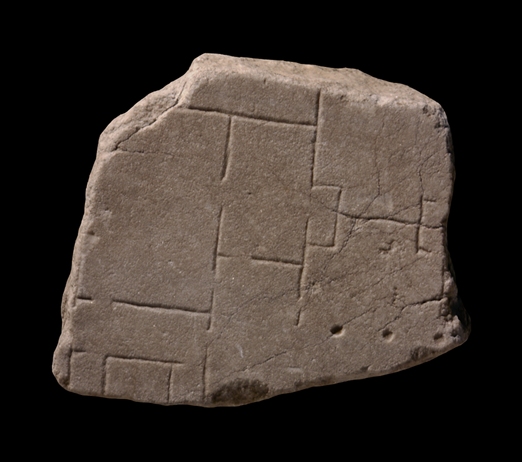
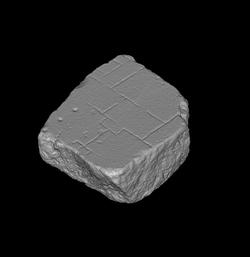
| Description The fragment depicts a series of seven large rooms in a rectilinear layout. Except for the two rooms at top, all rooms seem to interconnect. The large room in the bottom left corner features a rectangular structure in the center. The room on the right contains a horizontal colonnade, of which three columns are visible.
Identification The large size and interconnectedness of the rooms suggest they belonged to the same building. Although it could represent a single-family house, a domus, the somewhat unusual layout of rooms is closer to the architecture seen in the large imperial baths on the Map. As the central architecture of the Baths of Titus and of Trajan is rendered with double, recessed lines (see for example frs. 10wzy and 110), this fragment probably does not belong to one of them, unless it depicts a section of the outlying sections of these buildings. It compares well, however, with the Baths of Agrippa in fr. 38. The colonnade in this fragment consists of one straight line of columns, seemingly flanking one side of a large space or entrance hall. As such, it is different from the rows of columns that line all four sides of a peristyle in private houses. If this building is indeed a bath building, the rectangle in the bottom left corner may be a large water basin or pool. In 1914, C. Hülsen identified this fragment as belonging to the upper peristyle of the Domus Augustana on the Palatine Hill (Hülsen 1914, p. 112, pls. 2-3); his thesis was later proven incorrect when the area in question was unearthed (PM 1960, pp. 77-78).
Significance Matching this fragment to one of Rome's great, monumental bath structures would be an significant gain. |
|
| HISTORY OF FRAGMENT |
| The provenance of this piece is unknown. In 1742, it was exhibited with some of the other known fragments in wooden frames along the main staircase of the Capitoline museums (PM 1960, 136), so it was probably discovered in the 16th c. behind the Church of Saints Cosmas and Damian like the majority of the FUR fragments. Presumably, the fragment has been stored with the other known FUR fragments in various places since the beginning of the 20th c.: In the storerooms of the Antiquarium Comunale (1924-1939), the Capitoline Museums again (1939-1955), the Palazzo Braschi (1955-1998), and since 1998 in the Museo della Civiltà Romana in EUR under the auspices of the Sovraintendenza ai Beni Culturali del Comune di Roma.
Text by Tina Najbjerg |
|
| KEYWORDS
|
| rectilinear rooms, colonnade |
|
 Prev
Prev