ID AND LOCATION
| Stanford #
| 365 |
| AG1980 #
| 365 |
| PM1960 #
| 365 |
| Slab #
| unknown |
| Adjoins
| none |
CONDITION
| Located
| false |
| Incised
| true |
| Surviving
| true |
| Subfragments
| 1 |
| Plaster Parts
| 0 |
| Back Surface
| smooth |
| Slab Edges
| 0 |
| Clamp Holes
| 0 |
| Tassello
| no |
TECHNICAL INFO
|
|
|
|
|
|
|
|
|
|
|
| ANALYSIS
|
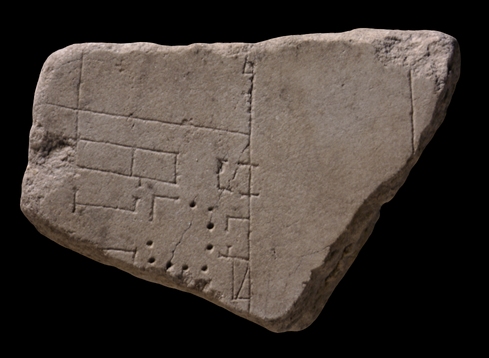
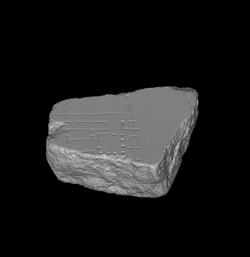
| Description To the right and at top, the fragment depicts two large, rectangular enclosures that must be open to the sky. They flank a section of a large building in the bottom left corner. The building contains a square peristyle around which are situated variously sized and shaped rooms.
Identification The function of the large enclosures is uncertain. The building in the bottom left, however, looks like it was the rear section of a single-family house, a domus. The wide entrance to the peristyle from the left would have been the tablinum, and the room above it an oecus. The elongated room above the peristyle may have been the kitchen and/or slaves' quarters. The tiny enclosure centered in the wall in the back of the peristyle may have been the household altar, lararium. The peristyle itself may have been used as a vegetable or flower garden.
Significance The fragment may depict a single-family house, a domus, which would have been a rarity in the crowded neighborhoods of Rome and thus probably occupied by someone of the Roman elite or a wealthy freedman.
|
|
| HISTORY OF FRAGMENT |
| Like the majority of FUR fragments, this piece was discovered in 1562 in a garden behind the Church of Saints Cosmas and Damian. From here, it was transferred to the Palazzo Farnese and stored there. Renaissance engravers reproduced the fragment in 16th c. drawings that are now kept in the Vatican (Vat. Lat. 3439), and Giovanni Pietro Bellori included it in his 1673 publication. N.B. As obvious from PM 1960, pl. 6.1, the Renaissance engraver only drew half of this fragment -- it was not finished. The fragment was later used as building material in the 17th c. construction of the Farnese familys Giardino Segreto (Secret Garden) near the Via Giulia, and was rediscovered in 1888 or 1898 when the walls of the garden were demolished. Since then, the fragment has been stored in various places: the storerooms of the Commissione Archeologica (1888/1898-1903), the Capitoline Museums (1903-1924), the Antiquarium Comunale (1924-1939), the Capitoline Museums again (1939-1955), the Palazzo Braschi (1955-1998), and since 1998 in the Museo della Civiltà Romana in EUR under the auspices of the Sovraintendenza ai Beni Culturali del Comune di Roma. (This fragments history corresponds to Iter C as summarized in PM 1960, p. 56.)
Text by Tina Najbjerg |
|
| KEYWORDS
|
| domus, enclosures, peristyle |
|
 Prev
Prev