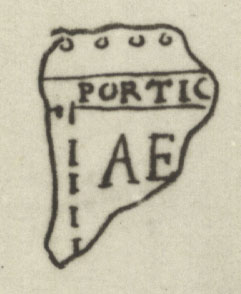
| Description The fragment is now lost, but Renaissance drawing Cod. Vat. Lat. 3439 - Fo 22r shows what it depicted (see detailed photo above or PM 1960, pl. 13, no. 8). Two parallel lines crossed the fragment at a diagonal angle from center left to upper right. Between them, the letters PORTIC were inscribed and above them ran a colonnade with four visible columns. To the left and below the letter P there was an opening in the bottom line. It seemed to give access to a room that was flanked on the right by an arcade or colonnade. The letters AE appeared in the space to the right of this colonnade.
Identification: Saepta Iulia In 1937, G. Gatti demonstrated that the letters AE in this missing fragment labeled the saepta Iulia, not an AEDES IULIORUM, as had been proposed (Gatti 1937). Three years earlier, he had demonstrated that the large, rectagular building by the Tiber, represented in frs. 23 and 24abc, was the porticus Aemilia and not the Saepta (Gatti 1934). It is now generally agreed that this missing fragment depicted the N end of the Saepta, other parts of which are visible in frs. 35bb,
35gg, 35hh,
35lpqr,
35nozaa, and 35uv (PM 1960, 91-96; AG 1980, p. 127). Referred to as the Saepta (Cass. Dio 53.23), or Septa (CIL 15.7195), the porticus Saeptorum (Plin., NH 16.201), the Saepta Agrippiana (Hist. Aug. Alex. 26), and the Ovile (Liv. 26.22; Lucan 2.197), the building was planned and perhaps begun by Caesar (Cic. ad Att. 4.16.14) to replace the earlier (wooden?) Saepta, the voting precinct in the campus Martius. It was partly built by M. Aemilius Lepidus (Cass. Dio 53.23), partly by Agrippa who completed and dedicated it and gave it the official designation of saepta Iulia in 26 BCE. Damaged by fire, it was restored by Domitian and later by Hadrian (LTUR IV, p. 228). With the transfer of electoral power from the people to the senate in the beginning of the 1st cent. CE, the Saepta lost its original function as Rome's voting precinct and came to serve a variety of purposes including that of a market in luxury goods and a place for strolling and relaxing. According to Pliny (NH 36.29) the building was filled with works of art, including sculptural groups of Olympos and Pan and of Achilles and Chiron.
Gatti demonstrated that Agrippa's Saepta consisted of a large open space, about 120 m. wide and 310 m. long, that was framed on the east and the west by covered colonnades or porticoes (Gatti 1937; Richardson 1992, p. 340; see reconstruction in PM 1960, p. 98 or LTUR I, fig. 122a). Excavations east of the Pantheon have revealed the remains of the back wall of the W portico (see Gatti 1938, fig. 2).
F. Coarelli has determined that the Caesarian and the Agrippan Saepta had similar dimensions; and he suggests that Cicero's reference to Caesar's Saepta as being one mile long (Cic., Att. 4.16.14) was not a reference to the length of the building itself but to the combined length of the covered colonnades that surrounded it on three sides (Coarelli assumes that the N end of the building consisted of a covered colonnade). The combined length of the lateral porticoes (310 m. each) and the short N portico (120 m.) was 740 m., or one half mile. If the porticoes were doublesided (porticus duplices), this would in effect bring their total length to one mile (Coarelli 1997, p. 157-9). Coarelli's thesis is an attractive solution to the mystery of the one-mile long building; his assumption that a covered colonnade framed the Saepta at its N end does not, however, match the evidence presented by this fragment. Here, the N end seems to consist of an arcade or a wall, which L. Richardson suggests must have had at least eight openings (Richardson 1992, p. 341). Richardson further points out that this wall must have separated the open, central space of the Saepta from a lobby or entrance hall at the N end, through which the thousands of voters would enter the building.
Identification: Porticus Meleagri The space delineated by the two parallel lines in this fragment is identified by the inscription in this and in frs. 35uv and 35nozaa as the PORTIC[US] M[ELEA]GRI, the E portico of the saepta Iulia. The inscription indicates that the two porticoes that flanked the E and the W side of the Saepta were thought of as individual features (Gatti 1937). Remains of the back wall of the W portico, the porticus Argonautarum, have been excavated behind the Pantheon (see Gatti 1938, fig. 2).
Significance This lost fragment was instrumental in Gatti's identification and location of the saepta Iulia. It furthermore reveals a section of the N end of the Saepta, otherwise unknown.
|
 Prev
Prev