ID AND LOCATION
| Stanford #
| 374 |
| AG1980 #
| 374 |
| PM1960 #
| 374 |
| Slab #
| III-12 |
| Adjoins
| none |
CONDITION
| Located
| false |
| Incised
| true |
| Surviving
| true |
| Subfragments
| 1 |
| Plaster Parts
| 0 |
| Back Surface
| smooth |
| Slab Edges
| 0 |
| Clamp Holes
| 0 |
| Tassello
| no |
TECHNICAL INFO
|
|
|
|
|
|
|
|
|
|
|
| ANALYSIS
|
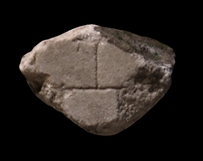
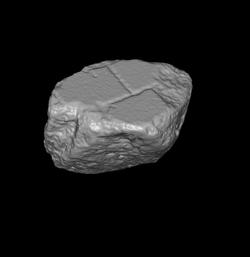
| Description A horizontal line traverses the fragment. N.B. The line is solid and not dashed as indicated in AG 1980, pl. 48. A perpendicular line joins it from below.
Identification Despite the small size of this fragment, E. Rodríguez-Almeida claims that marble color, thickness and sawing irregularities on the back places it in slab III-12 (Rodríguez-Almeida 2000). The piece is too small to allow an identification of the two lines depicted.
Significance Rodríguez-Almeida's research has shown the importance of the human eye in researching potential location and matches of FUR fragments. 3D digital matching, however, may bring us a step further and allow us to join this fragment to already identified and located areas on the Plan.
|
|
| HISTORY OF FRAGMENT |
| The provenance of this fragment is unknown. Presumably it has been in storage with the other known FUR fragments since its publication in PM 1960: In the storerooms of the Antiquarium Comunale (1924-1939), the Capitoline Museums (1939-1955), the Palazzo Braschi (1955-1998), and since 1998 in the Museo della Civiltà Romana in EUR under the auspices of the Sovraintendenza ai Beni Culturali del Comune di Roma.
Text by Tina Najbjerg |
|
 Prev
Prev