ID AND LOCATION
| Stanford #
| 376 |
| AG1980 #
| 376 |
| PM1960 #
| 376 |
| Slab #
| unknown |
| Adjoins
| none |
CONDITION
| Located
| false |
| Incised
| true |
| Surviving
| true |
| Subfragments
| 1 |
| Plaster Parts
| 0 |
| Back Surface
| smooth |
| Slab Edges
| 2 |
| Clamp Holes
| 2 |
| Tassello
| no |
TECHNICAL INFO
|
|
|
|
|
|
|
|
|
|
|
| ANALYSIS
|
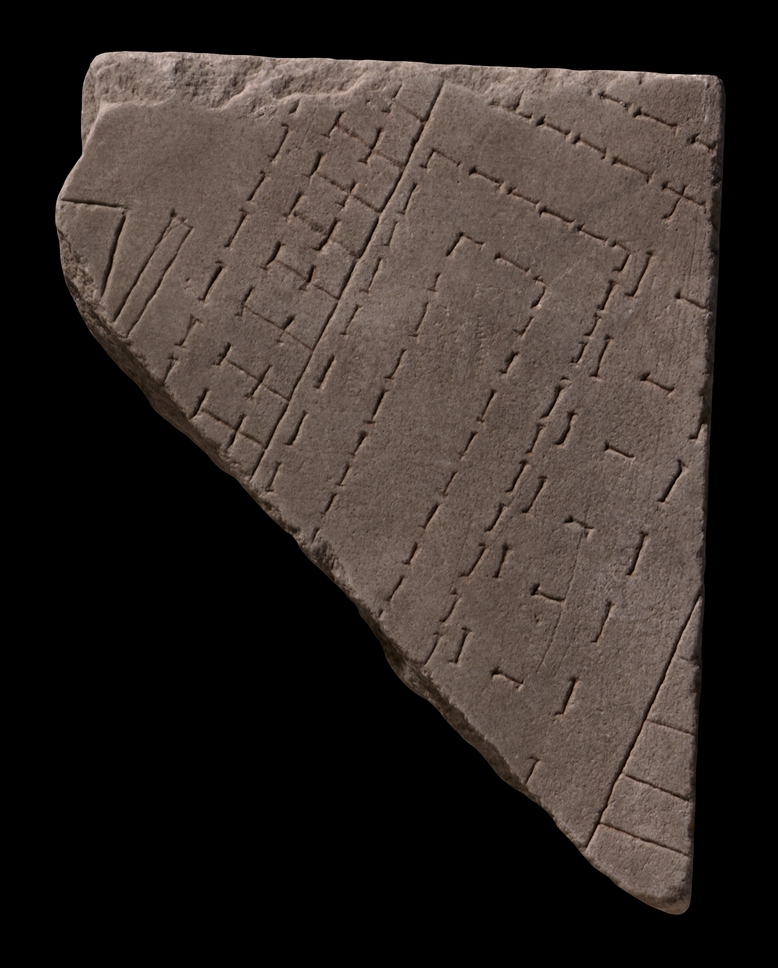
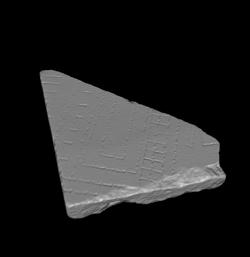
| Description The large fragment was part of the corner of a slab; two clamp holes are visible. It depicts one end of a large, elongated building. The central, open courtyard is surrounded by two arcades (covered?). Two additional arcades flank it at its short end, at top. On the left, it is enclosed by a long wall, which also forms the back of a row of tabernae with back rooms. The row is fronted by a single arcade. On the right, the central space is flanked by two additional arcades; these are spaced widely apart, and a row of perpendicular dashes is spaced in a regular pattern between them. On the left, the back wall of what might be another row of tabernae is parallel to the side arcades of the large building. On the far left, parts of two other structures are visible. One of these, the one closest to the building, consists of a thin, narrow strip.
Identification Based on the position of the clamp holes and veining direction of this fragment, E. Rodríguez-Almeida has tentatively proposed that it is to be positioned in the bottom left corner of slab IV-5, which also contains the Porticus Divorum, the Diribitorium, and part of the Saepta Iulia (Rodríguez-Almeida 1977; AG 1980, p. 123). Here, he suggests, the building corresponds to remains recorded by Lanciani along the Via Flaminia, near the fornix Claudii, whose S end lies under the Palazzo San Marco in Piazza Venezia. If this position is correct, the street that runs along the right side of the building, backed onto by a row of rooms, must be the via Lata and the building itself might be the porticus Vipsania which we know from Martial was situated along the Via Flaminia by the fornix Claudii (Rodríguez-Almeida 1977, fig. 14; AG 1980, pp. 123-24). L. Richardson (1992, p. 320) counterargues that the remains along the Via Flaminia are of a post-Neronian date and cannot belong to the Augustan porticus Vipsania. Rodríguez-Almeida points out, however, that the type of porticus depicted in this fragment is similar to the Augustan Basilica Iulia in the Roman Forum in fr. 18bc (AG 1980, p. 126). Furthermore, the porticus in this fragment seems to have undergone a series of (post-Augustan) transformations, including the addition of tabernae on the left side and of perpendicular pillars on the right side (see AG 1980, fig. 33, for the suggested succession of reconstructions). The pilasters shown along the left side of the building could represent the aqua Virgo but are more likely an arcaded sidewalk (Rodríguez-Almeida 1977).
Significance The positioning of this large fragment on the Plan and the identification of the porticoed structure would be a significant gain. If Rodríguez-Almeida's identification of the building as porticus Vipsania is correct, this fragment would be key to our knowledge of this structure. If his interpretation of the successive transformations of the edifice is correct, the fragment also offers insight into the gradual encroachment of commercial and residential interests (such as the addition of shops) upon a public monument. |
|
| HISTORY OF FRAGMENT |
| Like the majority of FUR fragments, this piece was discovered in 1562 in a garden behind the Church of Saints Cosmas and Damian. From here, it was transferred to the Palazzo Farnese and stored there. It was not among the fragments that were reproduced in the Renaissance drawings that are now kept in the Vatican, but Giovanni Pietro Bellori included it in his 1673 publication. In 1742, the fragment was moved to the Capitoline Museums and exhibited with some of the other known fragments in wooden frames along the main staircase. Since then, it has been stored with the other FUR fragments in various places: the storerooms of the Capitoline Museums (1903-1924), the Antiquarium Comunale (1924-1939), the Capitoline Museums again (1939-1955), the Palazzo Braschi (1955-1998), and since 1998 in the Museo della Civiltà Romana in EUR under the auspices of the Sovraintendenza ai Beni Culturali del Comune di Roma. (This fragments history corresponds to Iter E as summarized in PM 1960, p. 56.)
Text by Tina Najbjerg |
|
| KEYWORDS
|
| porticus, arcades, pilasters, tabernae, street |
|
 Prev
Prev