ID AND LOCATION
| Stanford #
| 377ab |
| AG1980 #
| 377a-b |
| PM1960 #
| 377 a b |
| Slab #
| unknown |
| Adjoins
| none |
CONDITION
| Located
| false |
| Incised
| true |
| Surviving
| true |
| Subfragments
| 2 |
| Plaster Parts
| 0 |
| Back Surface
| smooth |
| Slab Edges
| 0 |
| Clamp Holes
| 0 |
| Tassello
| no |
TECHNICAL INFO
|
|
|
|
|
|
|
|
|
|
|
| ANALYSIS
|
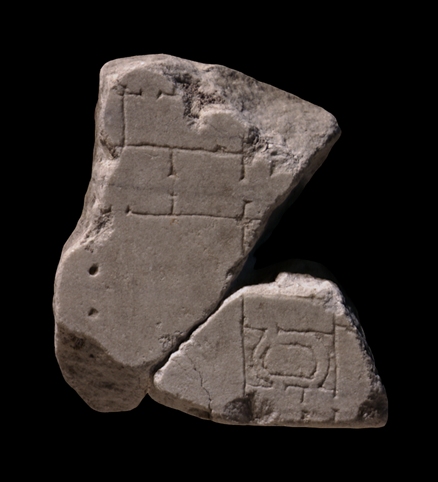
| Description The upper right corner of a large courtyard is visible on the lower left. Two visible columns suggest the courtyard was colonnaded. A small opening at top gives access from the peristyle to a series of rooms above it; at least three can be seen. It is uncertain whether additional rooms at top are part of the same complex. Another series of rooms flanks the peristyle on the right. They are all connected via small openings. The middle room contains what seems to be a narrow path around an elliptical feature. The bottom room is divided into two smaller rooms. A passage through them gives access to another, larger room on the far right.
Identification The authors of PM 1960 suggested that the elliptical feature in this fragment was a basin (PM 1960, p. 137). D. Reynolds has gone one step further and identified the entire complex as a small bath, a balneum (Reynolds 1996, fig. 3.42). Surprisingly, R. A. Staccioli did not include this fragment in his study of small baths on the Plan (see Staccioli 1961). All the characteristics of a small neighborhood bath complex are depicted in this fragment, however: A small palaestra, a series of interconnected hot, warm or cold rooms (the caldarium, the tepidarium, and the frigidarium), and what seems to be a plunge bath. Furthermore, the irregular architecture of the bath depicted in this fragment is one of the characteristics of small baths, according to Staccioli; he interprets the difference between large imperial baths (thermae) and small baths (balnea) as follows: thermae were large, imperial bath complexes where rooms, some being non-essential for bathing, were arranged symmetrically around a central axis and within a single building. Balnea, on the other hand, were smaller neighborhood bath houses, generally of Republican origin. Their insertion into larger structures means that their architecture is irregular, that they mainly consists of rooms essential for bathing, and that they often lack a proper palaestra.
Significance According to the Regionary Catalogues, 4th-c. Rome had eleven large imperial baths (thermae) and 856 small baths (balnea). Only a fraction of that number of balnea has been identified on the Plan thus far, and it is extremely likely that this fragment depicts one of Rome's 856 known neighborhood baths. |
|
| HISTORY OF FRAGMENT |
| The provenance of fr. b is unknown (PM 1960, p. 137). Fr. a was discovered, like the majority of FUR fragments, in 1562 in a garden behind the Church of Saints Cosmas and Damian. From here, it was transferred to the Palazzo Farnese and stored there. It was not among the fragments that were reproduced in the Renaissance drawings that are now kept in the Vatican, but Giovanni Pietro Bellori included it in his 1673 publication. In 1742, the fragment was moved to the Capitoline Museums and exhibited with some of the other known fragments in wooden frames along the main staircase. Since then, it has been stored with the other FUR fragments in various places: the storerooms of the Capitoline Museums (1903-1924), the Antiquarium Comunale (1924-1939), the Capitoline Museums again (1939-1955), the Palazzo Braschi (1955-1998), and since 1998 in the Museo della Civiltà Romana in EUR under the auspices of the Sovraintendenza ai Beni Culturali del Comune di Roma. (Fragment b's history corresponds to Iter E as summarized in PM 1960, p. 56.)
Text by Tina Najbjerg |
|
| KEYWORDS
|
| bath |
|
 Prev
Prev