ID AND LOCATION
| Stanford #
| 379 |
| AG1980 #
| 379 |
| PM1960 #
| 379 |
| Slab #
| unknown |
| Adjoins
| none |
CONDITION
| Located
| false |
| Incised
| true |
| Surviving
| true |
| Subfragments
| 1 |
| Plaster Parts
| 0 |
| Back Surface
| smooth |
| Slab Edges
| 0 |
| Clamp Holes
| 0 |
| Tassello
| no |
TECHNICAL INFO
|
|
|
|
|
|
|
|
|
|
|
| ANALYSIS
|
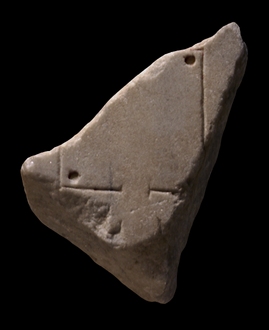
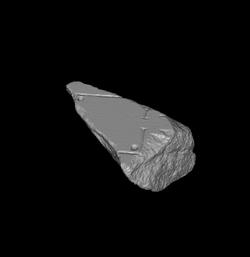
| Description The fragment depicts a major part of a square room with a column in each of the three visible corners. The structure has an opening in the bottom wall. Barely visible at the bottom of the fragment is the corner of yet another structure.
Identification It is uncertain what the room depicted in this fragment represents. It is likely to have been part of some monumental public structure. N.B. The authors of PM 1960 assert that this fragment cannot have been part of the porticus Divorum in slab IV-5.
Significance 3D digital matching may allow us to join this fragment to already identified and located areas on the Plan.
|
|
| HISTORY OF FRAGMENT |
| The fragment was discovered during excavations in the aula of the Templum Pacis in 1891 (PM 1960, p. 138). In 1903, museum curators at the Capitoline museums included the piece in a reconstruction of the FUR mounted on a wall behind the Palazzo dei Conservatori (1903-1924). Since then, the fragment has been stored with the other known FUR fragments in various places: the storerooms of the Antiquarium Comunale (1924-1939), the Capitoline Museums again (1939-1955), the Palazzo Braschi (1955-1998), and since 1998 in the Museo della Civiltà Romana in EUR under the auspices of the Sovraintendenza ai Beni Culturali del Comune di Roma.
Text by Tina Najbjerg
|
|
| KEYWORDS
|
| corner columns |
|
 Prev
Prev