| [FRAGMENT ANALYSIS IN PROGRESS]
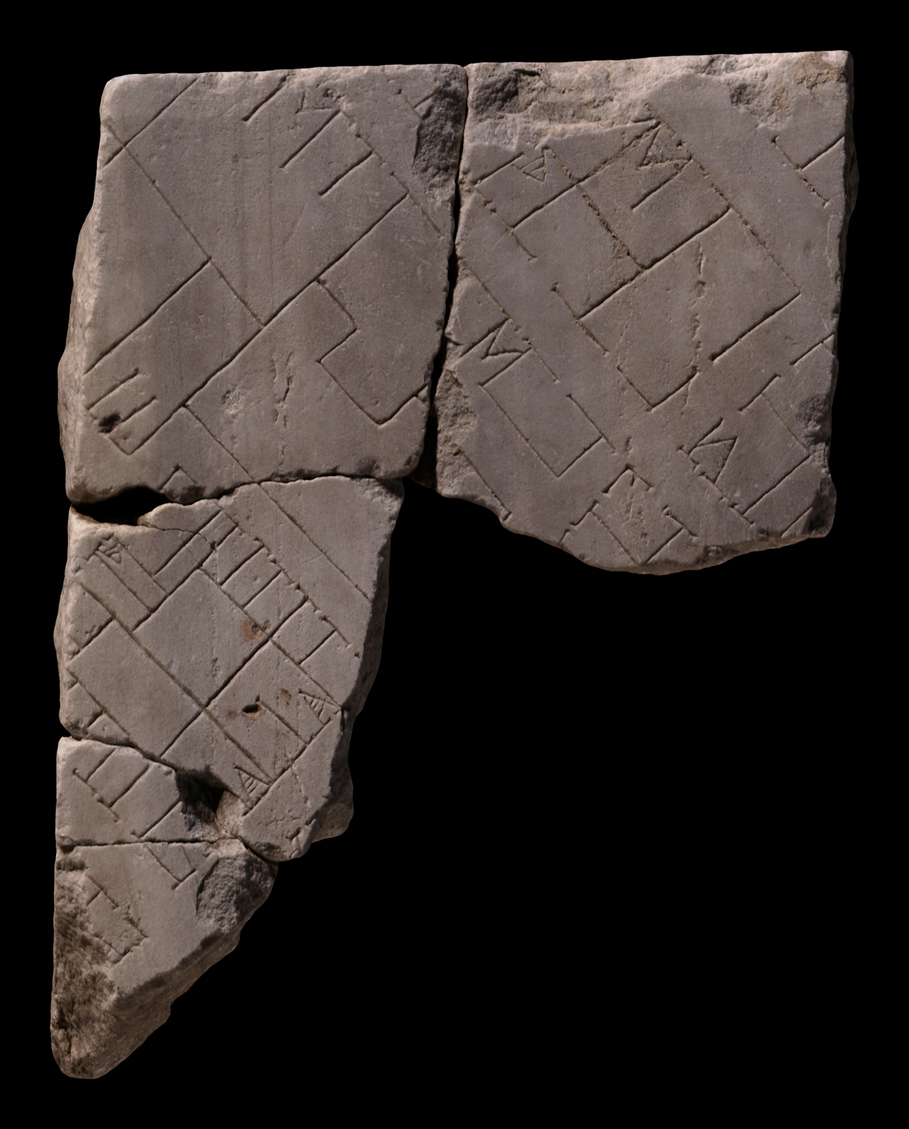
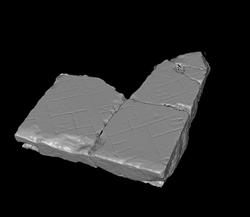
Description Five fragments joined together: square upper left fragment is 37i; 37l is upper right; below 37i on the left are fragment 37h and two small fragments 37g and 37f. Original slab edge at the top with clamp hole on the right side.
Combined fragments have 4 parallel and one perpendicular street. Diagonal/oblique street runs top left to bottom right of the two upper fragments. This street possibly continues on fragment 576
(see identification below). Street is flanked on the top left side by a large rectangular space with several partition walls and an internal staircase. Two similar but smaller spaces are noticeable at the back. To the lower right several structures of varied size are visible, some of which appear to open to an internal corridor or the continuation of the intersecting street (lower left to upper right). One staircase leads to an upper floor.
On the right side of the diagonal street a narrower cluster is visible with several rooms of different sizes; one room has a partition wall and two have a staircase. Below the perpendicular street the top of a new cluster is visible with several rooms opening up to the street. The start of another cluster is also visible in the top right corner, where two rooms can be distinguished.
The lower part of the fragments shows a zigzagging street running top left to bottom right. On the right a blind wall of the previous building faces the street. A block with a row of tabernae (?) of different size opens up to this street in the left. The other side of this block on the bottom left also shows a row of tabernae opening up to a street. The continuation of the intersecting street, or if it doesnt continue- another intersecting street flanks the block on the lower right. The rooms here have narrow openings to the street and several staircases. This block appears to be a domestic one with several floors of apartments and courts in the middle (insula?). The start of a new cluster is visible in the bottom left corner of the fragments.
Identification: possible connection with 37Ade Rodríguez-Almeida placed the 37A fragment group in the Transtiberium region (Trastevere), along the right edge of the horizontally oriented slab IV-7, connecting to fragment 37Ade (Rodríguez-Almeida 1981, pp. 140-143). This position is not compatible with the position proposed by the Stanford team using boundary incision matching.
Identification: possible connection with 576 Fragment 37Afghil is possibly matched with 576
by the boundary incision matching process done at Stanford (Koller-Levoy 2005, 7-8, fig. 19). Four sets of incised features aligned well across the horizontal slab boundary between the two candidates; three of them lie along the sides of the parallel streets, and the fourth appears as a half-eroded incision on the lower-left corner of fr. 576,perpendicular to the street features and aligning with the incision in the upper-left of fr. 37Ai. Though this proposed match is far from certain, other similarities between the two fragments deserve its consideration. The style of the incisions on fr. 576 is very much like that of fr. 37A, and the depiction of the architecture, such as the stairways, is similar.
Rodríguez-Almeida previously placed the 37A fragment group in Trastevere, along the right edge of a horizontally oriented slab (1981, pp. 140-143). Because fr. 576 is a slab corner, its range of possible positions on the wall is highly constrained, and the proposed match with 37A does not appear to be compatible with the expected slab boundary locations. If positioned directly above fr. 37Afghil in Rodríguez-Almeidas wall placement, fr. 576 would not be coincident with a slab corner; in fact, the closest such position would require a shift of fr. 37A to the left by almost 35 cm on the wall. The resolution of this dilemma requires further study, and is one reason to regard this proposed match with skepticism.
Significance With its mixed residential and commercial architecture, the fragment represents one of the non-monumental, and therefore lesser known sections of the ancient city.
|
 Prev
Prev