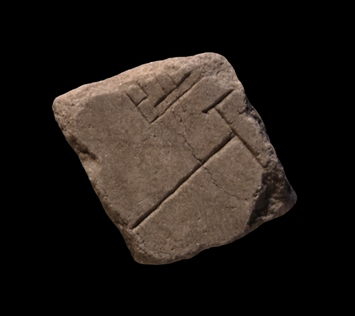
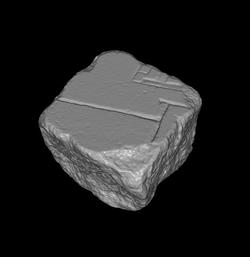
| Description The fragment shows the back corner of a peripteral sine postico temple. The back wall, the wall of the cella and the single visible column are drawn in outline which is the norm for temple architecture on the Plan. Behind the temple the corner of another building is visible. From this feature extends a long wall or edge, parallel to the back of the temple.
Identification: Temples C and D in the Largo Argentina
The corner of the peripteral sine postico temple in this fragment has been identified as the NW corner of Temple C, one of the four Republican temples in the sacred area of the Largo Agentina (PM 1960, pp. 103, 130; AG 1980, p. 130, pl. 28; see LTUR II, fig. 97, for a plan of all four structures). Temples A and B are visible in fr. 37a. The SW corner of Temple C and the NW corner of Temple D are visible in the now missing fr. 37b (see PM 1960, pl. 32; AG 1980, pl. 28). Excavations in the area have demonstrated that Temple C was a platform temple, peripteral sine postico, as represented in this and in fr. 37b, and that Temple D was simple structure that consisted of an uncolonnaded cella on a platform (Richardson 1992, pp. 33-35). However, excavations have also revealed an irregularity in the alignment of the four temples: Temple D was set back further than C which was set back further than A and B. This is not indicated on the Plan; here, Temples A, B, and C line up, and only D is set back from them. The identification of the four temples is still disputed, but Temple C is perhaps to be associated with the aedes Feronia (LTUR II, pp. 247-48) and Temple D with the aedes Lares Permarini (LTUR III, pp. 174-75) or a temple to Iuppiter Fulgur (Richardson 1992, pp. 35, 219).
Identification: Porticus Minucia Vetus(?) In 1968, L. Cozza identified the great porticus east of the Largo Argentina as the Porticus Minucia or Minicia (Cozza 1968). Remains of this porticus, which was bordered by the Diribitorium to the north and by the Theater and Crypta Balbi to the south, were excavated underneath the Via delle Botteghe Oscure.
Cozza's identification of the quadriporticus under the Via delle Botteghe Oscure as the Porticus Minucia did not solve all the problems of this enigmatic building, however. While most ancient sources refer to the Porticus Minucia as a single structure, the Regionary Catalogues lists two buildings by the name of Porticus Minucia in Regio IX: The porticus Minucia Vetus and the porticus Minucia Frumentaria (LTUR IV, p. 137). The older structure, the Minucia Vetus, which is known to have enclosed the Temple to the Lares Permarini and contained a statue of Hercules, was dedicated by M. Minucius Rufus, consul in 110 BCE, and completed in 100 BCE. It was repaired by Domitian, probably after the fire in 80 CE (LTUR IV, p. 137). The Porticus Minucia Frumentaria, sometimes referred to as the "new" Porticus Minucia, was a center for grain distribution, probably built in the Claudian period, and it is known to have had 44 ostia, or openings (LTUR IV, p. 134). Scholars are still disputing whether to identify the porticus under the Via delle Botteghe Oscure as the Porticus Minucia Vetus or the Frumentaria. Stressing that there must have been two structures situated next to each other (one perhaps being an extension of the other), scholars like F. Coarelli (1968), C. Nicolet (1976), and E. Rodríguez-Almeida (AG 1980) associate the porticus that surrounds the Republican temples in the Largo Argentina, visible in this fragment, with the Porticus Minucia Vetus; they suggest that Temple D in the Largo Argentina is the Temple to the Lares Permarini; and they identify the quadriporticus underneath the Via delle Botteghe Oscure as the Porticus Minucia Frumentaria and the temple inside it as the Temple to the Nymphs (LTUR IV, p. 132, with bibliographical references; AG 1980, p. 122; Coarelli 1997). Others, such as Castagnoli (1946 and 1984), G. Rickman (1983), L. Richardson (1992, pp. 315-16), and F. Zevi (1993) follow Cozza's lead and associate the Botteghe Oscure porticus with the Porticus Minucia Vetus and the temple in its center with that of the Lares Permarini (LTUR IV, pp. 132-33, with bibliographical references). Emphasizing the utilitarian nature of the Frumentaria with its 44 ostia, they disassociate this building with the two traditional porticus-type buildings in the Largo Argentina and under the Via delle Botteghe Oscure, and situate it elsewhere in Rome.
Identification: Porticus Pompeianae with the curia Pompeiana According to ancient authors, the curia, in which Julius Caesar was murdered on the Ides of March, 44 BCE, was incorporated into the back wall of the Porticus of Pompey (Richardson 1992, p. 104; LTUR I, p. 335). Augustus later had this curia Pompeiana walled up and converted into latrines (Cass. Dio 47.19.1). Excavations have revealed the foundations of the curia behind Temple B in the Largo Argentina and also of the latrines (LTUR I, pp. 334-335, fig. 196; Richardson 1992, p. 104 and fig. 8). The N edge of the curia foundation as well as the latrines installed by Augustus north of the curia are visible in fr. 37a. The line that traverses most of this fragment behind Temple C must be the E foundation wall of the curia. The feature from which the foundation wall extends may be part of the latrines that were built on the S side of the walled up curia.
The curia Pompeiana was incorporated into the back wall of the porticus Pompeianae, one of the components of Pompey's immense theater complex in the Campus Martius, constructed as a whole and inaugurated in 55 BCE (LTUR IV, p. 148) or 52 BCE (Richardson 1992, p. 318). Other parts of the Porticus of Pompey are visible in frs. 37a, 37b (missing), 37e, 37l, 39ac, 39b, 39d (missing), and 39g (PM 1960, p. 103, pl. 32; AG 1980, p. 148, pls. 28 and 32). In addition to the porticus, the complex comprised a theater and temples (see fr. 39f for more info on the temples and on the theater itself).
Vitruvius (5.9.1) explains that Pompey built the porticus behind the theater as a shelter for the spectators in the case of rain, as a place for them to relax and converse, and as a storage area for stage machinery (LTUR IV, p. 148; Richardson 1992, p. 318). According to ancient authors, the porticus whose fountains, trees, and expensive art works created an atmosphere of luxury and relaxation, was one of the most popular places in Rome to gather and stroll (Richardson 1992, p. 318). The exedrae visible in the back wall of the porticus in frs. 37a and 37b may have held statues or other pieces of art; food was probably sold in the shops and stalls behind the S wall of the porticus in fr. 39de; and public latrines, visible in fr. 37a and partially in this fragment, added to the overall comfort of the visitor.
Significance Despite the fragment's small size, it has helped ascertain the location of the curia Pompeiana in relation to the porticus Pompeianae.
|
 Prev
Prev